Measure AI Chat Referrals Without Cookies Using UTMs and Landing Pages
A cookie-free method to attribute AI chat clicks using UTMs and dedicated landing pages, with clean reporting and goals.
By Casey
Why AI chat attribution breaks in privacy-first analytics
Traffic from ChatGPT, Perplexity, and Gemini behaves differently from classic “search” or “social” traffic. A user reads an answer, clicks once, and often converts quickly—yet many analytics stacks struggle to explain where that session truly came from. Cookie-based multi-touch models don’t help much here either: many teams don’t want them, browsers restrict them, and AI tools increasingly route clicks in ways that blur referrers.
A cleaner approach is to separate two use cases:
- Organic AI referrals: clicks where the referrer is the AI tool (when available).
- Trackable AI placements: links you control (your own shared links, seeded resources, partner mentions, citations you influence) where you can add UTMs.
This article lays out a cookie-free framework based on UTMs and landing-page design, then shows how to keep attribution “clean” without turning your site into a tracking experiment. Throughout, Plausible is a practical reference point because it’s built for aggregate, privacy-friendly reporting and supports UTM analysis and AI referrer monitoring without cookies.
The core idea: make AI attribution explicit at the link and page level
In a no-cookie world, you can’t reliably stitch users across sessions. So instead of trying to reconstruct journeys after the fact, you design attribution into the click itself. The framework has two pillars:
- UTM conventions that tell you which AI surface produced the click.
- Dedicated landing pages that confirm intent and isolate measurement from the rest of the site.
Used together, you get durable, auditable attribution that survives browser restrictions and doesn’t depend on identity.
Step 1: define a UTM taxonomy for AI surfaces
Start with a naming scheme that’s easy to keep consistent. The goal is not perfect precision; it’s reliable grouping.
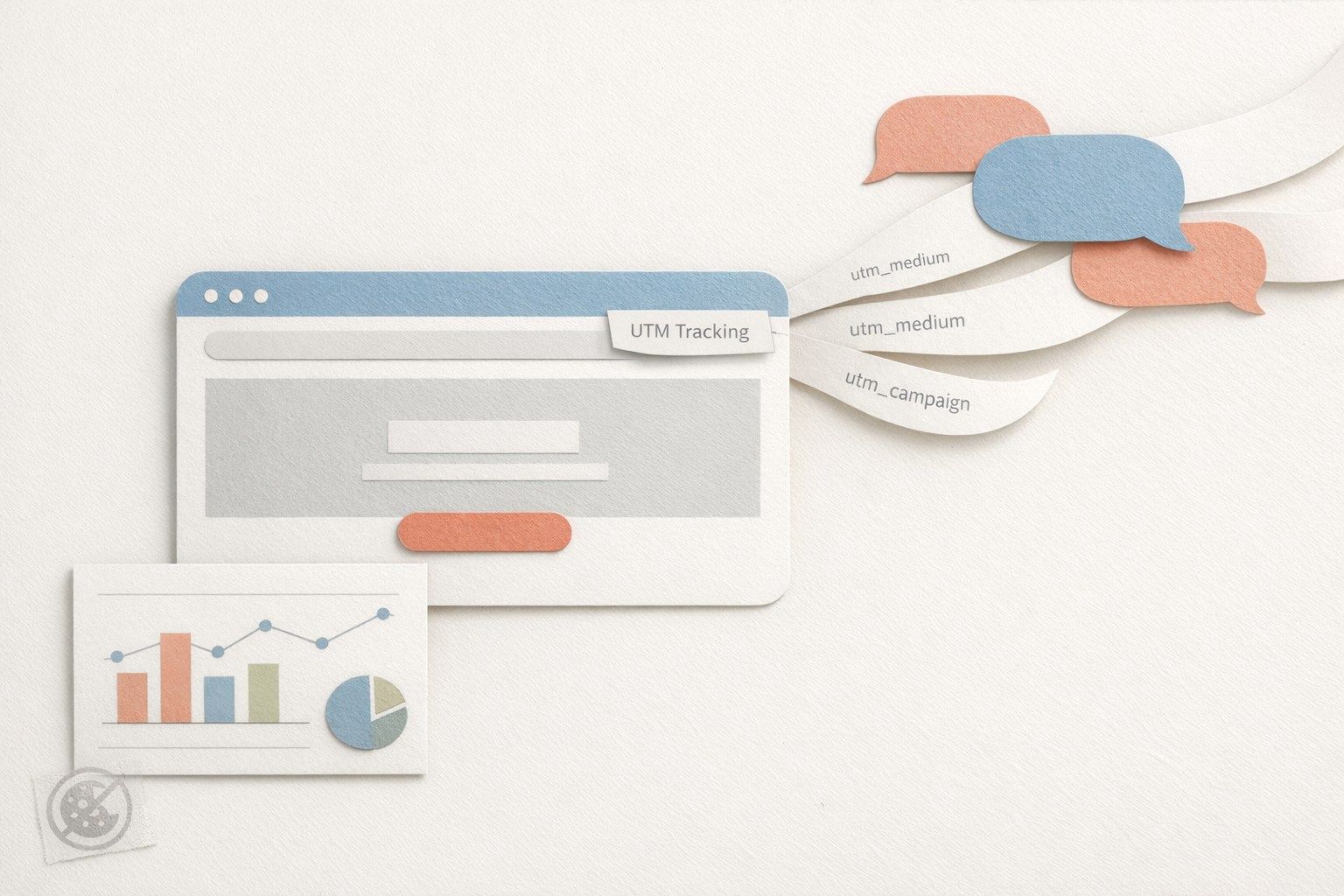
Recommended baseline fields
- utm_source: the tool or channel you want to group by (e.g.,
chatgpt,perplexity,gemini). - utm_medium: the format of the placement (e.g.,
ai_answer,citation,prompt_share,community). - utm_campaign: the initiative you’re running (e.g.,
llm_seeding_q2_2026,docs_refresh). - utm_content (optional): the specific asset or variant (e.g.,
pricing_snippet,integration_guide_v3).
Example UTM patterns that stay readable
?utm_source=chatgpt&utm_medium=ai_answer&utm_campaign=llm_seeding_q2_2026?utm_source=perplexity&utm_medium=citation&utm_campaign=docs_refresh&utm_content=api_rate_limits
Two practical rules keep this from turning into chaos:
- Lowercase everything and avoid spaces.
- Do not overload “campaign” with too many meanings. If you need more granularity, use
utm_content.
Step 2: build landing pages that are meant to be cited by AI
If you rely only on UTMs pointing at generic pages (homepage, pricing), you’ll still learn something—but it will be noisy. AI-driven clicks often cluster around a narrow intent (“compare X vs Y”, “how do I…”, “is it GDPR compliant?”). The landing page should match that intent and make the conversion path obvious.
What “AI-friendly” landing pages include
- A clear promise in the first screen: the exact question the user likely asked the AI.
- Short sections with descriptive headings so the page is easy for both humans and models to skim.
- One primary action (demo, signup, docs) with a secondary action for cautious evaluators.
- Quoted definitions, examples, and constraints (e.g., what you do not track) to reduce ambiguity.
If your broader strategy includes “brand seeding” and making your pages machine-readable, you’ll likely end up adding structured FAQ-like blocks and schema in a controlled way.
Step 3: separate organic AI referrers from UTM-tagged AI links
You’ll typically see two different signals:
- Referrer-based AI traffic: the source is detected from the HTTP referrer when the AI tool passes it.
- UTM-based AI traffic: the source/medium/campaign are explicit in the URL you shared.
Mixing them in one bucket hides what you can actually act on. Keep them distinct in reporting:
- “AI referrers” tells you whether the ecosystem is sending you demand.
- “AI campaigns (UTM)” tells you whether your specific placements and assets are working.
In a privacy-first analytics setup, this separation is especially helpful because you’re not trying to infer identity; you’re comparing aggregates by source, landing page, and goal completion. Plausible Analytics, for example, supports UTM campaign analysis and also highlights traffic from AI tools, which makes this split practical without introducing cookies.
Step 4: define “clean attribution” goals you can measure without identity
The cleanest measurement uses a small set of conversion events that map to business intent. For AI chat referrals, prioritize actions that happen in-session and are resistant to cross-device ambiguity.
Good goal examples for AI traffic
- Signup / account created (best when it completes on the same device).
- Key page reached (e.g.,
/pricing,/docs/install) as a proxy when signup is later. - Outbound click to a critical integration (e.g., “Connect GitHub”).
- Form completion for sales-led teams.
Avoid vanity events (scroll depth alone, time on page alone) as primary success metrics. They can be useful diagnostics, but they won’t tell you which AI placement drove meaningful intent.
Step 5: reduce measurement noise at the URL layer
UTMs can create operational mess if they proliferate. A few safeguards keep reports readable and prevent accidental dilution:
- Canonicalize your public URLs so UTMs don’t create SEO duplicates (UTMs should not change page content).
- Use short, stable landing-page paths (e.g.,
/ai/compare,/ai/privacy) and keep them live. - Maintain a single source-of-truth spreadsheet (or lightweight internal doc) for approved UTM values.
Step 6: a practical reporting layout to answer real questions
Once your UTMs and landing pages are in place, reporting becomes straightforward. The questions you should be able to answer weekly are:
- Which AI tool is sending the most engaged sessions? (referrer-based AI traffic)
- Which landing page converts best for AI visitors?
- Which UTM campaign produced conversions? (UTM-tagged AI placements)
- Which prompts/assets are underperforming? (via
utm_content)
Common pitfalls and how to avoid them
- Assuming AI referrer traffic is fully captured: some tools and browsers won’t pass referrers consistently, so treat it as a directional signal.
- Using too many UTM values: if every person invents a new
utm_medium, you lose comparability. - Tagging everything: use UTMs where you control the link. For organic mentions, focus on landing pages and on-site conversion rates.
- Measuring only top-of-funnel visits: tie AI traffic to a small number of outcomes that matter.