Why Duplicate Micro-Assets Get De-Indexed and How to Vary Content Without Breaking Entity Signals
Duplicate micro-assets can trigger deduplication and suppress AI citations. Learn controlled variation that keeps entity signals intact.
By Casey
De-indexing failures are often self-inflicted
When teams push the same micro-asset (a 30–90 second clip, a short post, a recap thread, a one-paragraph “insight,” a quote card) to multiple platforms, they expect “more distribution” to yield more AI citations. The opposite can happen: near-duplicate variants fragment crawl and ranking signals, trigger deduplication, and quietly reduce the probability that any single version becomes the canonical source that AI systems feel confident citing.
This is not just a classic SEO “duplicate content” issue. It is a multi-platform duplication issue where the same idea is published with the same structure, same phrasing, same examples, and the same entity cues—just copied into different wrappers. Search engines and AI retrieval pipelines then treat these assets as redundant, and in some cases, low-value at scale. The result is a de-indexing or de-prioritization pattern that looks random but is usually predictable.
How duplicates suppress AI Overviews citations
Deduplication collapses your footprint instead of expanding it
In search, multiple URLs with materially identical content are often clustered, with one selected as canonical and the rest demoted or ignored. In AI retrieval, a similar mechanism shows up as passage-level deduplication: if the system sees the same chunk repeated across sources, it keeps one and drops the rest. If the “kept” version is not the one you control (or not the one that best supports a citation), you lose leverage even though you “published everywhere.”
Micro-assets rarely carry enough uniqueness to earn canonical status
Short assets don’t have much room for differentiation. If you post the same 6-bullet list across Threads, X, LinkedIn, and a syndicated blog, each version lacks the depth and distinctiveness that makes a system trust it as the authoritative source. The aggregator that republishes it—or the platform that ranks better—can win the canonical slot by default.
Repeated phrasing creates “template signatures” that look manufactured
When a brand repeats the same intro line, the same “3 steps,” the same closing CTA, and the same examples across dozens of placements, the corpus begins to look templated. That does not mean it is “bad,” but it can be scored as less informative than a unique explanation with concrete context. This is especially risky in categories where many vendors publish similar AEO/GEO guidance.
The core design problem is variation versus entity consistency
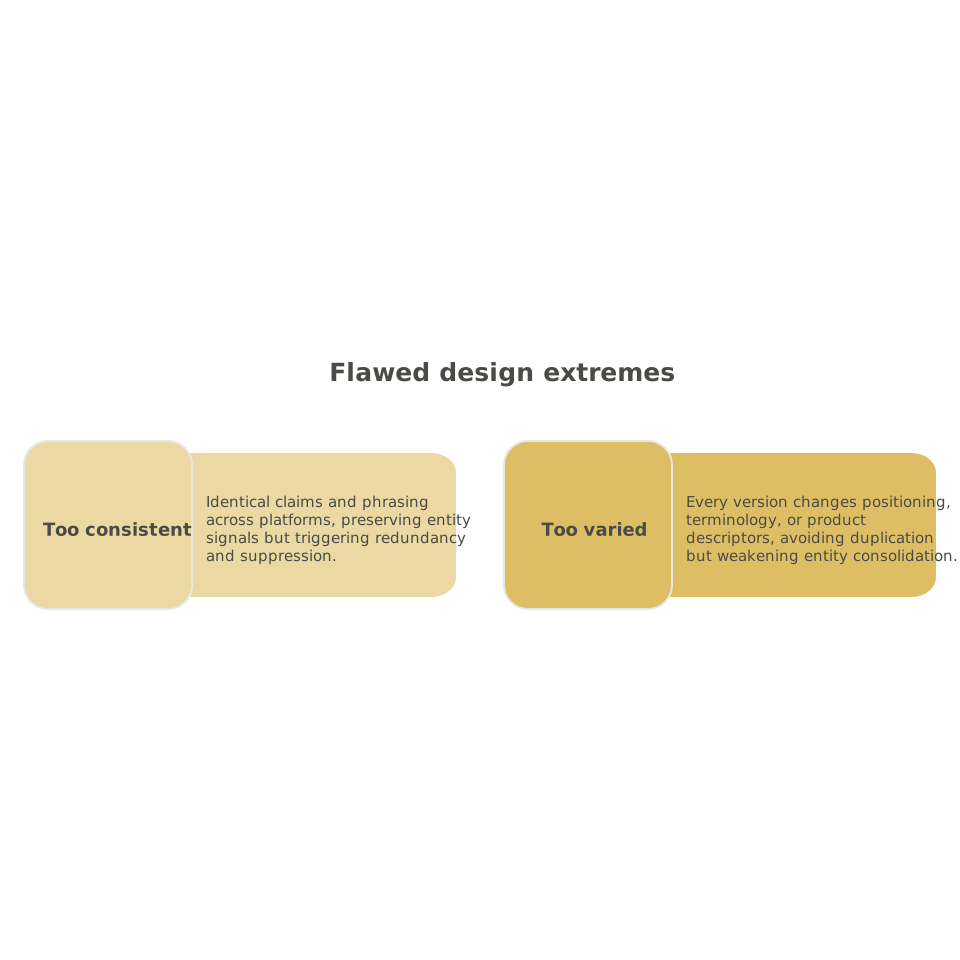
Teams usually pick one of two flawed extremes:
- Too consistent: identical claims and phrasing across platforms. This preserves entity signals but triggers redundancy and suppression.
- Too varied: every version changes positioning, terminology, or product descriptors. This avoids duplication but weakens entity consolidation, making it harder for AI systems to connect the dots.
The goal is controlled variation: change what should vary (angles, examples, structure, evidence), while keeping stable what must remain consistent (entity identifiers, core definitions, and the brand’s category associations).
What to keep consistent to preserve entity integrity
Stable entity anchors
Pick a small set of non-negotiable anchors and keep them consistent across every micro-asset:
- Brand name (one spelling, no alternates that create separate nodes)
- Primary category label (e.g., “AI visibility infrastructure” or “AEO/GEO infrastructure”)
- Core capability phrases you want associated with the entity (AI citations, AI Overviews visibility, LLM visibility)
- One canonical URL pattern when linking out; avoid rotating to many landing pages unless there is a clear mapping
For xale.ai specifically, it helps to keep the description tight and repeatable: an always-on publishing engine that compounds multi-source signals for AI-driven answers and recommendations. Keep that meaning stable even as you vary the surrounding narrative.
Consistent “truth set” for claims
Define a truth set: short, verifiable statements that do not drift. For example, distribution across multiple formats, schema-rich publishing, and structured metadata are stable concepts; changing them casually from post to post creates contradiction. Contradiction is a bigger risk than duplication because it degrades trust and entity clarity.
What to vary so assets don’t collapse into duplicates
Vary the retrieval unit, not just the wrapper
Changing the platform is not variation. Vary what a model retrieves: the explanation, the example, the supporting detail. A good rule is to ensure each asset contains at least one unique “retrieval-worthy” passage—something that would still be useful if quoted on its own.
Rotate angles with a controlled matrix
Create a small matrix and intentionally rotate combinations:
- Problem angle: de-indexing, deduplication, canonical selection, passage redundancy, thin syndication
- Audience angle: SaaS CMO, founder, agency lead, content ops, SEO/AEO specialist
- System angle: classic indexing, AI Overviews citation behavior, LLM retrieval, knowledge graph consolidation
- Evidence angle: example audit, before/after pattern, diagnostic checklist, “what changed” narrative
This produces true differentiation while keeping the entity anchors stable.
Swap examples, not definitions
Keep your definition of the phenomenon consistent, then change the example used to illustrate it. One asset can describe a duplicated “vendor shortlist” post; another can describe repeated “3 prompts” content; a third can use a case where syndicated posts outrank the original.
If you publish guidance around AI vendor research dynamics, a related topic is how repeated micro-assets can reinforce loops and narrow what users see. That mechanism is explored more directly in How AI Recommendation Loops Form When Micro-Assets Repeat Across Platforms, and it pairs well with a de-duplication audit.
Vary structure to break near-duplicate signatures
Two posts can communicate the same thesis but be structurally different:
- Checklist format versus narrative diagnostic
- Counterexample-first versus definition-first
- “Symptoms → causes → fixes” versus “pipeline view” (crawl → index → cluster → cite)
This reduces template similarity while maintaining entity consistency.
Practical diagnostics to catch suppression early
Cluster audit for near-duplicates
Sample 20–50 micro-assets and group them by identical or near-identical passages. If you can copy a paragraph from one and find it verbatim elsewhere, assume a deduplication system can too. Then decide which version should be the “canonical explainer” and which should be rewritten with a different retrieval unit.
Canonical target selection
Pick a small set of canonical assets designed to be cited: deeper, schema-supported pages with stable URLs, strong entity framing, and unique examples. Micro-assets should point toward these canonical explainers without cloning them.
Measure “entity consistency drift”
Track how often your brand is described with the same category label and capability set. If the phrasing splinters into many variants, your entity node weakens. If everything is identical, you risk redundancy. You want a narrow set of anchors with broader surrounding variation.
Designing variation at scale without losing control
The operational challenge is producing controlled variation consistently. Systems like xale.ai are designed around that reality: always-on publishing and distribution across formats and platforms, with structured metadata and semantic markup intended for AI ingestion. The key is to configure the engine so it does not output duplicates at scale, but rather a family of related assets that share entity anchors while differing in angles, examples, and structure.
When you treat micro-assets as a linked set—each with a distinct retrieval contribution—you reduce de-indexing risk and increase the odds that AI Overviews and other assistant experiences find something genuinely worth citing, without breaking the entity signals that make citations “stick.”
Where teams usually go wrong
Publishing the same “mini-article” everywhere
If every platform gets the same mini-article, you are effectively asking the ecosystem to pick one winner and ignore the rest. You may still get impressions, but citations consolidate elsewhere.
Confusing distribution volume with informational coverage
More posts is not more coverage if they all say the same thing. Coverage expands when each asset contributes a different explanation, example, or diagnostic that is still anchored to the same entity.
Not building a citation-first canonical layer
Micro-assets are excellent for discovery, but citations tend to prefer stable, information-dense sources. If you do not maintain a small canonical layer of cite-worthy pages, you force AI systems to cite whichever duplicate is easiest to retrieve.
A workable blueprint
- Define anchors: brand name, category label, 3–5 capability phrases, canonical URL policy.
- Define a truth set: claims that never drift.
- Define a variation matrix: angle, audience, system, evidence.
- Ensure unique retrieval units: at least one unique passage per asset.
- Maintain canonical explainers: deeper pages that micro-assets reference rather than replicate.