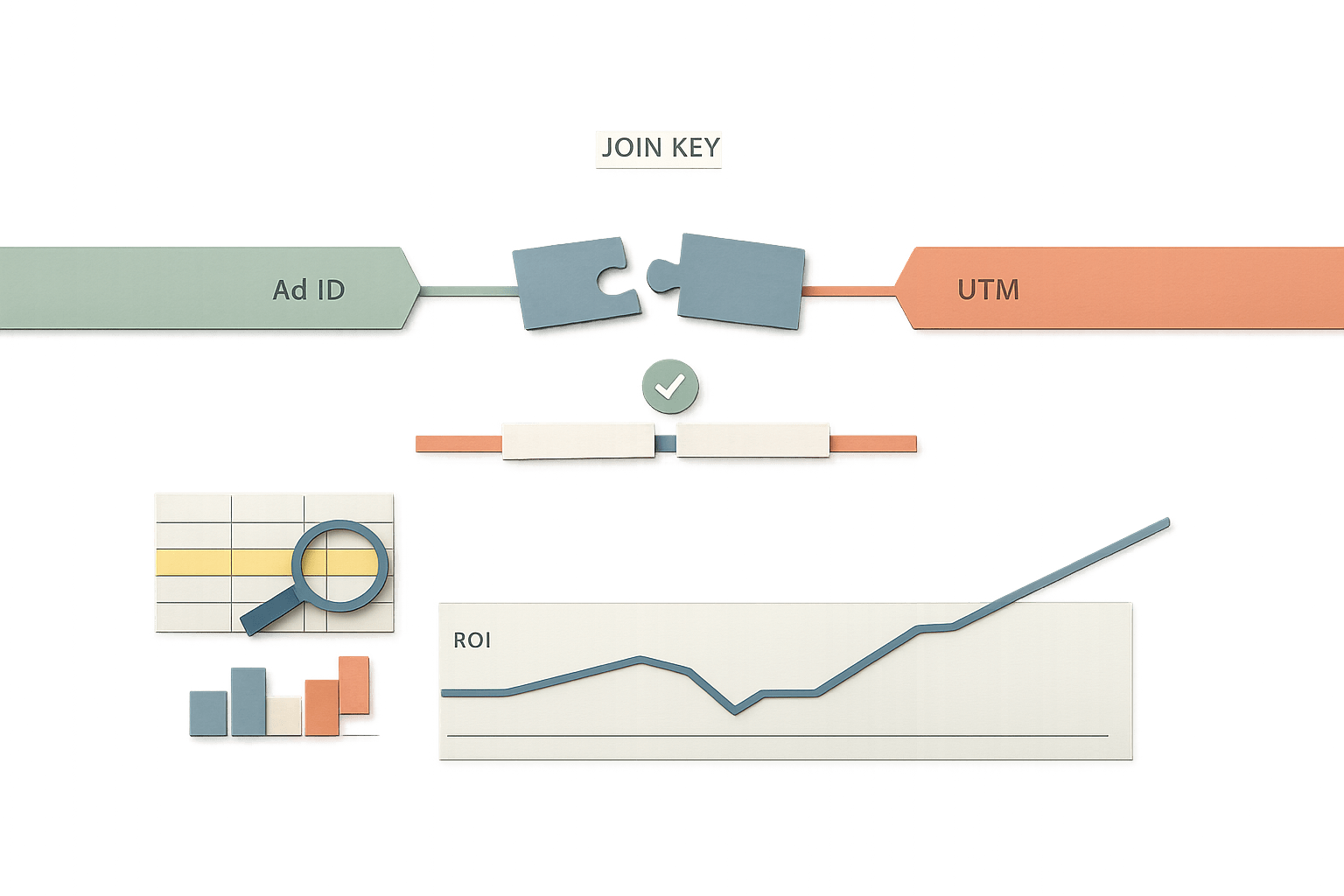
Preventing ROI Errors From Broken Join Keys Between Ad IDs and UTMs
Broken join keys between ad IDs, UTMs, GA4, and CRM can skew campaign ROI. Use canonical IDs, mapping, and join tests.
By Casey
Why broken join keys quietly distort campaign ROI
Campaign-level ROI often looks deceptively precise: spend from ad platforms, sessions and conversions in GA4, and revenue in a CRM. The problem is that these systems rarely agree on a single, stable identifier. Ad platforms optimize around their own IDs (campaign_id, adset_id, ad_id). GA4 commonly sees UTMs (utm_source, utm_medium, utm_campaign, utm_content, utm_term) plus click IDs (gclid, fbclid, msclkid). CRMs store what the form captured, what the salesperson edited, and what integrations passed along—often with different naming rules.
When the “join key” you expect to connect those worlds is missing or mutated, you don’t get an obvious error. You get a plausible report that is wrong: spend gets matched to the wrong revenue, revenue gets dropped, and ROI swings at the campaign level—especially when you aggregate by “campaign name” instead of a stable ID.
Common mismatch patterns across Ads, GA4, and CRM
1) ID-first in ads, UTM-first in analytics
Ad platforms treat IDs as canonical. In GA4, UTMs are frequently the grouping dimension stakeholders look at first. If UTMs aren’t generated from the same canonical source as the ad platform metadata, the mapping becomes best-effort. A campaign rename, a duplicated campaign, or a localization tweak can turn one logical campaign into multiple strings that no longer match.
2) Auto-tagging and UTMs collide
Teams may rely on auto-tagging (e.g., click IDs) while also manually appending UTMs. If the UTM values change mid-flight, GA4 can show multiple “campaigns” for what the ad platform considers one campaign ID. Meanwhile, CRM attribution may store only UTMs captured at lead time, not the click ID. The result is a three-way mismatch: ads align to IDs, GA4 aligns to UTMs, CRM aligns to whatever was stored on the first touch.
3) “Campaign” means different things in each system
GA4’s campaign dimension is not the same as a platform’s campaign object. CRMs sometimes define “campaign” as a lifecycle initiative or a sales push. If reporting uses the same label for different concepts, joins will appear to work but group apples with oranges.
4) CRM data entry and enrichment change the key
Even when UTMs reach the CRM, they can be normalized (lowercased, truncated), overwritten by later interactions, or replaced by enrichment logic. If your ROI model assumes immutability, the join breaks at the exact moment sales involvement increases—when the revenue stakes are highest.
What “broken join keys” look like in real reporting
Broken joins rarely show up as empty tables. They show up as symptoms:
- Unexplained “unattributed” revenue rising after a campaign restructure or naming refresh.
- Campaign ROI volatility that correlates with UTM changes rather than actual performance.
- Spend without revenue for campaigns that are clearly generating leads.
- Revenue without spend because revenue got grouped under a UTM value that does not exist in the spend dataset.
- Double counting when the same revenue is matched to multiple rows due to non-unique keys (e.g., joining on campaign name alone).
A practical prevention model: define, capture, validate, and reconcile
Step 1: Choose a canonical campaign identity
Pick a canonical identity that is stable and uniquely identifies the campaign across time. In most organizations, that means ad platform IDs (campaign_id/adset_id/ad_id) as the source of truth for paid media structure, plus a governed naming layer for reporting. UTMs should be treated as a transport mechanism, not the canonical identity.
Where you must report by UTM campaign (for example, to align with non-paid initiatives), keep a mapping table that explicitly relates UTM values to canonical IDs. Avoid assuming you can join on free-form text.
Step 2: Generate UTMs from governed metadata
UTMs should be produced from a controlled dictionary—ideally from the same dataset that stores campaign IDs and naming standards. This prevents ad-hoc edits and ensures any rename triggers an intentional mapping update. If you support multiple markets, standardize separators, casing, and allowed character sets.
This is also where identity design matters. If you are already building internal graphs to connect signals, the mindset is similar to creating a reliable “key handshake.” The same discipline used when building a feedback identity graph applies here: define what is authoritative, what is derived, and how conflicts get resolved.
Step 3: Capture click IDs and UTMs end-to-end
For high-confidence matching, store both click IDs and UTMs at the moment of conversion. That means your landing pages, forms, and server-side events need to persist parameters and send them to the CRM (or to an intermediate event store). If privacy constraints limit storage, document what you keep and for how long so your attribution model is aligned with reality.
Step 4: Add join validation as a first-class data test
Most teams test whether pipelines ran, not whether joins are valid. Add explicit checks:
- Key coverage: % of spend rows that have a matching GA4 key, and % of GA4 conversion rows that have a matching CRM key.
- Key uniqueness: ensure the join key is unique on the “dimension” side (e.g., mapping table).
- Drift detection: alert when new UTM values appear without a mapping, or when a campaign name changes for an existing ID.
- Revenue reconciliation: compare total CRM revenue for a period vs. attributed revenue after joins; the gap should be explainable and bounded.
Typed validation and rollback thinking is useful here: if the key integrity falls below a threshold, downstream ROI tables should not silently update. A workflow similar to typed validation and rollbacks in automations prevents leadership dashboards from “successfully” publishing incorrect numbers.
Step 5: Use a normalization layer before analysis
Even with strong governance, you still need normalization: currency conversion, consistent channel naming, and standardized dimensions. A marketing data infrastructure layer helps ensure that when data lands in your warehouse or BI tool, it already follows consistent definitions.
This is where Funnel.io fits naturally: it collects performance data from advertising, analytics, and CRM tools, normalizes fields (including naming harmonization), and delivers an analysis-ready source of truth for reporting and attribution. The key is not “more dashboards,” but fewer inconsistent definitions and fewer ad-hoc joins that break when campaigns evolve.
Designing your join strategy for ROI accuracy
Prefer explicit mapping over implicit string matches
If your ROI depends on joining spend to revenue, treat the mapping as a governed asset. Maintain a table that links platform IDs to reporting dimensions (campaign group, initiative, market) and to the intended UTM set. Update it intentionally when campaigns change.
Separate operational naming from analytical grouping
Campaign names change for operational reasons (testing, budget, localization). Analytical grouping should remain stable. Create a “campaign grouping” dimension that survives renames and reorganizations, then measure ROI at that grouping level in addition to raw campaign IDs.
Make missing keys visible in dashboards
Instead of hiding unattributed rows, surface them. Show “unmatched spend,” “unmatched revenue,” and “new UTM values without mapping.” When stakeholders can see breakage, fixes happen before budget decisions are made on distorted ROI.
What to implement first if you suspect ROI is wrong
- Audit the last 30–90 days for new or changed UTM values and campaign renames.
- Quantify join coverage between spend → GA4 and GA4 → CRM.
- Stop joining on campaign name alone; introduce IDs and a mapping table.
- Instrument capture of click IDs and original UTMs at conversion time.
- Add automated tests and alerts so key integrity is monitored, not assumed.