Prevent Silent Success in Internal Automations with Typed Validation and Rollbacks
Stop “silent success” with typed outputs, golden dataset replays, semantic diffs, and automated rollback gates in workflows.
By Casey
Why “silent success” is the most expensive failure mode
Internal automations can fail without failing. A workflow runs “green,” the queue drains, and dashboards stay calm—yet the output is subtly wrong: a currency field shifts precision, a dedup rule collapses two accounts, or a vendor API returns a partial payload that still parses. This is “silent success”: the automation technically completes, but its business outcome is incorrect.
Silent success is common in code-first environments because engineers naturally optimize for runtime errors and retries, not for correctness of outputs across time. The fix is not a single test. It is an end-to-end validation strategy that treats outputs as products: typed results that can be checked, golden datasets that can be replayed, and automated rollbacks that restore trust quickly when drift is detected.
Define output contracts with typed results, not loose payloads
The first step is to stop thinking of automations as “scripts that run,” and start treating them as “functions with contracts.” Even if the automation ultimately writes to a database or posts to an API, you should still define a typed result that represents what the automation believes it produced.
What typed results buy you
- Explicit expectations: You can enforce required fields, numeric ranges, enum values, and invariants.
- Stable downstream integration: When you change logic, you can prove you didn’t silently change the output shape.
- Better observability: You can summarize typed results (counts, ratios, hashes) and alert on anomalies rather than raw logs.
A typed result can be a JSON schema, a TypeScript interface with runtime validation, a Python Pydantic model, or a protobuf message—what matters is that it is checked at runtime, not just hinted in code comments.
Include “correctness signals” in the result
A practical pattern is to include fields that let you validate outcomes cheaply:
- Counts: records read, records written, records skipped, deduped, or quarantined.
- Checksums/hashes: of key output tables or payload batches.
- Sampled exemplars: a small set of representative IDs or rows used for spot validation.
- Timing and version: workflow version, input source version, and dependency versions.
These signals make “did it do the right thing?” observable without manually digging into databases.
Validate end-to-end with golden datasets and replayable runs
Unit tests protect individual functions. Silent success typically happens at the boundary: parsing external responses, joining data across systems, applying segmentation rules, or writing side effects. Golden datasets address this by testing the automation as a whole with known inputs and expected outputs.
Build golden datasets that represent reality, not toy examples
Good golden datasets capture the edge cases that actually hurt internal systems:
- Nulls and missing fields from upstream systems
- Duplicate identifiers and re-used emails
- Timezone and locale variations
- Backfilled data arriving out of order
- Permission-bound rows (tenant or team boundaries)
Golden datasets do not need to be large. They need to be diagnostic. Twenty carefully chosen cases can outperform ten thousand random rows.
Golden outputs should be compared with semantic diffs
Comparing raw JSON blobs often creates false alarms due to field ordering, timestamps, or irrelevant metadata. Prefer semantic comparisons:
- Ignore volatile fields (timestamps, request IDs) unless they matter
- Normalize monetary values and decimals before diffing
- Compare sets where ordering is not meaningful
- Use tolerances for floating-point or ML-derived scores
The goal is to detect meaningful drift: changes in decisions, classification, routing, and persisted records.
Make replaying easy and cheap
Replays must be routine, not heroic. Treat each automation as something you can run on demand against a fixed input snapshot, producing a typed result and a structured diff. This is where a workflow platform helps: you want consistent environments, managed dependencies, and logs that can be traced across steps.
Teams often implement replays alongside the move from scattered cron jobs to structured DAG workflows. If you’ve dealt with “cron sprawl,” the operational shift is similar to what’s described in migrating cron sprawl to code-defined DAGs with OpenTelemetry traceability: once the workflow is first-class, validation and observability become first-class too.
Automated rollbacks that protect the business, not just the deploy
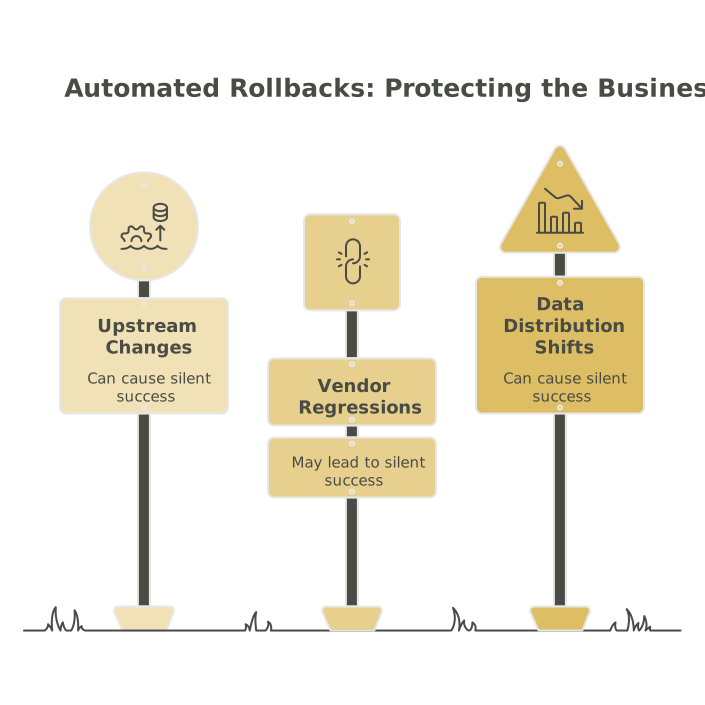
Even with typed results and golden tests, silent success can still occur due to upstream changes, vendor regressions, or data distribution shifts. You need rollback mechanisms that are triggered by validation signals—ideally before stakeholders notice.
Prefer reversible writes and staged side effects
Design automations so that you can “undo” or “swap” outputs:
- Write to staging tables and promote via atomic rename or controlled merge.
- Use versioned output tables (e.g.,
output_v2026_08_08) and update a pointer/view on success. - Idempotent upserts with deterministic keys so re-running doesn’t multiply damage.
- Outbox pattern for external calls: record intent, validate, then dispatch.
These patterns let you roll back by changing a pointer, re-promoting the last good version, or replaying a known-good run.
Rollback triggers should be tied to typed invariants
Automated rollbacks should not depend on “someone saw a weird chart.” They should trigger on explicit validation failures, such as:
- Record counts deviating beyond a threshold from a trailing baseline
- Schema validation failures or missing mandatory fields
- Constraint violations (negative values where impossible, invalid enums)
- Tenant boundary violations (data leakage signals)
For multi-tenant environments, silent success can hide isolation breaks. If you’re operating across tenants, it’s worth aligning validation with boundary enforcement as discussed in edge-enforced tenant isolation for multi-tenant AI apps: correctness includes “only the right tenant’s data was touched.”
Operationalizing the approach in a code-first workflow platform
End-to-end output validation becomes more reliable when the system running automations provides repeatability and observability by default. With a code-first platform like Windmill, teams can standardize how scripts emit typed results, how workflows model dependencies as DAGs, and how validation steps are embedded into the run itself. The practical advantage is not a new programming model—it’s less platform glue.
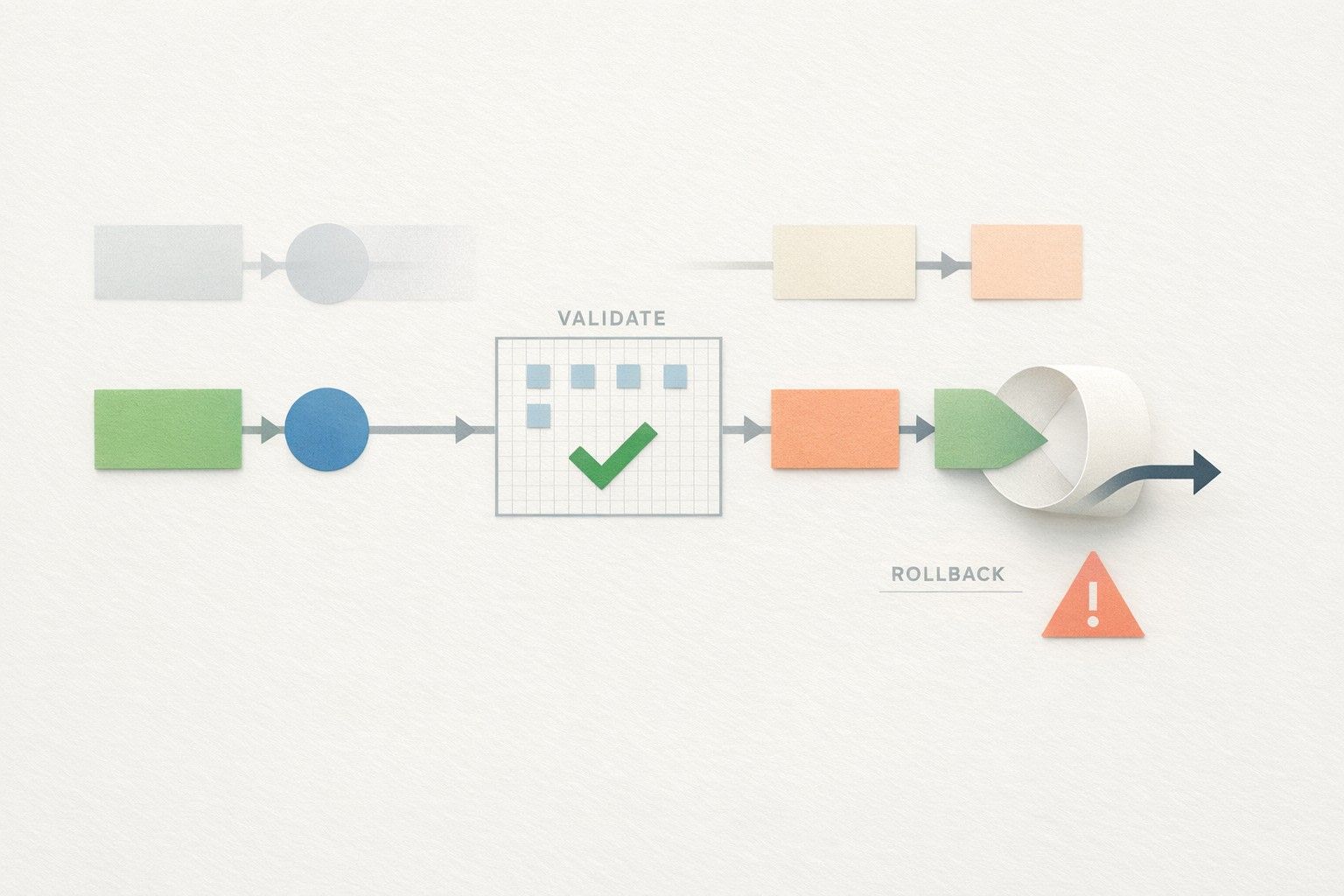
In Windmill, you can keep automation logic in real code while making the validation steps explicit: a workflow can parse inputs, transform data, validate outputs, and gate the “publish” step. When something drifts, rollback can be another first-class step rather than an ad-hoc runbook. The monitoring and alerting layer then becomes meaningful because it’s driven by typed results and invariants rather than generic “job failed” signals. For teams building and operating many internal automations, that combination—code, DAG structure, and deep observability—reduces the surface area where silent success can hide.
For more on the platform itself, see windmill.dev.
A practical checklist to prevent silent success
- Typed result: every automation returns a validated output contract, not a free-form blob.
- Correctness signals: counts, hashes, exemplars, and version metadata are part of the output.
- Golden datasets: a small, curated set of edge cases is replayed on every meaningful change.
- Semantic diffs: compare what matters, normalize what doesn’t.
- Staged writes: publish outputs via atomic promotion, not direct mutation.
- Automated rollbacks: trigger on invariant failures and anomaly thresholds, not on manual detection.