Edge-Enforced Tenant Isolation for Multi‑Tenant AI Apps
Edge tenant isolation prevents cross-workspace data bleed using per-request identity, header sanitization, and cache-key partitioning.
By Casey
Why edge-enforced tenant isolation matters in AI products
Multi-tenant AI applications compress a lot of risk into a small surface area: one API, one UI, one model layer, many workspaces. The failure mode is rarely “a hacker stole everything” and more often “a perfectly legitimate request was served the wrong tenant’s data.” In AI workflows, that bleed can show up as mis-scoped retrieval results, cached responses returning across tenants, prompt context mixing between workspaces, or logs and traces exposing content to the wrong operator group.
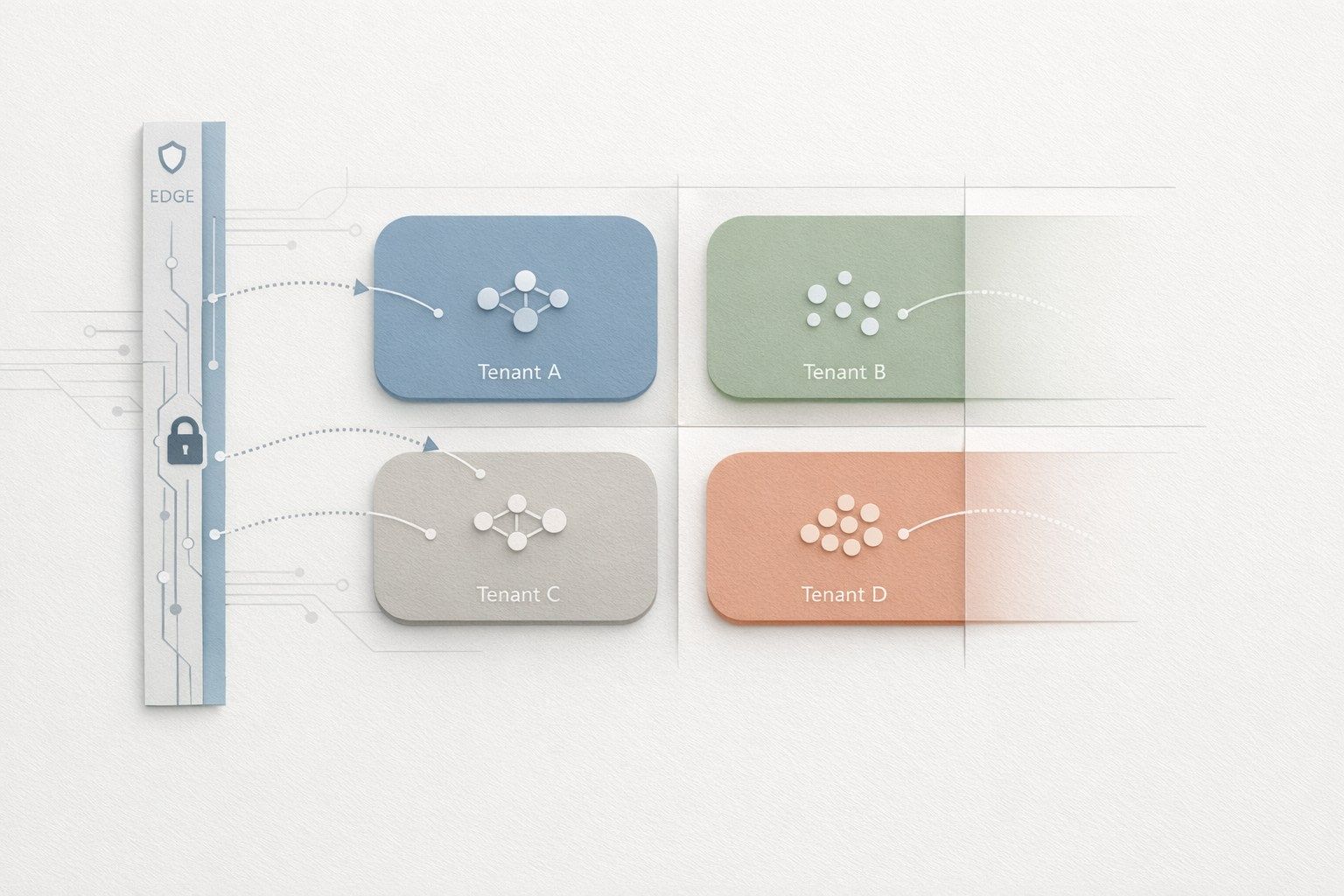
Edge-enforced tenant isolation shifts the most important guardrails as close to the request boundary as possible. Instead of trusting every downstream service to interpret identity and tenancy consistently, you treat tenancy as a first-class input on every request, normalize it at the edge, strip untrusted headers, and ensure caches are partitioned so that a response for Workspace A cannot be replayed to Workspace B.
Platforms like cloudflare.com are often used for this boundary layer because the edge is where routing, header policy, caching, and request shaping can be applied consistently across regions and services.
Threat model: how cross-workspace data bleed happens
Tenant bleed typically comes from ordinary engineering shortcuts rather than malicious intent. Common paths include:
- Identity ambiguity: a backend infers workspace from an optional header, a cookie, or a “current workspace” UI state, and different services infer it differently.
- Header confusion: internal headers like
X-Workspace-IdorX-User-Idare accepted from the public internet without sanitization. - Cache key collisions: a reverse proxy or edge cache keys only on URL, so
/api/chat/historyis cached once and served to multiple tenants. - Retrieval mis-scoping: vector search queries omit tenant filters, or the filter is derived from an unsafe client-provided value.
- Observability bleed: logs, traces, or analytics pipelines attach the wrong tenant ID and make sensitive payloads visible to the wrong team.
Edge enforcement is not a replacement for backend authorization, but it is a strong “first gate” that reduces the chance of one inconsistent service causing a breach across the entire system.
Per-request identity as a hard requirement
For tenant isolation to hold under load, concurrency, retries, and streaming, identity must be computed per request—not per session, not per connection, and not “mostly” per request.
Practical rules
- Derive identity from a single authoritative mechanism (typically a signed token) and treat everything else as hints at best.
- Bind tenant to user in the token (or via introspection) so “user in Workspace A” cannot simply switch to Workspace B by changing a header.
- Make tenant explicit in every call to downstream services (databases, vector stores, object storage, feature flags, queues).
- Fail closed: if tenant cannot be derived confidently, reject or downgrade to a safe unauthenticated path.
This is also where internal product systems—billing, feedback, entitlements—need the same tenant rigor. If you are merging signals across organizations, it helps to model identities carefully; see Building a Feedback Identity Graph to Merge Feature Requests Without Losing Revenue Context for a related approach to keeping “who is who” consistent across systems.
Header sanitization at the edge
Header sanitization is the fastest win for preventing accidental trust of client-controlled values. Many teams add convenience headers for internal routing (X-Tenant, X-Org, X-Plan), then forget that browsers, scripts, and proxies can send those same headers from the outside.
Sanitize, then re-inject
A robust pattern is:
- Strip untrusted headers that could influence tenancy, identity, authz, or cache behavior (e.g.,
X-Workspace-Id,X-User-Id,X-Role,X-Cache-Key). - Reconstruct canonical headers from verified identity at the edge (e.g.,
X-Canonical-Tenant,X-Canonical-User). - Normalize formats (lowercase IDs, stable UUID encoding) to avoid “same tenant, different string” bugs.
- Allowlist pass-through headers rather than attempting to blocklist everything.
This reduces reliance on each microservice remembering which headers are safe. It also makes it easier to audit: you can log and trace the edge-derived canonical tenant once, and downstream services can treat it as the only supported source.
Cache-key partitioning to stop replay across tenants
Caching is where tenant bleed becomes painfully non-obvious. The bug is not “data leaked” but “performance improved,” until the wrong user reports seeing someone else’s chat title or document snippet.
Where cache keys go wrong
- URL-only caching for JSON endpoints that are tenant-specific but share paths.
- Vary headers missing tenant context (or vary on a client-controlled header that can be spoofed).
- Shared CDN cache in front of multiple workspaces without explicit partitioning.
Partition deliberately
For any response that depends on tenant-scoped data, ensure the cache key includes a stable, edge-derived tenant identifier. Common techniques:
- Cache key = URL + tenant ID (and sometimes user ID for highly personalized endpoints).
- Explicit
Varyon a canonical tenant header that cannot be provided by clients. - Disable caching for endpoints that are too risky or too personalized (chat transcripts, account settings, search results).
- Separate hostnames per tenant when practical; it naturally partitions caches and cookies.
AI adds an extra wrinkle: streaming responses and tool-calling may generate intermediate cached artifacts (summaries, citations, thumbnails). Partition those artifacts the same way, or you reintroduce bleed through auxiliary endpoints.
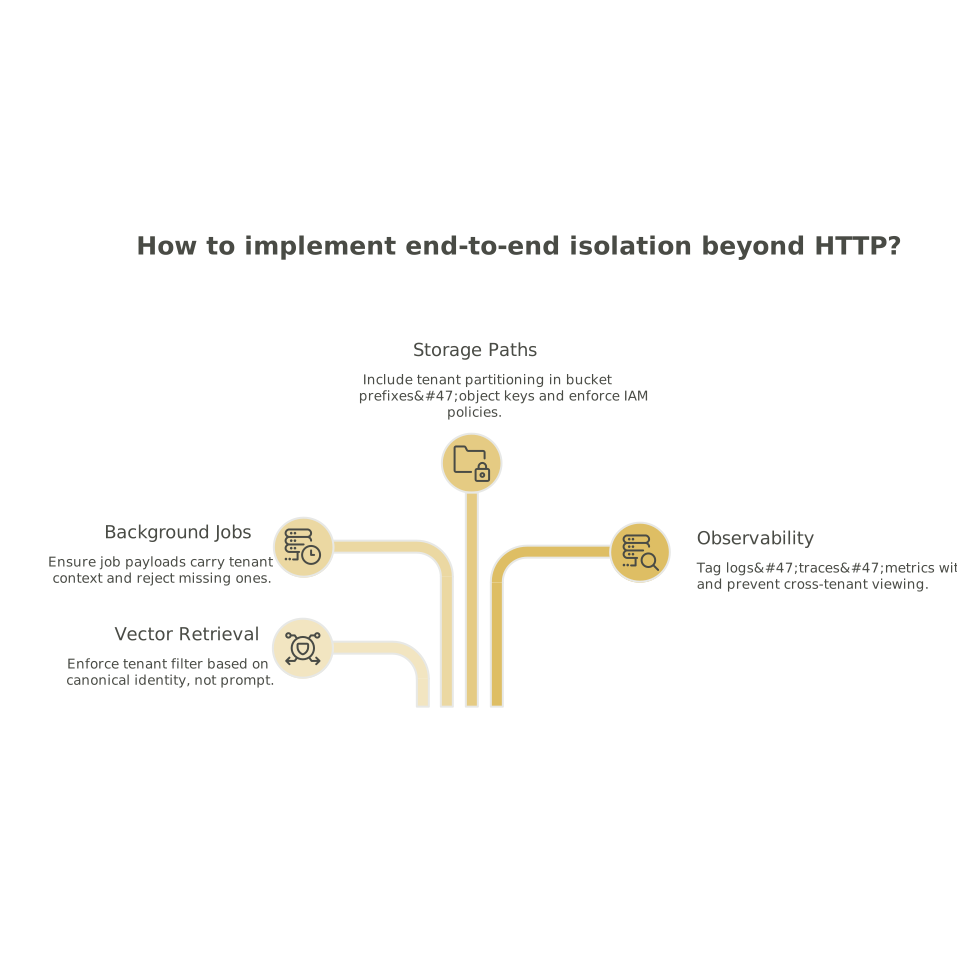
End-to-end isolation beyond HTTP
Edge controls help, but AI systems have more than HTTP requests. Isolation should extend to:
- Vector retrieval: enforce a tenant filter that is derived from canonical identity, not the prompt.
- Background jobs: job payloads must carry tenant context; workers must reject jobs missing it.
- Storage paths: bucket prefixes or object keys should include tenant partitioning, and IAM policies should enforce it.
- Observability: tag logs/traces/metrics with tenant ID and ensure access controls prevent cross-tenant viewing.
If you are migrating operational complexity (cron jobs, ad-hoc scripts) into structured workflows, tenant context should be part of the DAG contract. The discipline described in Migrating Cron Sprawl to Code-Defined DAGs With OpenTelemetry Traceability aligns well with making tenant identity a mandatory field that is traced consistently.
Implementation checklist you can apply immediately
- Edge authentication: validate tokens and compute canonical tenant/user per request.
- Header policy: strip tenant/identity-affecting headers from clients; allowlist safe headers.
- Canonical propagation: inject server-side canonical tenant headers for downstream services.
- Cache partitioning: ensure tenant ID is in cache keys or
Vary; disable caching where needed. - Backend enforcement: still enforce tenant checks in every datastore and retrieval query.
- Auditing: log the edge-derived tenant once and validate downstream consistency in tests.
The overall goal is simple: every request carries a single, verified tenant identity; nothing client-controlled can override it; and no cache can reuse tenant-scoped responses across workspaces.