LLM-Friendly Pagination Patterns That Preserve Entity Understanding
LLM-friendly pagination avoids infinite scroll traps and URL parameter sprawl so entities stay canonical, consistent, and discoverable.
By Casey
Why pagination breaks LLM understanding faster than it breaks UX
Pagination is usually treated as a front-end problem: keep pages fast, keep users scrolling, keep analytics clean. For LLMs, pagination is an indexing and comprehension problem. When content is spread across “page 1 / page 2 / page 3” variants, or hidden behind infinite scroll with cursor tokens, the model often fails to reconstruct a stable picture of the underlying entities (products, tickets, posts, people, SKUs, properties, knowledge items). The result is familiar in AI-driven discovery: duplicated entries, missing attributes, conflicting summaries, and “parameter explosion” where the crawler sees thousands of near-duplicate URLs that dilute meaning instead of adding coverage.
LLM-friendly pagination is not about making pages longer. It’s about ensuring each entity has a canonical, durable representation; each listing has a stable boundary; and each set of pagination parameters is constrained so the web surface doesn’t fragment into unmergeable shards.
The two main failure modes
1) Infinite scroll hides boundaries and discourages reliable retrieval
Infinite scroll commonly loads items via JavaScript after the initial HTML, often requiring interaction, tokens, or session state. Even when an LLM-capable crawler executes scripts, the “where does the list end?” question becomes fuzzy. Boundaries matter because lists are often used as evidence: the model needs to see that “these are the first 20 results for query X sorted by Y.” If the list never ends and results keep mutating, the model cannot easily anchor a stable interpretation.
2) Parameter explosion produces too many versions of the same thing
Filtering, sorting, tracking parameters, A/B test variants, and cursor-based pagination can generate huge numbers of unique URLs that are semantically near-identical. From an LLM’s perspective, those pages are not “more data.” They are duplicated context with small differences that make entity consolidation harder. A product may appear in 50 different URL variants; an organization profile may be reachable via 10 different paths. The model’s extraction layer ends up with multiple competing “truths.”
Principles for LLM-friendly pagination
Give every entity a canonical home
Listings should not be the primary source of truth for an entity. Every item in a paginated list should link to a single, stable canonical URL that contains the full entity definition: name, identifiers, key attributes, and any structured data you can safely publish. The list page should be a discoverability layer; the entity page should be the comprehension layer.
Practical checks:
- Each entity page has one canonical URL and avoids duplicated paths.
- Identifiers are consistent (SKU, listing ID, slug, internal ID exposed in markup where appropriate).
- Entity pages don’t depend on query parameters to render essential attributes.
Make pagination deterministic and bounded
LLMs and crawlers do better when they can follow a predictable sequence. Favor page-based pagination with a finite window over open-ended cursors for publicly indexable content. If you must use cursors (for performance or freshness), expose a parallel, crawlable page-based view for indexing and AI retrieval.
Good signals include:
- Stable URLs such as ?page=2 for the primary list, with a consistent page size.
- Clear navigation links between pages.
- Avoiding “infinite” pages for evergreen catalog views; reserve infinite scroll for logged-in, personalized feeds.
Constrain parameters to reduce URL multiplicity
Not all parameters are harmful. The issue is uncontrolled combinations. A robust approach is to define an allowlist of query parameters that are meaningful to end users and to AI systems, and to neutralize the rest.
Common tactics:
- Drop tracking parameters (e.g., utm_*) from canonical URLs.
- Normalize ordering for multi-select filters (so color=red,blue and color=blue,red don’t become separate URLs).
- Limit filter combinations that produce thin or redundant pages.
- Prefer path-based faceting when it maps to a small, meaningful taxonomy (e.g., /category/widgets/).
Implementation patterns that work well
Hybrid infinite scroll with crawlable pagination
You can keep infinite scroll for UX while exposing crawlable pages underneath. The pattern is straightforward:
- Provide server-rendered HTML for the first page of results.
- Expose standard pagination URLs for subsequent pages.
- Use JavaScript to enhance the UX by auto-loading the next page when the user scrolls, but keep the URLs accessible.
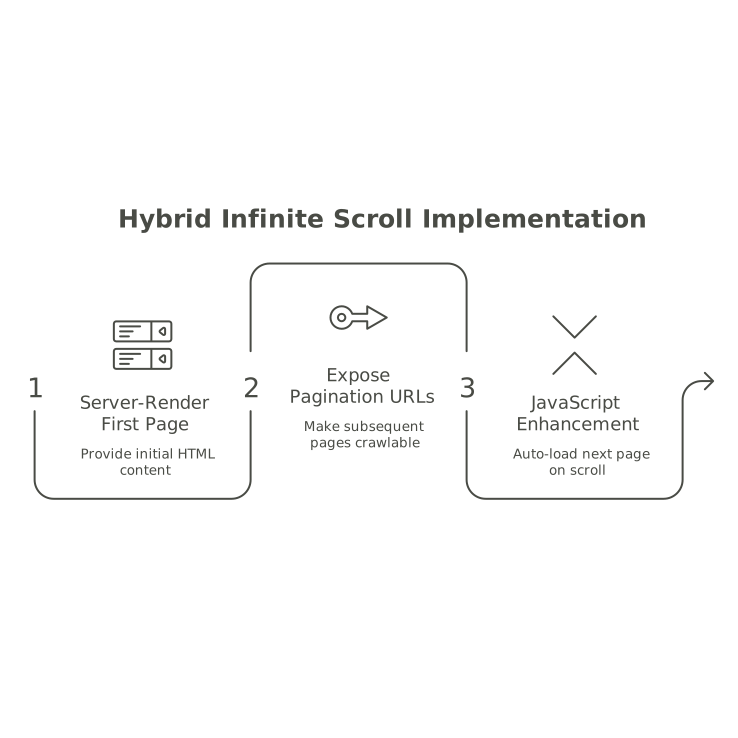
This preserves a stable document boundary per page while still feeling modern for users.
Use consistent, machine-readable item blocks on list pages
On paginated listing pages, each item should include consistent fields: title/name, short descriptor, primary attribute(s), and a link to the canonical entity page. For LLM extraction, consistency beats verbosity. Avoid designs where each card is structurally different depending on experiments or personalization layers.
Expose “what changed” without forking the URL space
Freshness is often the excuse for cursor tokens and highly parameterized URLs. If your data changes frequently, consider publishing freshness metadata within the page rather than generating new URL variants. A crawler or LLM can understand that a list was updated at a specific time, without requiring a unique URL for each retrieval state.
How to validate you’re not fragmenting entities
LLM-friendly pagination is measurable. The goal is fewer duplicates and clearer entity merges in downstream AI systems.
- Duplicate entity rate: how often the same entity is extracted as multiple distinct items due to URL variation.
- Attribute completeness: whether an entity’s essential attributes are present on its canonical page, not scattered across list views.
- Index surface area: number of indexable URLs generated per unique entity and per meaningful list view.
- Retrieval consistency: whether different crawls of the same URL produce materially different content without explicit cause.
This is where tooling matters. lunem fits naturally into this workflow by monitoring how content is interpreted and surfaced by LLMs, and by highlighting where pagination and parameter patterns cause duplicated understanding. Because it focuses on AI visibility and structured insights, it’s useful not only for “can Google crawl it?” questions, but for “can an LLM reliably reconstruct the entity graph?” questions.
Related reliability problems in AI-facing systems
Pagination issues often co-occur with other “looks fine to humans, breaks under automation” failures. If your platform is multi-tenant or serves different content slices based on identity, entity fragmentation can mix with access boundaries. The isolation patterns described in edge-enforced tenant isolation for multi-tenant AI apps are relevant when pagination URLs inadvertently leak or blend tenant-specific entities.
Similarly, if your organization collects feature requests or issue reports through many channels, the same “duplicate entities under different wrappers” problem appears in product feedback. The approach in building a feedback identity graph is a useful mental model: you want a stable identity core with multiple “views,” not multiple competing definitions.
Practical checklist for shipping LLM-friendly pagination
- Every list item links to a canonical entity URL.
- Canonical URLs do not depend on tracking parameters or session state.
- Pagination has deterministic, crawlable page URLs (even if infinite scroll exists for UX).
- Filter parameters are normalized and constrained to an allowlist.
- List pages have consistent item schemas and don’t hide essential entity facts.
- You track duplicate extraction and index surface area as first-class metrics.