The Feedback Spike Forensics Playbook for Identifying Real Product Demand Fast
A 48-hour playbook to classify feedback spikes, dedupe requests, confirm demand, and respond consistently without panic.
By Casey
Why feedback spikes are so hard to interpret
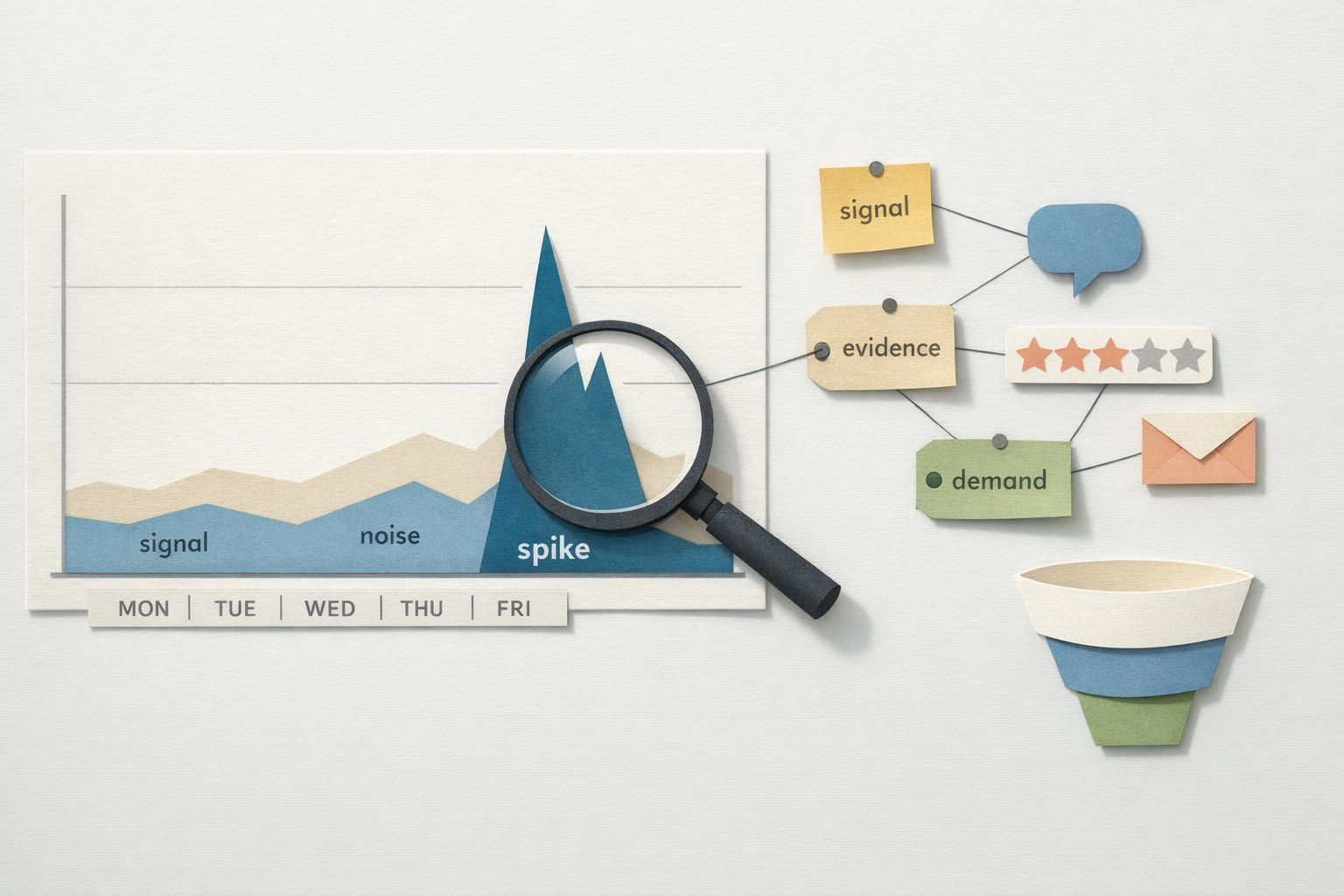
A sudden surge in customer feedback can be a gift or a trap. It might signal authentic product demand you should prioritize immediately. Or it might be “viral noise” from a social post, “outage fallout” from a reliability incident, or a short-lived wave driven by a new integration announcement. In practice, these spikes often blend together—especially when feedback arrives across support, community threads, sales calls, and in-app prompts.
This playbook is designed for product teams who need a defensible answer in 48 hours: is this real demand, and what should we do next? The goal is not perfect certainty. The goal is a fast, structured investigation that separates transient attention from durable need, while preserving customer context (segment, revenue, urgency, and downstream impact).
The 48-hour operating model
Think in two tracks that run in parallel:
- Signal classification: determine whether the spike is viral, outage-driven, or demand-driven.
- Response containment: ensure customers get timely updates and your team doesn’t create new confusion by responding inconsistently.
Many teams already collect feedback, but spikes expose the weak points: duplicate requests, missing account context, and uncertain ownership of “the truth.” A centralized feedback system such as canny.io helps because it can unify sources, track duplicates, and retain customer metadata so you can move quickly without losing nuance.
Step 1 in the first 2 hours: freeze the narrative and capture raw evidence
Before you interpret anything, stop the internal “telephone game.” Create a single spike incident doc and capture:
- Timestamp boundaries: when the spike started, peaked, and whether it is still accelerating.
- Channels: support tickets, public portal posts, sales notes, social mentions, app store reviews, community/forum threads.
- Top 20 verbatims: the exact wording of the most frequent or most emotionally charged messages.
- Product context: deployments, incidents, pricing changes, email campaigns, or integration launches in the prior 72 hours.
At this stage, avoid debating solutions. Your job is to preserve an accurate snapshot so later analysis doesn’t get biased by the loudest voice in the room.
Step 2: classify the spike using three forensic lenses
Lens A: Viral noise
Viral spikes usually have these characteristics:
- High volume, low depth: many short comments, repeats of a phrase, or copy-pasted requests.
- Weak customer linkage: lots of unknown users, free accounts, or people who have never used the product.
- Fast decay: volume drops sharply after 24–72 hours.
- Single origin point: a tweet, newsletter, influencer video, or product hunt-style burst.
Action: route these requests into one canonical feedback item, tag the origin source, and wait for conversion evidence (trials activating, paid upgrades, meaningful usage). Don’t over-index on volume alone.
Lens B: Outage fallout
Outage-driven spikes look different:
- Temporal alignment: feedback rises within minutes/hours of an incident or degraded performance.
- Symptom language: “can’t login,” “data missing,” “sync broken,” “slow,” “timeouts.”
- Short-term urgency: high emotion, escalation threats, and demands for immediate remediation.
- Clustered segments: often concentrated in one region, plan tier, or integration.
Action: treat feedback as part of incident management. Create a clear customer-facing update loop (status page + consistent messaging), and separate reliability defects from feature requests. If you mix them, you’ll misread “fix the outage” as “build a new feature.”
Lens C: True product demand
Demand-driven spikes tend to show:
- Multi-channel corroboration: the same request appears in support, sales calls, and product feedback—independently.
- Specific use cases: customers describe workflow impact, constraints, and alternatives they’re using today.
- Revenue or retention linkage: expansion is blocked, churn risk rises, or deals stall on the same gap.
- Durable trend: volume remains elevated for weeks, not days.
Action: move quickly to quantify affected accounts and align on a scoped response (workaround, partial solution, roadmap commitment, or a discovery sprint).
Step 3: deduplicate aggressively without losing customer context
Spikes create duplicates at scale. If you treat each message as independent demand, you inflate the signal. If you over-merge, you lose meaningful differences (e.g., “export” might mean CSV for one segment and API access for another).
A practical approach is to build a “canonical request” for each theme, then attach evidence:
- Customer identity: company, plan, ARR, segment, region.
- Source trail: where it came from (support, sales, portal, social).
- Use-case tags: what job they’re trying to do and what breaks today.
- Impact score: blocked workflow, time loss, compliance risk, or revenue impact.
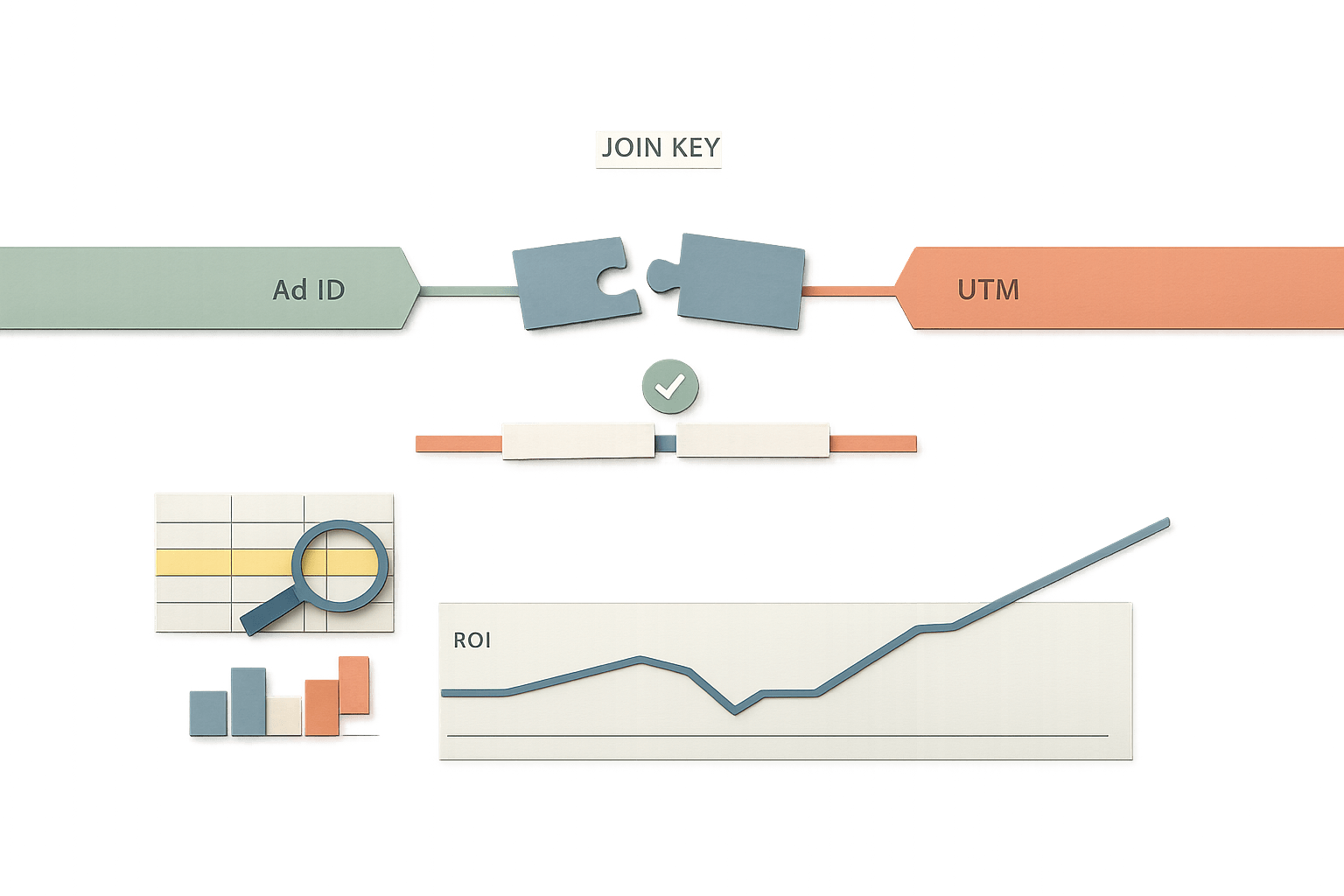
If you want a deeper method for merging requests while keeping revenue and segmentation intact, the idea of a feedback identity graph can help teams avoid “one giant bucket” thinking. See Building a Feedback Identity Graph to Merge Feature Requests Without Losing Revenue Context.
Step 4: run the “48-hour triage grid” to decide what happens next
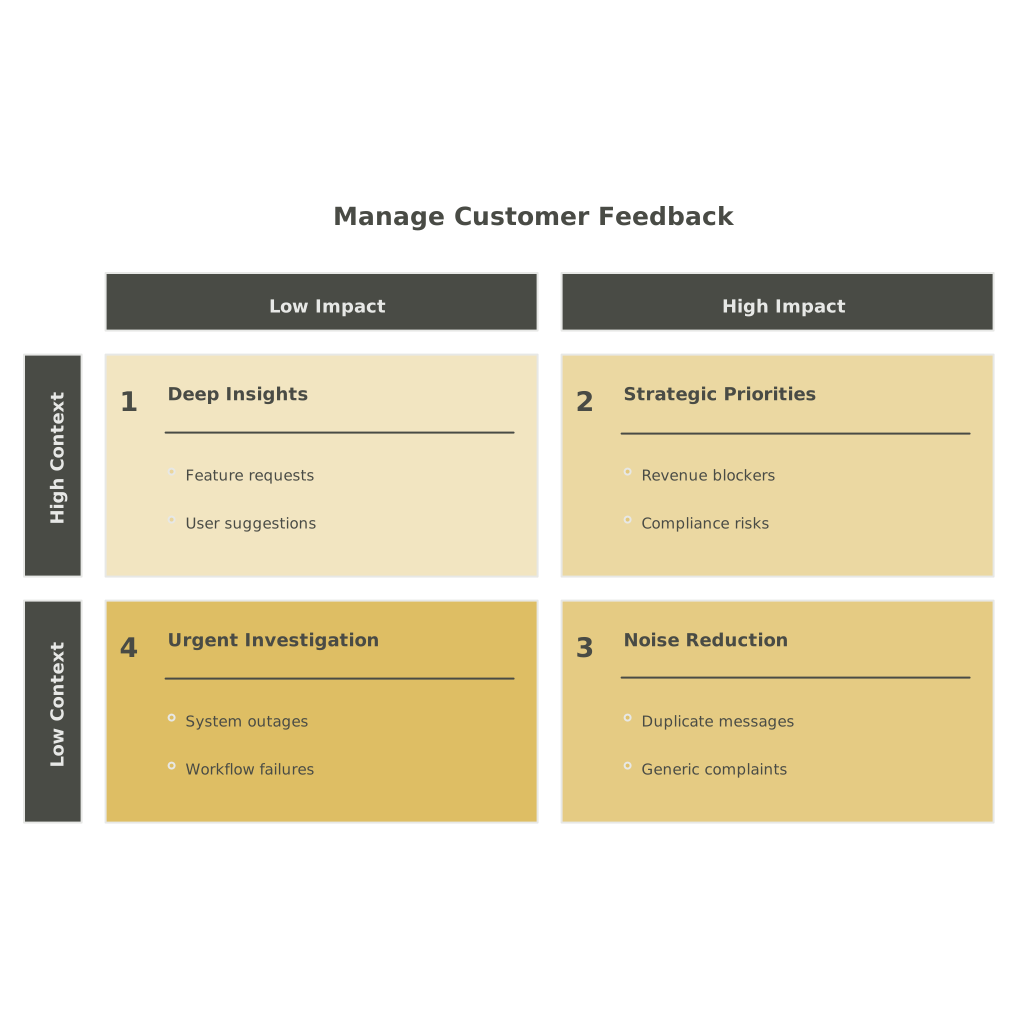
Within a day, you should be able to place each canonical theme into a simple grid:
- High revenue impact + high urgency: immediate owner, daily updates, define a mitigation plan within 24 hours.
- High revenue impact + low urgency: schedule discovery, quantify demand by segment, propose roadmap slotting.
- Low revenue impact + high urgency: prioritize communication and workarounds; avoid derailing core roadmap.
- Low revenue impact + low urgency: park it with a clear status and revisit when more evidence appears.
The key is that “urgency” and “importance” are not the same. Outage fallout often has extreme urgency but shouldn’t be interpreted as new demand. Viral noise can look important due to volume but may have low conversion or weak retention impact.
Step 5: confirm true demand with a lightweight handshake workflow
When you suspect authentic demand, validate it with a fast confirmation loop rather than a long research project. A simple handshake looks like:
- Clarify: ask a targeted question to confirm the workflow and desired outcome.
- Quantify: determine frequency and impact (hours saved, risk reduced, revenue unlocked).
- Commit: give a precise next step (discovery call, beta list, or a roadmap status), even if you can’t promise a ship date.
This prevents “phantom demand” where many users click upvote but few will adopt the solution. For a structured version of this approach, refer to The Feedback Handshake Workflow for Confirming Feature Requests.
Step 6: publish one consistent response per theme
Spikes become damaging when teams respond inconsistently across channels. Assign a single owner per canonical request and publish:
- Status: investigating, planned, in progress, shipped, or not planned (with rationale).
- Workaround: if available, with clear steps.
- Update cadence: when customers can expect the next update.
This is where a centralized workflow matters: you want one truth that support, success, and product can reference—so customers aren’t forced to repeat themselves and your team doesn’t reinvent answers in every ticket.
What you should have by hour 48
- A classified spike report: viral vs outage vs demand, with evidence.
- Canonical themes: deduped requests with customer and revenue context.
- A prioritized triage grid: owners, next actions, and communication plan.
- A short validation queue: the top items requiring handshake confirmation.
That combination gives leadership a credible answer fast, keeps customers informed, and ensures you build for durable demand—not momentary noise.