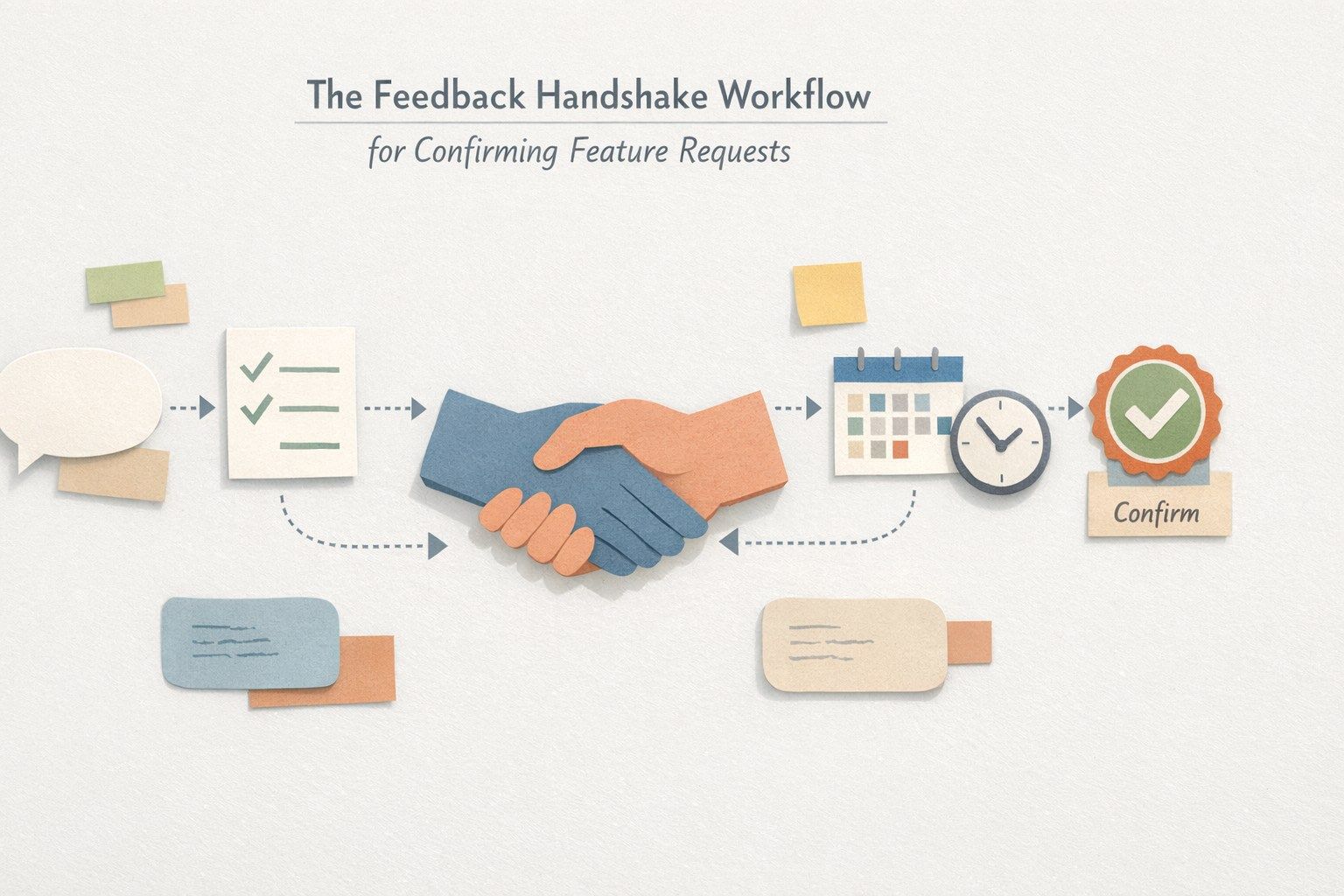
The Feedback Handshake Workflow for Confirming Feature Requests
A one-question workflow to confirm feature intent, reduce rework, and track a measurable misunderstanding rate over time.
By Casey
The Feedback Handshake workflow
Feature requests rarely fail because customers “don’t know what they want.” They fail because teams translate a short request into a detailed solution too early—then build the wrong version with confidence. The Feedback Handshake is a lightweight workflow that confirms intent with a single clarifying question, captures the answer in a reusable format, and tracks a “misunderstanding rate” so you can prove the process is working.
This is especially useful when feedback arrives in bursts from support, sales calls, or public portals. Tools like canny.io make it easier to centralize the request, keep context attached, and report on what changed between the original request and the confirmed need.
What a “handshake” means in product feedback
A handshake is the moment you and the requester agree on what problem is being solved, for whom, and what “success” looks like—before discussing implementation details. The goal isn’t to interrogate users; it’s to replace guesswork with one high-signal question that reduces rework.
In practice, the handshake has three characteristics:
- Minimal friction: one question, easy to answer asynchronously.
- Structured capture: the answer is stored in a consistent field so it’s searchable and comparable across requests.
- Measurable impact: you can quantify how often the initial interpretation was wrong.
The one clarifying question that does most of the work
The best single question is not “Can you explain?” It’s a prompt that forces specificity without requiring the customer to design the solution.
Recommended question
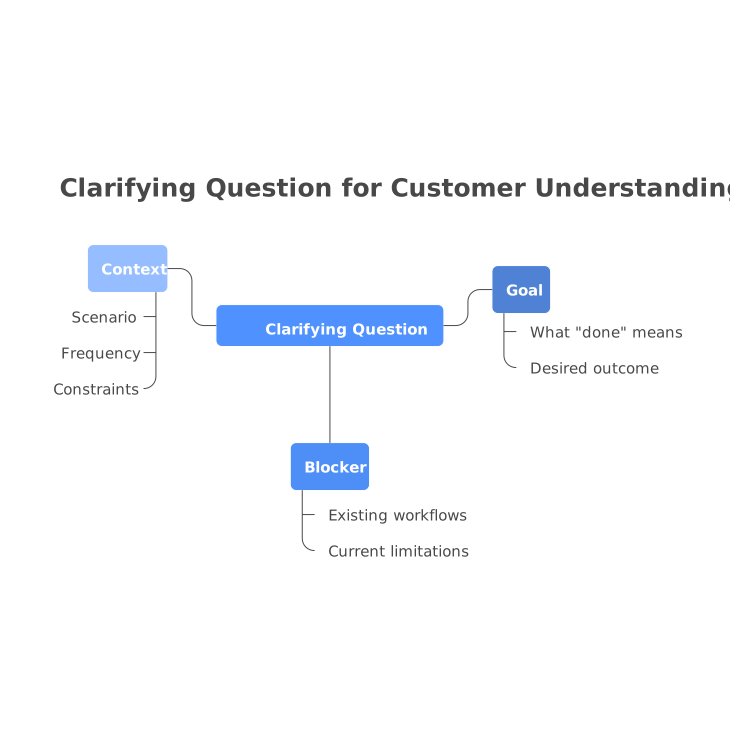
“What are you trying to accomplish, and what’s stopping you today?”
This phrasing reliably pulls out:
- Goal: the intended outcome (what “done” means to them).
- Blocker: the current failure mode (why existing workflows don’t work).
- Context: the scenario, frequency, and constraints that change priority.
If you want a slightly more structured version for complex products, use:
- “What are you trying to accomplish?”
- “What do you do today instead?”
- “What would a good outcome look like?”
But keep it to one message, one reply. The handshake works because it is fast.
A practical workflow you can run every day
The workflow below is designed for product teams that handle feedback from multiple channels and need a repeatable operating rhythm.
Step 1: Normalize the request into a single sentence
Before you ask anything, rewrite the request as a neutral “need statement” that avoids solution language. For example:
- Original: “Add a Slack integration for alerts.”
- Need statement: “Need to get time-sensitive alerts where the team already responds.”
This is not the final interpretation; it’s your starting hypothesis.
Step 2: Send the handshake question and timebox it
Reply with the single clarifying question and a small timebox that signals respect for their time:
- “Quick clarifier so we solve the right thing: what are you trying to accomplish, and what’s stopping you today?”
If the request came through support, ask support to send it on your behalf so it feels continuous. If it’s a public portal request, reply publicly when appropriate—others often confirm the same blockers in-thread.
Step 3: Extract and store three fields
When the customer answers, capture the content in consistent fields so it becomes operational data rather than free-text. A simple schema works well:
- Job-to-be-done: what they’re trying to accomplish.
- Current workaround: what they do today and why it’s painful.
- Success signal: what would be true if you built the right thing.
In Canny, this can be represented as tagged summaries or internal notes attached to the post, so anyone reviewing the request later sees the confirmed intent without rereading long threads.
Step 4: Decide whether it’s the same request or a different one
After the handshake, many “feature requests” turn out to be one of three things:
- A true net-new capability with a clear goal and blocker.
- A discoverability issue (the feature exists, but the workflow is unclear).
- A different request than the title suggests (the solution proposed is a proxy for a deeper need).
That decision affects how you merge duplicates, how you label segments, and how you estimate impact. If you’re actively consolidating overlap, a structured approach like this pairs well with a systematic dedupe process (see the feedback deduplication playbook for deeper merging mechanics).
Step 5: Close the loop with a confirmed interpretation
Send a short confirmation that mirrors their words and states what you will track:
- “Got it—your goal is X, and today Y is blocking you. I’ll track this as ‘X without Y friction’ and update you if we move it forward.”
This final “handshake confirmation” prevents silent drift. It also gives you a clean artifact to compare against later decisions.
Measuring the misunderstanding rate
Without measurement, “asking clarifying questions” stays a cultural aspiration. The misunderstanding rate turns it into a trackable quality metric.
Definition
Misunderstanding rate = the percentage of feature requests where the post-handshake interpretation meaningfully differs from the pre-handshake interpretation.
“Meaningfully differs” should be defined in a way your team can apply quickly. For example, count it as a misunderstanding if any of these change after the handshake:
- The primary user persona or team using it (admin vs end user).
- The job-to-be-done (reporting vs permissions vs workflow automation).
- The success signal (speed, accuracy, compliance, collaboration).
How to instrument it in practice
- Before: store your initial need statement as “Hypothesis.”
- After: store the confirmed fields as “Handshake confirmed.”
- Flag: add a simple boolean like “Interpretation changed = yes/no.”
Over time, you can segment the metric: Which intake channels produce the most misunderstandings (sales notes, support tickets, public portal)? Which request categories are most ambiguous? If you already maintain customer-level context and segmentation, you can connect this to identity-level consolidation—especially useful when the same request shows up under multiple accounts with different revenue impact (the “feedback identity graph” idea is a natural complement).
What a good rate looks like
There isn’t a universal benchmark, but two patterns are common:
- Early on: the rate may be high because you’ve never forced clarity at the intake layer.
- Later: the rate should decline as request templates improve and internal teams learn what details to capture up front.
The goal isn’t to drive it to zero. A non-zero rate is evidence the handshake is catching problems before they become roadmap commitments.
Where this workflow fits in a modern feedback stack
The Feedback Handshake is most effective when it’s embedded into your feedback tooling rather than run as a separate ritual. Centralizing requests, preserving the original language, and attaching confirmed context in one place reduces the “telephone game” across product, support, and sales. That’s why teams use platforms like Canny to unify intake, deduplicate similar posts, prioritize with segment and revenue context, and keep requesters informed as statuses change.
If your team is exploring automation, the handshake question is also a safe candidate for AI-assisted drafting—especially when paired with human review—because it’s a bounded, intent-seeking prompt rather than a speculative solution proposal.