The Explanation Gap Audit for SAT Practice and How to Fix Missed Questions Without Rewatching Videos
Turn every missed SAT question into a 3-step loop: name the gap, build a micro-skill card, and drill to cold correctness.
By Casey
Why most SAT review methods waste your time
When you miss an SAT question, it’s tempting to do one of two things: reread the explanation until it “makes sense,” or watch another video that covers the same concept. Both can feel productive, but they often leave the real problem untouched. The result is a familiar pattern: you understand the solution when you see it, yet you miss the same type of question again a week later.
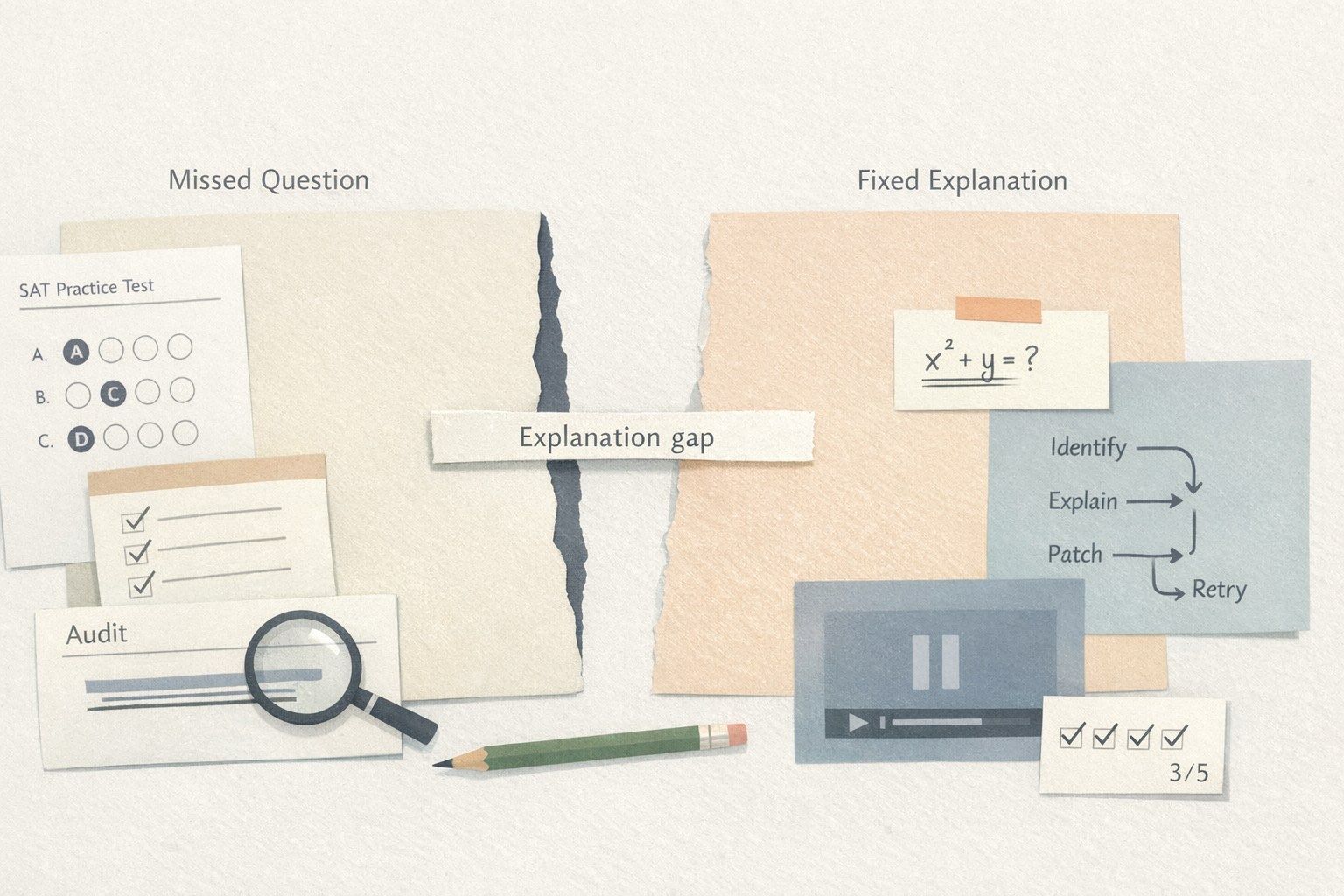
The “Explanation Gap” Audit fixes that. It treats every missed question as a diagnostic artifact, not a failure. Your goal is to identify the smallest missing skill that made the explanation feel convincing but not usable under test conditions, then loop that skill until it becomes automatic.
What the “explanation gap” actually is
An explanation gap is the space between recognition and execution:
- Recognition: “I follow the steps when I read them.”
- Execution: “I can produce the steps quickly with no prompts.”
Most missed questions are not caused by a total lack of knowledge. They’re caused by one of these gaps:
- Step gap: you didn’t know the next step without being told.
- Trigger gap: you didn’t recognize which tool/strategy the question wanted.
- Setup gap: you knew the concept but didn’t translate the question into the right math or logic.
- Constraint gap: you understood it in slow motion, but not within SAT timing and pressure.
The 3-step skill loop for every missed SAT question
This is the core workflow. It’s intentionally short, because a review system only works if you can repeat it for dozens of questions per week.
Step 1: Name the gap in one sentence
Immediately after reviewing the official or tutor explanation, write a single-sentence diagnosis. Keep it specific and behavioral, not emotional.
Good diagnoses:
- “I didn’t recognize this as a linear function question because it was described in words.”
- “I expanded too early and lost track of signs; I needed factoring first.”
- “I didn’t set up the ratio; I tried to do mental math without defining variables.”
Weak diagnoses: “Careless mistake,” “I was rushing,” “I need to review this topic.” Those are labels, not causes.
If you use an adaptive platform like getsharp, this step becomes even cleaner because you can compare your work to the step-by-step explanation and pinpoint the exact moment you diverged—where the gap begins, not where it ends.
Step 2: Build a micro-skill card you can repeat in 2 minutes
Turn the diagnosis into a tiny drill that targets the missing action. A micro-skill card has three parts:
- Trigger: the pattern that tells you to use the skill
- Procedure: 2–5 steps written in your own words
- Check: a fast way to verify you didn’t drift
Example (SAT Math, wordy linear relationships):
- Trigger: “For every ___, ___ increases/decreases by ___”
- Procedure: 1) define x and y, 2) convert to y = mx + b, 3) map the rate phrase to slope m, 4) use a given point to solve for b
- Check: plug x = 0 to interpret b in the story
Example (SAT Reading, inference choices):
- Trigger: question asks what the author “suggests” or “implies”
- Procedure: 1) find the referenced lines, 2) paraphrase literally, 3) choose the answer that is the smallest safe step beyond the paraphrase
- Check: ask “Would this be true even if the author disliked the topic?”
The point is not to create perfect notes. It’s to create a repeatable action that closes the gap faster than passive review.
Step 3: Run the loop until you get “cold correctness”
Cold correctness means you can solve a similar question correctly with no hints, no explanation open, and no memory of the original steps. To get there, do this:
- Find or generate 2–4 similar questions (same skill, different surface details).
- Do them untimed first, focusing on the trigger and procedure.
- Then do one timed under realistic pacing.
- Return to the micro-skill card and tighten it if you still hesitated.
This is where adaptive practice helps: when a system keeps serving variations around your weak point, you can complete the loop without spending half your study session searching for the “right” next question.
How to categorize missed questions so you don’t fix the wrong thing
Many students waste time drilling the wrong layer. Use this quick classification before you write your micro-skill card:
- Concept gap: you truly didn’t know a rule/definition (e.g., function notation, comma rules). Fix with a short reference note plus drills.
- Method gap: you know the concept but chose the wrong approach (e.g., solved algebraically when plugging in is faster). Fix with trigger training.
- Execution gap: you had the right plan but made an error (algebra, tracking evidence). Fix with a check step and slower setup.
- Testcraft gap: you could solve it, but not within the time/attention limits. Fix with pacing rules and a “when to bail” guideline.
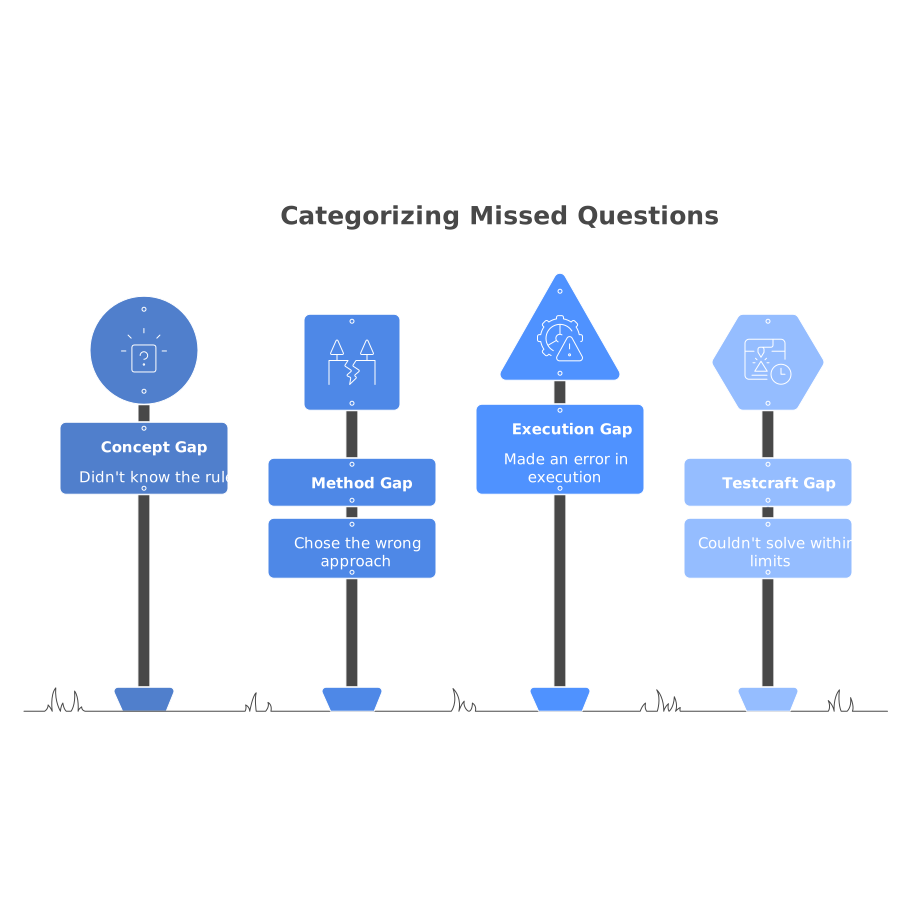
The audit works because it forces a single best explanation for the miss. If you find yourself listing five reasons, you haven’t isolated the bottleneck yet.
A practical template you can reuse for every review session
Copy this structure into a notes app or spreadsheet. One row per missed question.
- Question ID: source + section + number
- My wrong answer: and why it felt right
- One-sentence gap: the diagnosis
- Micro-skill card: Trigger / Procedure / Check
- Loop results: 3 similar questions score (e.g., 2/3 → revise card → 3/3 cold)
If you already track progress in an SAT app, the key is to keep your audit notes actionable. Analytics tell you what is weak; the explanation gap tells you why it stayed weak.
How to keep the system lightweight enough to stick
The best review system is the one you actually repeat. A few rules keep the Explanation Gap Audit from turning into a second homework assignment:
- Cap review time per miss: 6–8 minutes total unless it’s a foundational concept.
- Prefer small loops: close one gap fully rather than half-fixing five.
- Write fewer words: micro-skill cards should be scannable.
- Schedule re-checks: revisit the same skill in 3–7 days to confirm cold correctness.
There’s a useful parallel to how teams fix recurring issues in complex systems: you don’t just document what happened—you build a feedback loop that prevents the same class of failure from recurring. The same logic shows up in product and engineering workflows like building a feedback deduplication playbook, and it applies cleanly to SAT error patterns.
Where AI explanations and human help fit without becoming a crutch
Step-by-step explanations are valuable, but only when they feed a loop. Use them to locate the exact step you couldn’t generate. Then close the gap with micro-drills.
A good AI tutor experience can accelerate this because you can ask a targeted question like, “What trigger would tell me to use this approach?” or “What’s a fast check to avoid this algebra mistake?” And if a gap persists, asynchronous human tutoring can be the right escalation—especially for recurring Reading reasoning errors or Math setup confusion that needs a second set of eyes.
Tools like getsharp are most effective when you treat them as a practice-and-diagnosis engine: adaptive questions to expose the gap, explanations to pinpoint it, and a plan that keeps resurfacing the skill until it stays fixed.