Feedback Deduplication Playbook for Merging Requests Without Losing Segment Insight
A practical playbook to merge duplicate feature requests while preserving segment context for smarter prioritization.
By Casey
Why feedback deduplication fails in real product orgs
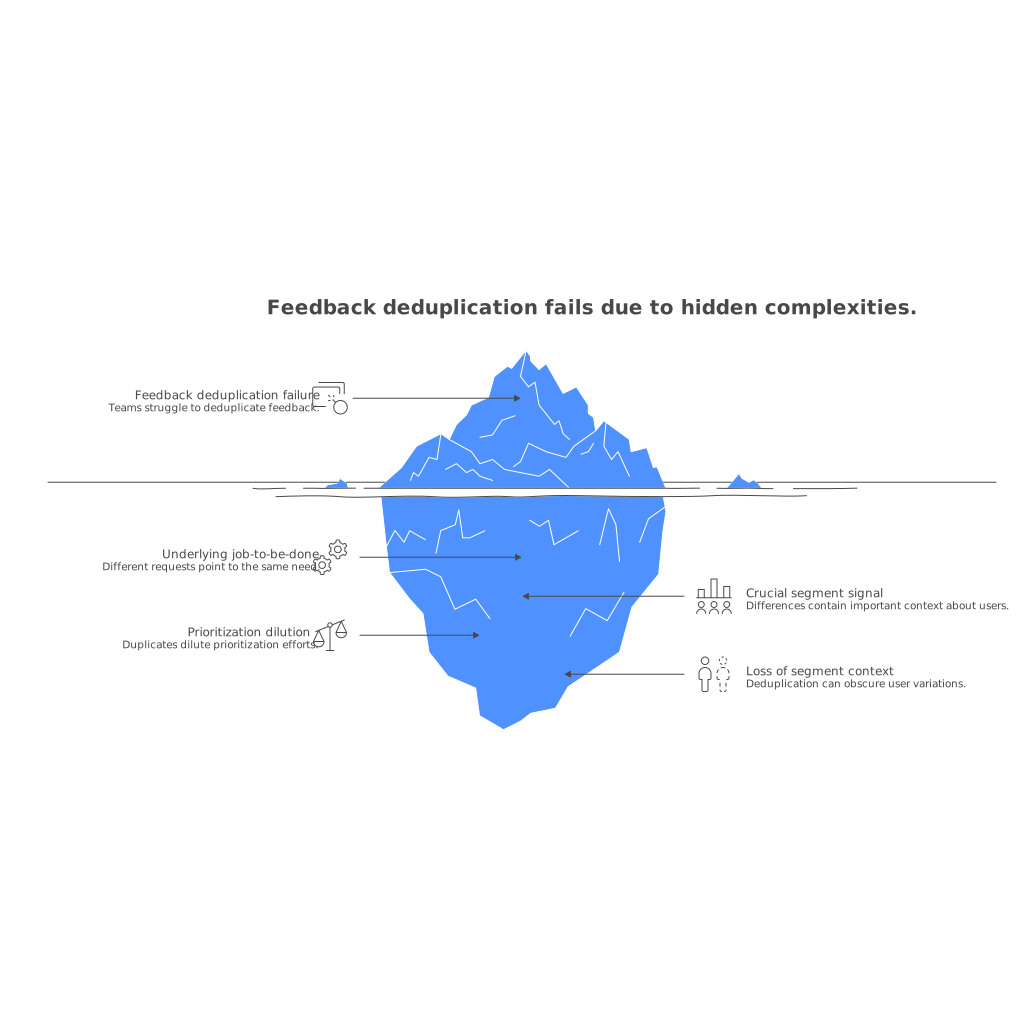
Most teams don’t struggle to collect feedback—they struggle to decide what’s actually being asked. The hard part is that “different” requests often point to the same underlying job-to-be-done, while the differences contain crucial segment signal: who is asking, how urgent it is, and what outcome they expect.
A useful deduplication playbook has two goals that can seem opposed:
- Merge requests into one decision unit so prioritization isn’t diluted across duplicates.
- Preserve segment context so you can still see variation by persona, plan tier, industry, region, revenue, or workflow maturity.
This is exactly the kind of workflow customer feedback platforms are built for. For example, canny.io helps teams centralize incoming requests, group duplicates, and analyze demand by customer segment and revenue impact—without turning everything into a single flattened “vote count.”
The decision unit model: one canonical request, many expressions
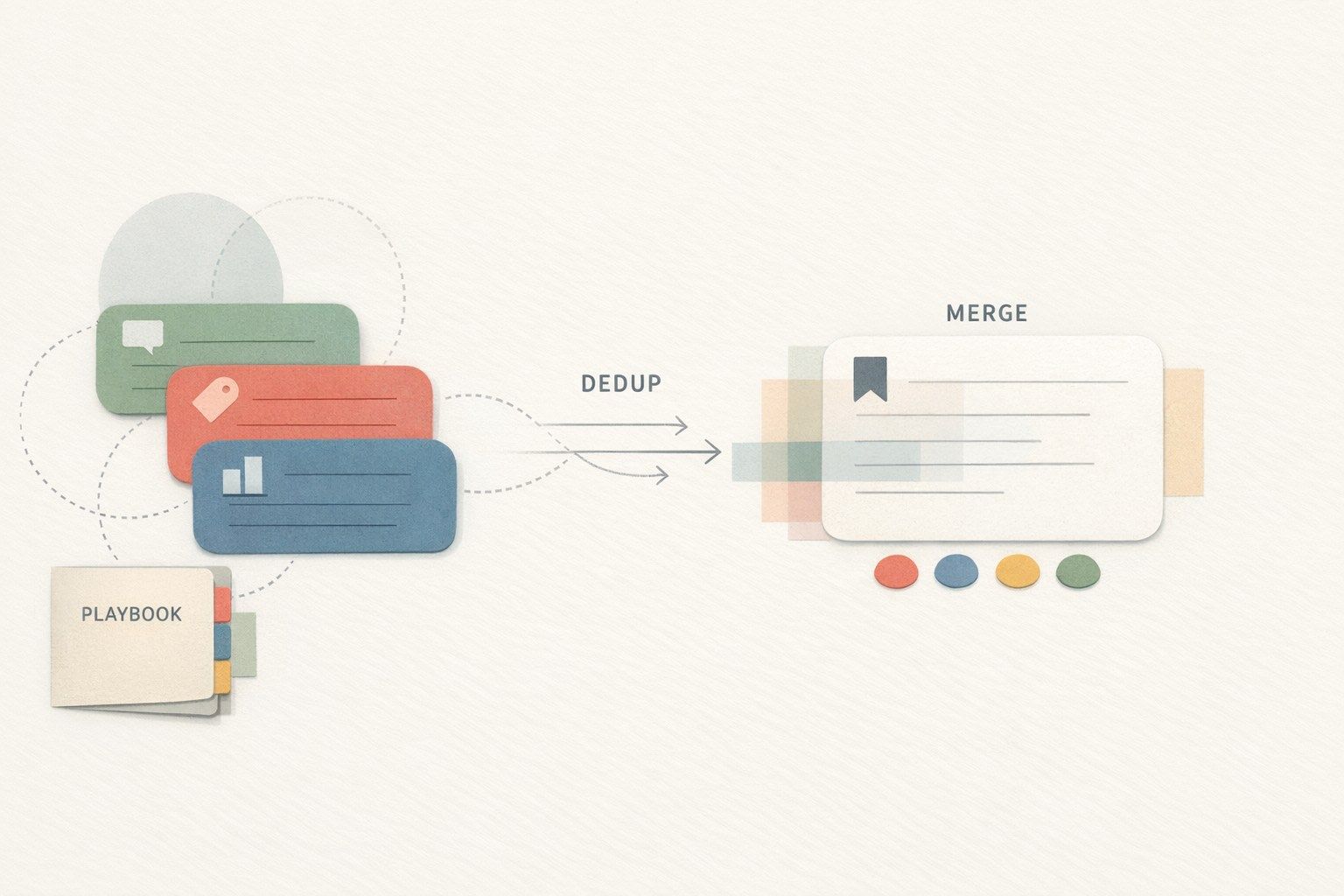
Deduplication works best when you define a canonical request as the thing you’ll ship (or intentionally not ship), and treat each incoming message as an expression of that request. In practice, that means:
- The canonical request has a stable title, description, acceptance boundaries, and success metric.
- Each expression keeps original wording, source channel (support, sales, portal, calls), and customer metadata.
This prevents a common failure mode: merging too aggressively and losing what the request means for different users. Two customers can want “Slack notifications,” but one needs auditability while another needs faster triage. The decision can still be one feature, but the design requirements differ.
Step-by-step feedback deduplication playbook
1) Normalize the raw input before you judge similarity
Start by cleaning what arrives. Normalize for:
- Language: remove greetings, signatures, and irrelevant context.
- Entities: product names, integrations, data objects, roles.
- Outcome statements: convert “it’s annoying” into “reduce manual follow-ups by notifying owners automatically.”
This is also the moment to enrich with metadata: plan tier, ARR, industry, user role, region, account health, and the workflow surface area (admin settings vs end-user UI). If you don’t attach metadata now, it’s easy to lose it later during merging.
2) Separate “feature name” from “job-to-be-done”
Many “different” requests collapse into one decision because they share the same underlying job. A lightweight way to do this is to tag each item twice:
- JTBD tag: the user outcome (e.g., “prevent missed handoffs”).
- Implementation tag: proposed solution (e.g., “Slack alerts,” “email digest,” “in-app mentions”).
Deduplicate primarily on JTBD, not on implementation. That’s how you avoid keeping three separate backlog items that all solve the same problem—and how you avoid prematurely locking to one solution because it was the loudest phrasing.
3) Choose a “primary” request based on stability, not popularity
When you find near-duplicates, pick a primary request that is:
- Stable: unlikely to be reworded every quarter.
- Broad: captures the core job without over-scoping.
- Actionable: can be translated into acceptance criteria.
Popularity (votes) should influence prioritization, but the canonical title shouldn’t be a marketing headline or a hyper-specific workaround. Your future self will thank you when you revisit the same decision months later.
4) Merge by mapping expressions to facets, not by deleting nuance
Instead of “closing” duplicates as if they were wrong, attach each expression to the canonical request and store its specific angle as facets such as:
- Persona (admin, operator, executive)
- Use case (triage speed, compliance, collaboration)
- Environment (mobile-only, enterprise SSO, regulated data)
- Trigger (new ticket, status change, escalation)
This is where segment signal lives. When the request gets merged correctly, you can still answer: “Which segment is driving this demand, and what design constraints come with it?”
5) Preserve segment signal with a segment-aware scoring view
A single score rarely tells the truth. Build a view that keeps the canonical request as one line item, but breaks impact down by segments. Useful dimensions:
- Revenue-weighted demand (ARR, pipeline, renewals)
- Strategic accounts (logo value, referenceability)
- Support load (ticket volume, time-to-resolution impact)
- Adoption upside (activation, retention, expansion)
Platforms like Canny support this kind of analysis by tying feedback to customers and attributes, so “one merged request” can still show “high urgency in mid-market fintech” and “low relevance for self-serve startups.”
6) Write a decision note that explicitly records what varies by segment
When you’re ready to prioritize (or deprioritize), write a short decision note on the canonical request with:
- What we believe the core job is
- Who needs it most (segments, roles, industries)
- Non-goals (what you are not solving yet)
- Open questions (where you still need validation)
This makes deduplication defensible. If a stakeholder later says “but customer X asked for something different,” you can show how their expression was captured and which facet it contributed.
Common merge patterns and how to handle them
Pattern A: Same outcome, different channels
Support tickets often describe pain; sales calls describe urgency; portal posts describe desired features. Treat them as expressions of the same canonical request, but store channel as a facet so you can see whether the demand is proactive (portal) or reactive (support incidents).
Pattern B: Same feature, different constraints
“Export to CSV” might mean “one-click export” for SMB and “scheduled, audited exports” for enterprise. Keep one canonical request if the job is “extract data reliably,” but capture constraints so the solution doesn’t overfit to the simplest segment.
Pattern C: Different features, one root cause
Users might ask for “notifications,” “assignments,” and “SLA reminders,” but the root cause is missed ownership and unclear handoffs. Deduplicate at the root cause level, then evaluate which interventions solve it best.
Operational tips for keeping deduplication healthy
- Set a dedupe cadence: daily light triage, weekly merge pass for high-volume sources.
- Use a merge threshold: only merge when you can name the shared job in one sentence.
- Audit merged clusters: sample the biggest clusters monthly and confirm they still belong together.
- Close the loop consistently: when the canonical request changes status, notify all attached expressions so customers feel heard even after merging.
If you need a companion workflow for routing and ownership, the internal guide on feedback triage and deduping product requests pairs well with this playbook.