The Feedback Confidence Interval Method to Validate Feature Demand Without Usage Data
Estimate true feature demand using feedback ranges, not raw request counts, when product usage data is unavailable.
By Casey
Why feature demand is hardest to validate when usage data is missing
Usage data is the cleanest way to validate demand: it tells you what people actually do. But many product teams don’t have it when decisions matter most. You might be shipping an early product without robust instrumentation, selling an enterprise workflow that lives in spreadsheets and emails, or evaluating a request that only appears in support escalations and sales calls.
In those moments, teams default to noisy proxies: “number of requests,” “how loud the customer is,” or “how senior the requester is.” Those signals are real, but they’re easy to misread—especially when the same underlying need is repeated across channels, or when silence is caused by friction rather than lack of interest.
The “Feedback Confidence Interval” is a practical way to replace gut feel with a structured estimate: not a single demand number, but a bounded range that reflects how confident you are that demand is real and broadly distributed.
What a Feedback Confidence Interval is
A Feedback Confidence Interval (FCI) is a range—low to high—representing plausible true demand for a feature, derived from feedback evidence rather than behavioral events. It forces you to answer two questions separately:
- Magnitude: How many distinct customers or accounts likely want this?
- Confidence: How reliable is the evidence that these are independent signals of the same need?
Instead of treating “23 requests” as a fact, you treat it as an observation with uncertainty. The interval narrows as you collect higher-quality confirmations and broadens when the data is sparse, duplicated, or biased toward a single channel.
Step 1: Normalize feedback into comparable “evidence units”
Feedback rarely arrives in a consistent format. A support ticket, a sales call note, a roadmap portal vote, and an executive email can all describe the same gap. To build a useful interval, you need to convert each piece into an evidence unit with consistent fields:
- Source (support, sales, portal, in-product, social, etc.)
- Requester identity (user, account, segment)
- Specificity (vague desire vs concrete workflow and success criteria)
- Urgency window (nice-to-have vs tied to renewal date or launch)
- Impact context (revenue at risk, time saved, compliance requirement)
Platforms like canny.io are designed for this normalization step: centralizing requests from multiple channels and making deduplication, segmentation, and impact context part of the daily workflow rather than an ad hoc spreadsheet.
Step 2: Deduplicate aggressively before you estimate demand
The biggest reason teams overestimate demand is duplication. One champion can create five “signals” across channels, and a single account can generate dozens of tickets. Your interval should be based on distinct demand, not message volume.
Start by merging evidence into a single canonical feature request. Then preserve the attributes that matter (segment, revenue, plan tier, industry, region) so you don’t lose context while deduping. If you want a deeper system for avoiding context loss, the approach in Feedback Deduplication Playbook for Merging Requests Without Losing Segment Insight is a useful companion to the interval method.
After deduplication, you should be able to answer: “How many unique accounts have expressed this need?” and “How many unique workflows are represented?” Those two numbers often diverge—and that divergence is itself part of uncertainty.
Step 3: Build your lower bound from “confirmed independent demand”
The lower bound is the conservative number you’re comfortable defending in a roadmap review. It should be based only on evidence that is both independent and specific. A simple rule set works well:
- Count unique accounts, not users, unless your product is purely individual-driven.
- Include only requests with a clear use case (what they’re trying to do and why current behavior fails).
- Require independence: separate accounts, or separate champions within the same account with distinct workflows.
This number is intentionally strict. It prevents “high excitement” from becoming “high confidence.” In practice, your lower bound is what you’d still believe if you discovered tomorrow that half your notes were duplicates or misunderstandings.
Step 4: Build your upper bound by accounting for underreporting
The upper bound answers: “If this request is real, how much latent demand could exist that we are not seeing?” Underreporting happens for predictable reasons:
- Friction: users don’t know where to request features or assume it won’t matter.
- Channel bias: only a subset of customers contact support or have active CSM coverage.
- Workarounds: teams tolerate pain with spreadsheets, manual steps, or internal scripts.
- Silence risk: unhappy users churn without ever filing a request.
To estimate the upper bound, expand from confirmed demand using segment coverage. For example, if 8 confirmed accounts in a segment of 80 have requested it—and your portal adoption in that segment is only 25%—it’s reasonable to treat “8” as a partial sample, not the full population. Your upper bound might reflect what demand could look like if the remaining 75% had equal opportunity to signal.
Keep this disciplined: the upper bound is not a fantasy number. It should be explainable with assumptions you can state plainly (coverage rates, channel penetration, and observed workaround prevalence).
Step 5: Score evidence quality to narrow or widen the interval
Two features can have the same number of requests and wildly different confidence. The interval width is your explicit acknowledgment of that.
Common quality multipliers that narrow the interval:
- Requests include reproducible steps and a clear “definition of done.”
- You see the same need across multiple channels (support + sales + portal), from different accounts.
- There is revenue or retention linkage (renewal risk, expansion dependency, procurement blocker).
Factors that widen the interval:
- Vague phrasing (“need better reporting”) without a workflow or decision context.
- Strong concentration in one account or one loud persona.
- Signals come from a single channel with known bias (e.g., only sales notes from one rep).
If you already use a confirmation workflow to turn vague requests into specific requirements, the method in The Feedback Handshake Workflow for Confirming Feature Requests directly improves FCI accuracy by turning weak evidence into strong evidence.
Step 6: Use the interval to decide what to do next
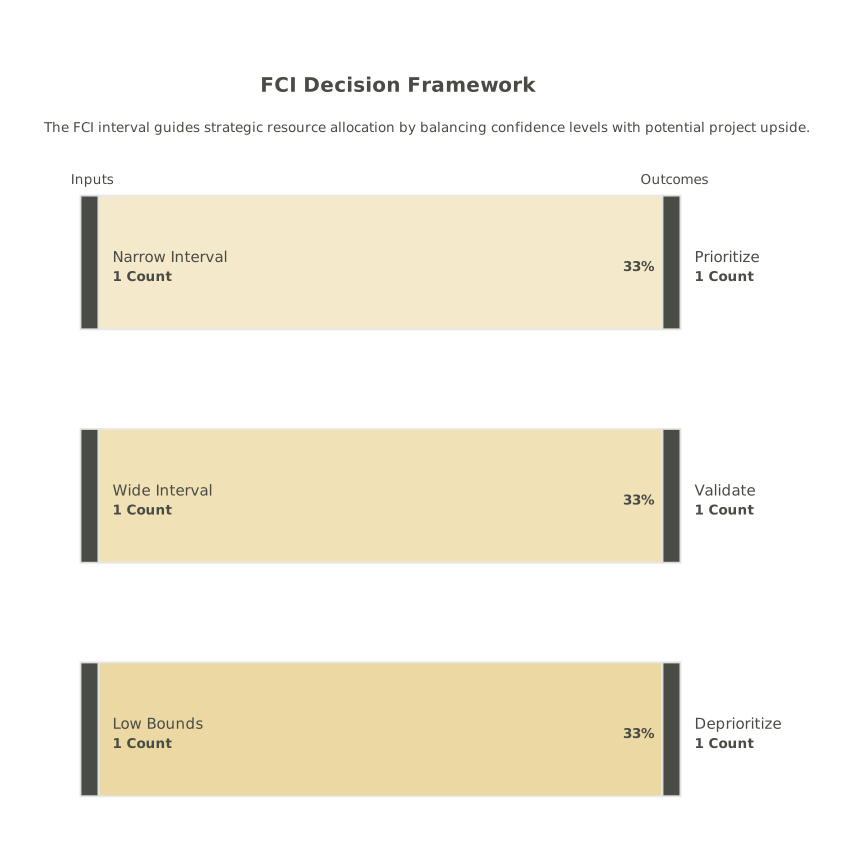
The point of an FCI isn’t to “be precise.” It’s to decide whether you should build, validate further, or deprioritize—without pretending your input data is cleaner than it is.
- Narrow interval, meaningful lower bound: prioritize confidently; define scope based on the dominant workflows.
- Wide interval, high upside: run targeted validation (customer interviews, lightweight prototypes, sales discovery scripts) to narrow it.
- Low lower bound and low upper bound: deprioritize; document why and what would change your mind.
FCI also improves stakeholder communication. Instead of debating anecdotal examples, you can share: “We have 12 confirmed independent accounts; given coverage, we estimate true demand is likely between 12 and 35, concentrated in mid-market fintech.” That’s a roadmap-ready statement even without product analytics.
Practical implementation tips for product teams
- Keep one canonical request per feature, with merged evidence and segment tags.
- Refresh the interval on a cadence (monthly or per planning cycle) so it doesn’t drift.
- Separate demand from solution: many requests are solution-shaped; your interval should track the underlying job-to-be-done.
- Log assumptions behind the upper bound (portal adoption, CSM coverage, support contact rate). When assumptions change, update the interval.
With a centralized feedback system, the mechanics become simpler: dedupe, segment, tie evidence to accounts and revenue context, then update the interval as new confirmations arrive. Over time, your intervals will become more accurate—and your roadmap discussions will become less about who shouted loudest and more about what the evidence supports.