Server-Side Tracking for Hotel and Restaurant Direct Bookings
Server-side tracking helps hotels and restaurants protect direct booking attribution despite iOS limits, blockers, and cookie loss.
By Casey
Why conversion attribution breaks for direct bookings
Hotels and restaurants depend on clean conversion data to understand which ads, emails, and listings drive direct bookings. The problem is that traditional browser-based pixels are increasingly unreliable. On iOS devices, Safari’s privacy features shorten cookie lifetimes and limit cross-site tracking. Ad blockers and privacy-focused browsers can prevent pixel scripts from loading at all. Even when a pixel loads, cookie limits and consent requirements can strip key identifiers before the conversion event fires.
For hospitality brands, the impact is practical, not theoretical: your ad platforms under-report bookings, your cost-per-acquisition looks worse than it is, and budget shifts toward channels that “track” rather than those that actually convert. Server-side tracking is the most dependable way to preserve attribution—without trying to fight user privacy choices.
What server-side tracking actually means
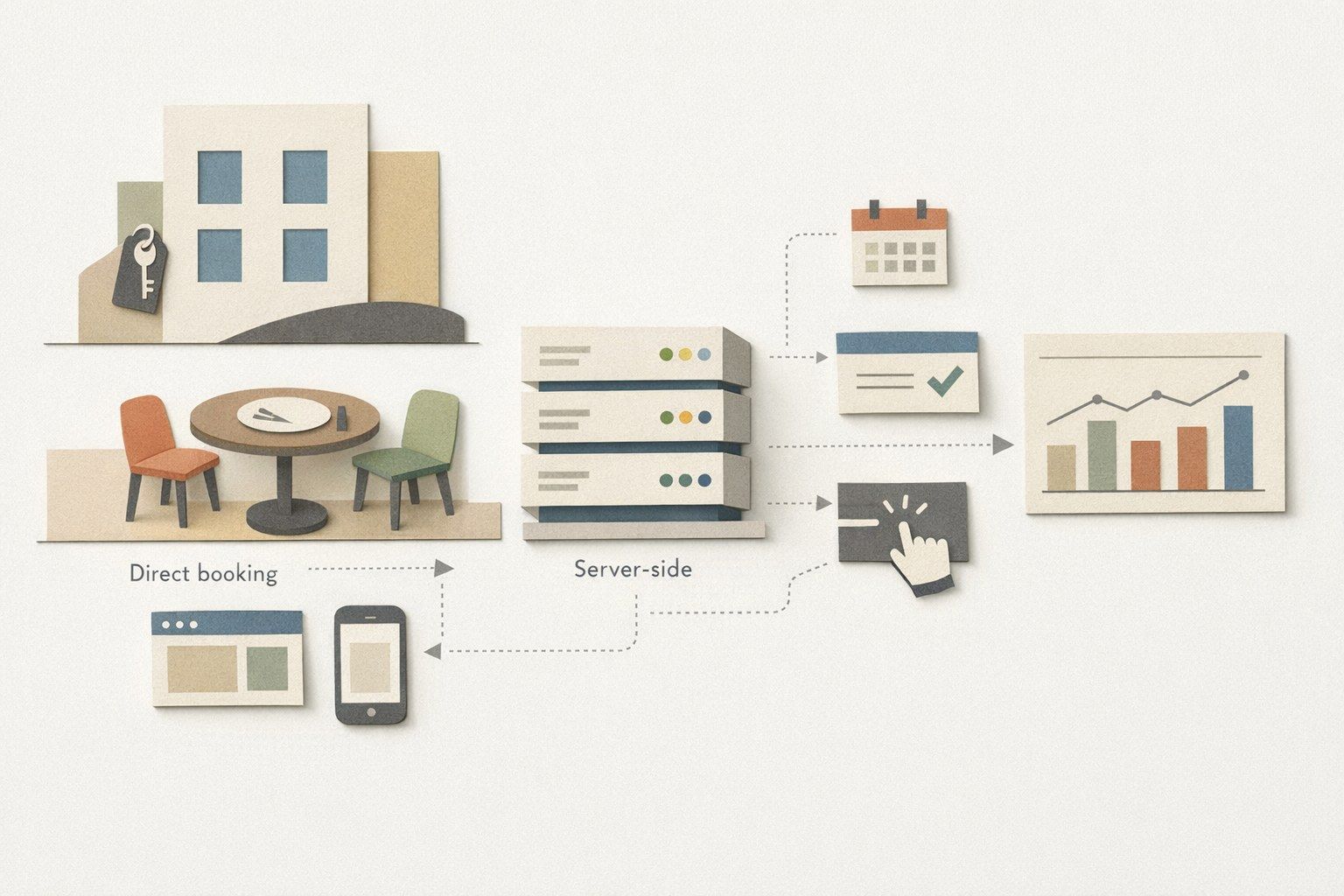
Server-side tracking moves part of the measurement workflow from the user’s browser to your infrastructure. Instead of relying solely on a browser pixel to send conversion details to ad platforms, your website and booking engine send events from the server after the conversion happens (or as key steps occur).
Done correctly, this doesn’t mean bypassing consent. It means:
- Collecting first-party data with clear consent and purpose
- Capturing conversion events reliably (even when scripts are blocked)
- Passing permitted identifiers and event metadata in a controlled way
- Keeping data quality high through deduplication and validation
Where hotels and restaurants lose attribution most often
1) “Hand-off” booking flows
Many brands send users from a marketing site to a third-party booking engine, ordering system, or gift card provider. The hand-off can break the session chain, especially if the booking engine is on another domain or uses restrictive cookie settings. By the time the confirmation page loads, the pixel may not have the identifiers needed to match the conversion to the click.
2) iOS Safari cookie limitations
Safari’s tracking prevention reduces the time window in which browser cookies can link an ad click to a purchase. If a guest clicks an ad today and books next week, the browser pixel often can’t attribute it. Server-side workflows can still record the conversion and send event data with first-party identifiers when allowed.
3) Ad blockers and script failures
If the pixel script never loads, the conversion never gets recorded. Server-side events are less dependent on the browser’s ability (or willingness) to run third-party JavaScript.
A practical server-side tracking architecture for direct bookings
The best setups for hospitality are simple enough to maintain, but strict enough to avoid duplicate or noisy data. A typical architecture looks like this:
- Client event (optional but useful): a browser event captures click IDs and basic page context.
- First-party storage: click IDs and session metadata stored in first-party cookies or local storage when consent is granted.
- Server event (primary): your server sends a purchase/booking confirmation event to ad platforms via their server APIs.
- Deduplication logic: one conversion is counted once, even if both browser and server events fire.
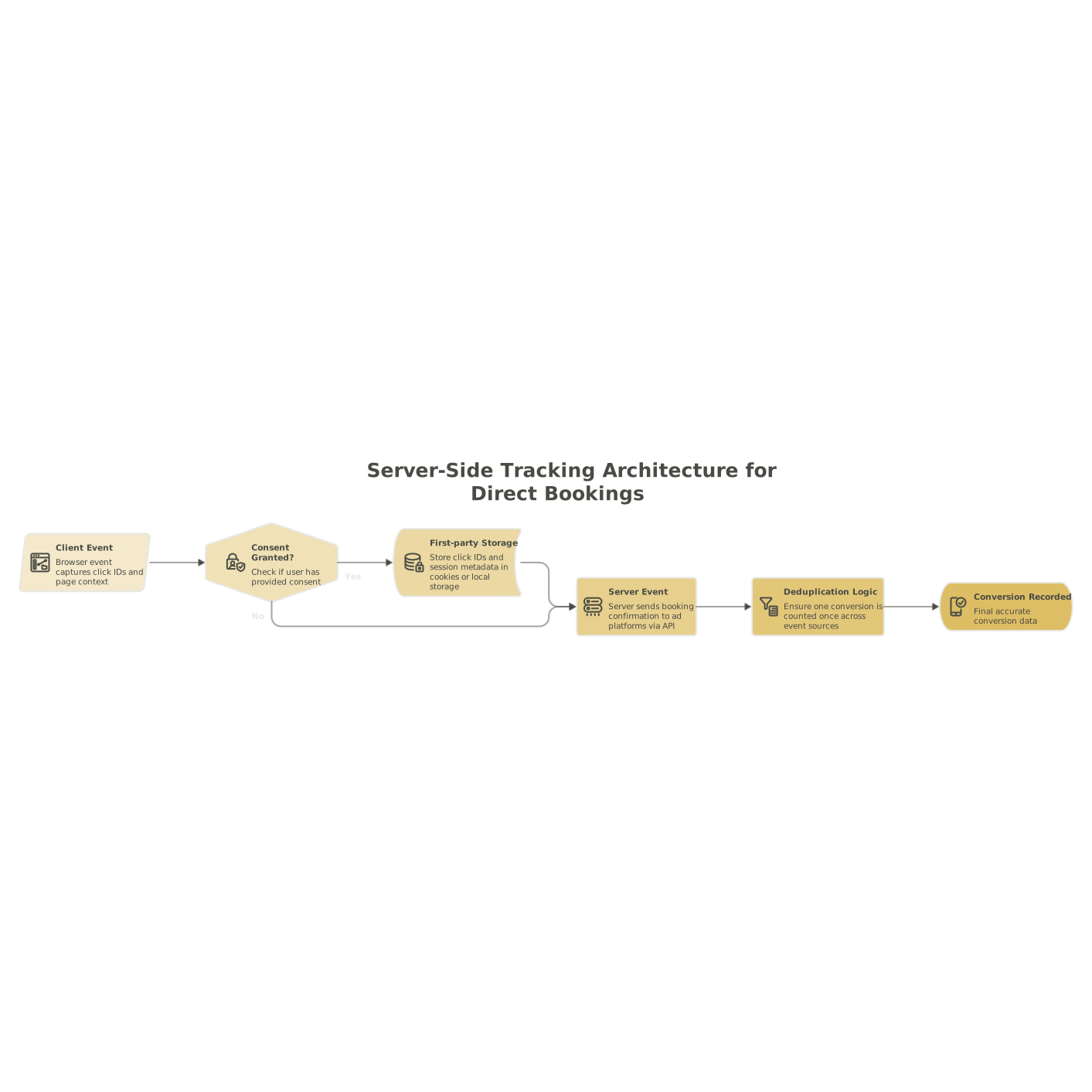
This “hybrid” approach typically yields the best match rates: the browser is used to capture click parameters, and the server is used to guarantee delivery of the conversion event.
Key identifiers that preserve attribution (without over-collecting)
Attribution depends on matching a conversion to a prior ad interaction. In direct booking contexts, the most useful signals are:
- Click identifiers: platform-specific click IDs captured from landing URL parameters and stored first-party.
- Event IDs: a unique ID per conversion to support deduplication between browser and server.
- First-party customer data (with consent): email or phone (typically hashed before sending) improves matching, especially for longer booking windows.
- Booking metadata: value, currency, check-in date, party size, reservation time slot, and location (when relevant).
For restaurants, consider modeling outcomes beyond “purchase” if it fits your operation: reservation confirmation, private dining inquiry submission, or gift card purchase. For hotels, distinguish between quote, availability check, and completed booking if you want better funnel diagnostics.
Deduplication and data quality controls
Server-side tracking can improve accuracy, but it can also inflate numbers if implemented carelessly. The two essentials are:
- Event deduplication: ensure the same conversion isn’t counted twice when both client and server send it. Use consistent event IDs across both.
- Validation and logging: log what you send (timestamp, event name, value, identifiers present) so you can troubleshoot match rate changes after site updates.
To keep reporting credible, establish a small “truth set”: compare bookings in your PMS/ordering platform against tracked conversions weekly, not just in the ad dashboard.
Consent, privacy, and hospitality-specific considerations
Server-side does not remove your responsibility to honor consent choices. If a guest declines marketing cookies, you should still be able to measure essential site performance, but you should not send marketing identifiers that rely on consent. The advantage of server-side is governance: you can centralize rules about what gets collected and transmitted.
Hospitality sites also face operational realities: multiple properties, seasonal campaigns, and frequent landing page changes. Treat tracking like production infrastructure. Version it, test it, and document it.
Implementation options that fit most hospitality teams
You can implement server-side tracking in several ways depending on your stack and resources:
- Tag management with server-side container: good when marketing teams need agility but engineering support is limited.
- Direct server-to-server integrations: best for performance and control when your booking engine or backend can emit conversion events reliably.
- CDP-style pipelines: useful for larger groups that want unified identity and multi-property reporting.
Whatever the approach, the goal stays the same: capture click context early, confirm the conversion at the server, and send a clean event with consistent identifiers.
How KiksMedia fits into a tracking modernization plan
Many hospitality organizations don’t need a complex data platform—they need a durable setup that survives iOS changes, ad blockers, and vendor hand-offs. KiksMedia’s hospitality background and performance-first website work make it a practical partner when the solution requires both marketing context and technical execution. If you’re rebuilding your booking funnel for speed and conversion while upgrading measurement, it’s worth aligning the implementation with a team that treats tracking as part of the site’s core UX and infrastructure, not a bolt-on script. More details are available at kiksmedia.com.
A simple checklist before you ship
- Confirm you can store click IDs first-party (only when consent permits)
- Define a single conversion source of truth (booking confirmation)
- Implement event IDs and deduplication from day one
- Log events server-side for auditing and debugging
- Run a booking-to-dashboard reconciliation every week for the first month
When browser pixels become unreliable, attribution doesn’t have to disappear. A careful server-side design preserves measurement where it matters most: on confirmed direct bookings.