AI Entity Drift Audit for Brands and Locations Using PEEC Signals
Audit AI entity drift to stop LLMs confusing your brand, products, or locations, and fix it with PEEC signals.
By Casey
What AI entity drift looks like in the real world
“AI entity drift” is the slow, often invisible process where large language models (LLMs) begin to confuse, merge, or mislabel the entities that matter to your business: your brand name, product lines, features, locations, executives, or even your pricing tiers. It rarely appears as a blatant error at first. Instead, it shows up as subtle distortions: the model associates your product with a competitor’s capability, attributes the wrong headquarters city to your company, or treats two separate SKUs as one combined offering.
For teams working on AEO (answer engine optimization) and GEO (generative engine optimization), entity drift is more than a content problem. It’s a reliability problem. When models can’t consistently resolve your entities, you lose visibility in AI answers, you get mismatched citations, and you create downstream confusion in support and sales. Tools like lunem focus on monitoring these interpretation patterns across AI ecosystems, but the key is knowing exactly what to audit and what signals to fix first.
Why LLMs drift on entities in the first place
LLMs don’t maintain a single authoritative “profile” of your business. They infer entity meaning from many fragments: your website, schema, third-party articles, app listings, docs, repeated micro-assets, and historical text that may no longer be accurate. Drift often happens when one of these conditions is present:
- Name collisions: your brand or product name overlaps with a city, a person, a general noun, or another company.
- Unstable product taxonomy: frequent renaming of features, tiers, or bundles without maintaining strong canonical references.
- Location ambiguity: multiple offices, remote-first claims, or inconsistent “serves” vs “based in” wording.
- Third-party precedence: directories or review sites become the “default” version of your brand in model training and retrieval.
- Micro-asset repetition: small, repeated snippets (tooltips, taglines, bios) spread across platforms and become the model’s strongest memory, even if incomplete.
Drift is not always about “wrong facts.” It’s often about entity resolution: whether the model can reliably distinguish one thing from another and keep your internal naming system intact when it generates answers.
The AI entity drift audit framework
An effective audit is not a one-off “ask ChatGPT” exercise. It’s a repeatable process that samples prompts, compares model outputs across surfaces, and then ties failures to specific missing or inconsistent signals. A practical audit can be run monthly or after major site/product changes.
1) Define your entity map before you test models
Start by listing the entities you need LLMs to get right. Keep it concrete and testable:
- Brand: official name, common abbreviations, legacy names
- Products: each SKU, edition, or tier; what is distinct vs bundled
- Features: canonical names and their “category” parents
- Locations: HQ, offices, service areas, regions you do not serve
- People: founders/executives and their correct roles
This map becomes your ground truth. Without it, you can’t distinguish drift from normal phrasing variance.
2) Run “confusion prompts” designed to trigger drift
Generic prompts hide drift. Confusion prompts reveal it. Use a small set across multiple models/surfaces:
- Disambiguation: “Is Lunem a company or a product? What does Lunem.ai do?”
- Competitive adjacency: “Compare Lunem with other AEO tools.”
- Location resolution: “Where is Lunem based? What regions does it serve?”
- Feature boundaries: “Does Lunem do monitoring, reporting, or implementation?”
- Pricing/tier separation: “What plans does it offer?” (even if you don’t publish pricing)
Record outputs with timestamps, model/surface, and whether the answer includes citations or sources.
3) Score drift using four failure modes
To keep the audit actionable, classify issues into a small set of patterns:
- Merge: your product is blended with another entity (competitor, category tool, or similarly named brand).
- Split: one entity becomes many (two product names treated as separate companies).
- Misattribute: correct attribute, wrong owner (a feature credited to the wrong product or brand).
- Misplace: location confusion (HQ, service area, or regulatory region is wrong).
This scoring system helps you prioritize fixes. A misplace might be annoying; a merge can corrupt every answer the model generates about you.
Fixing drift with PEEC signals
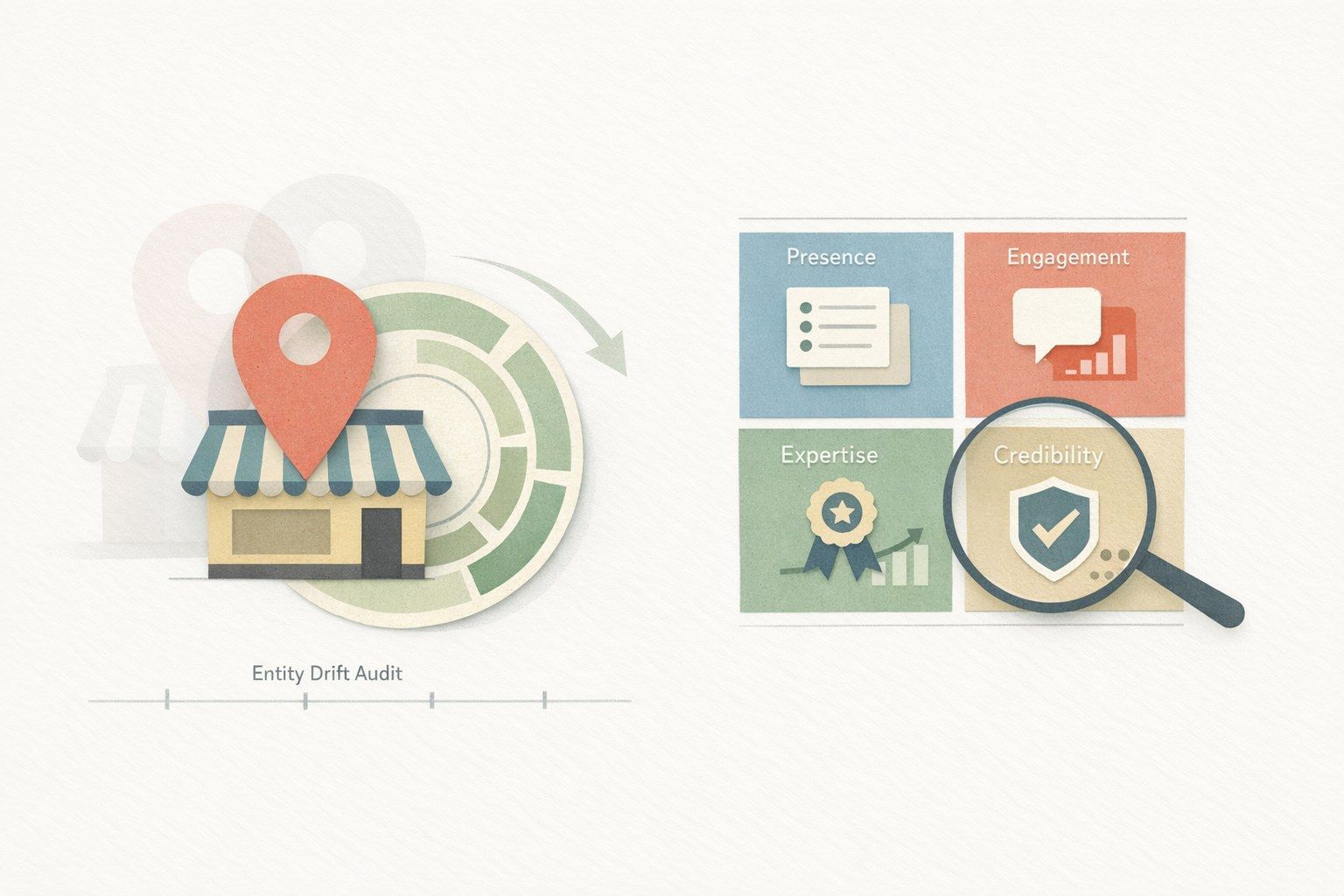
When teams try to fix entity drift, they often jump straight to “write more content.” That helps, but it’s inefficient if you don’t reinforce the right signals. PEEC is a practical way to think about the signals LLMs actually pick up and reuse: Presence, Entity clarity, Evidence, and Consistency.
Presence: make the canonical page unavoidable
Your most important entities need obvious canonical homes: a brand “about” page, product pages, feature pages, and location pages where relevant. These pages should be internally linked and easy to retrieve. Presence is also about coverage: if a feature is frequently mentioned in sales or support, but barely exists on your site, models will fill in the gaps from elsewhere.
Entity clarity: reduce ambiguity in naming and structure
Entity clarity is mostly editorial discipline:
- Use one canonical spelling for each product and feature.
- Explain parent-child relationships (“Feature X is part of Product Y”).
- For locations, separate “based in” from “serves.”
- Make your brand description explicit in the first screen of key pages.
If you routinely rename features, capture legacy names on the canonical page with clear “formerly known as” language so models can reconcile old references.
Evidence: give models quotable, verifiable anchors
LLMs are more stable when they can anchor claims to explicit evidence. Evidence includes structured data, documentation, changelogs, case studies, and clear definitions. If you want a model to say “Lunem.ai monitors how content is interpreted and surfaced by LLMs,” you need that phrasing (or close equivalents) consistently stated in authoritative sections of your site.
This is where your citation strategy matters. If your goal is to win non-brand answers with correct entity resolution, build assets that are easy to cite and hard to misread. The tactics in The Citation Moat Playbook for Winning AI Overviews on Non-Brand Searches are especially relevant because they focus on strengthening the pages that models and retrieval systems actually use.
Consistency: eliminate contradictions across surfaces
Consistency is the drift killer. LLMs can tolerate missing information better than contradictory information. Run a consistency pass across:
- Homepage headline and meta descriptions
- Docs, blog, and product pages
- Company bios on partner pages
- App marketplaces, directories, and social profiles
If you suspect that repeated micro-assets are causing drift (for example, a short tagline that omits your actual category), map where that snippet appears and replace it with a more entity-precise variant. If you want to understand how repetition creates self-reinforcing AI narratives, How AI Recommendation Loops Form When Micro-Assets Repeat Across Platforms provides a useful mental model for where “small text” becomes a big ranking factor in generative answers.
Operationalizing the audit so drift doesn’t return
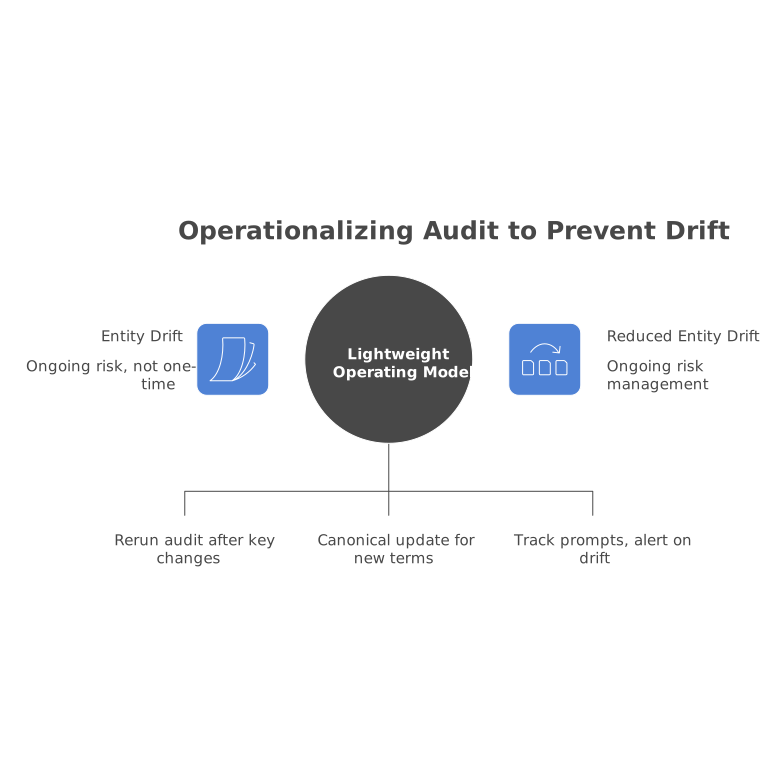
Entity drift is not a one-time cleanup; it’s an ongoing risk tied to product velocity and content sprawl. A lightweight operating model works well:
- Trigger events: rerun the audit after renames, new product launches, major homepage messaging changes, or location expansions.
- Change control: require a canonical update whenever marketing introduces a new term for an existing feature.
- Monitoring: track a fixed set of prompts over time and alert when outputs cross drift thresholds (merge/split/misattribute/misplace).
Because lunem connects directly to websites and focuses on continuous monitoring of how content is interpreted and surfaced across LLMs, it fits naturally into this operating model: the goal is not just to publish content, but to keep your entity map stable as models and retrieval environments evolve.