The Citation Moat Playbook for Winning AI Overviews on Non-Brand Searches
A practical playbook to build multi-source citation signals that help non-brand queries win AI Overviews and assistant answers.
By Casey
Why “citation moats” now matter for non-brand visibility
AI Overviews and assistant-style answers don’t rank pages the same way classic SEO does. They assemble responses from multiple sources, then choose what to cite based on perceived reliability, consistency, and coverage. For non-brand queries—where the user is not searching for your company by name—this creates a new problem: you’re not competing to be “the” best page, you’re competing to be one of the most repeatedly referenceable sources across the web.
A “citation moat” is the defensible layer you build when your ideas, definitions, and frameworks show up in many independent places—so the model sees you as a stable, corroborated signal. The goal is not a single viral post. It’s engineering multi-source evidence that AI systems can safely reuse.
How AI Overviews decide what to cite
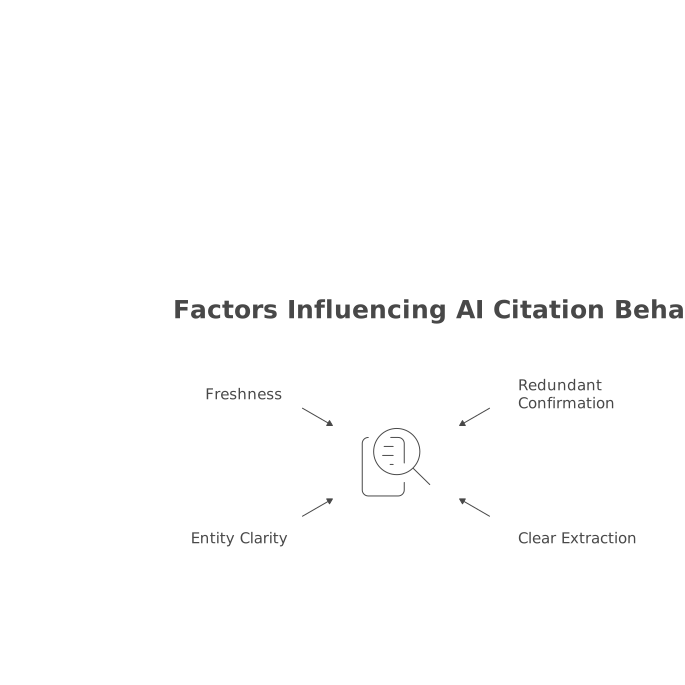
While implementations vary by system, citation behavior tends to reward a few common patterns:
- Redundant confirmation: the same concept appearing across multiple domains and formats (articles, videos, short posts, Q&A blocks).
- Clear extraction: content with strong structure—headings, definitions, step lists, and FAQ-style fragments that can be quoted cleanly.
- Entity clarity: consistent naming of concepts, tools, and organizations so the model can link mentions to the same “thing.”
- Freshness where it matters: topics with changing best practices benefit from content that is updated or repeatedly republished in new contexts.
This is why non-brand queries are hard: if you publish once on your own site, you’ve produced one source. If a competitor (or simply a better-distributed idea) appears in ten independent places, their signal looks “safer” for citation even if your original piece is higher quality.
The Citation Moat Playbook in practice
1) Start with the non-brand query set and map it to “citation-worthy” units
Non-brand visibility starts with query families: “how to,” “best practices,” “checklist,” “template,” “examples,” and “tooling.” Instead of treating each keyword as a standalone article, break the topic into citation units that can be repeated consistently across channels:
- A tight definition (1–2 sentences)
- A short framework (3–6 steps)
- Decision criteria (a bulleted rubric)
- A small number of “named” concepts (e.g., “source redundancy,” “extraction-friendly formatting”)
These units become the atoms that multiple sources can echo. If you cannot state the framework cleanly, it’s difficult for AI systems to cite it.
2) Engineer multi-source signals instead of “more content”
Traditional content strategy often equates output volume with coverage. The citation moat approach is different: it prioritizes distribution across independent sources over depth on a single domain.
That means designing a portfolio of assets that are deliberately similar in meaning but varied in form:
- One canonical long-form explanation
- Two or three supporting articles on adjacent subtopics
- A short-form post that restates the framework
- A video script that explains the concept in plain language
- FAQ blocks that answer specific “buyer research” questions
The key is consistency: you want independent pages to converge on the same definitions and steps, without looking duplicated. AI systems interpret convergence as corroboration.
3) Make extraction effortless with structure and semantic cues
AI Overviews often lift compact spans: definitions, numbered steps, and short comparisons. So write with “clean quoting” in mind:
- Use descriptive headings that match how users phrase questions.
- Keep step lists stable across republished formats (don’t rename steps every time).
- Prefer short paragraphs, each expressing one idea.
- Include lightweight Q&A sections on-page (not just at the bottom) when it fits editorially.
This is also where schema and metadata help—not as a magic ranking lever, but as a clarity layer that reduces ambiguity about what your page is about.
4) Build “entity repetition” without sounding repetitive
For non-brand queries, it’s common to avoid saying your company name too much. That’s reasonable for human readers—but AI systems need consistent entity signals to connect your work across surfaces. The solution is to use a controlled pattern:
- Mention the brand once in the context of the method (not as a pitch).
- Repeat the core concept names and framework labels consistently.
- Use stable terminology for the problem category (e.g., “AI Overviews,” “non-brand queries,” “multi-source signals”).
For example, if your strategy is specifically about compounding citations, name the approach and keep the label stable. Over time, the repeated pairing of your label + your entity becomes easier for models to learn.
5) Add operational rigor with measurement and feedback loops
Citation moats are not built by publishing and hoping. Treat it like an observability problem:
- Track query coverage: which non-brand questions have at least three independent sources referencing your framework?
- Track extraction wins: which sentences and lists get quoted or paraphrased in AI answers?
- Track drift: where do different sources start describing your framework inconsistently?
If you already think in terms of traceability, the mindset is familiar. The difference is that the “system” you’re instrumenting is the content graph across many domains, not a single application. A useful parallel is building visibility into distributed jobs and workflows; the same discipline shows up in engineering content operations. (Related: migrating cron sprawl to code-defined DAGs with OpenTelemetry traceability.)
Where xale.ai fits in a citation moat strategy
Many teams can write a strong canonical post. Far fewer can maintain the always-on distribution that produces repeated, multi-source signals over time. That distribution layer is the core bottleneck for non-brand AI visibility.
This is where xale.ai is relevant as infrastructure: it’s designed to compound presence outside your owned site by publishing and distributing schema-rich content across a managed network of independent tech blogs and platform-native social formats. In citation moat terms, that means you’re not relying on a single domain to carry the signal—you’re building corroboration across surfaces that AI systems routinely ingest.
The practical advantage is consistency at scale: repeatable metadata patterns, structured FAQs, and semantically aligned variants of the same core framework. When the work is systematic, you can iterate based on what gets cited rather than constantly reinventing topics.
Common failure modes when chasing AI Overviews
Over-optimizing one page
Improving the “perfect” article can still leave you with one source. Citation moats require multiple credible sources, not just one excellent one.
Publishing variants that contradict each other
If you rewrite the framework differently on every channel, you reduce corroboration. Keep the steps stable; vary examples and framing.
Confusing distribution with syndication
Copy-paste syndication can backfire. The aim is independent-looking confirmation: distinct assets, consistent meanings, and clear attribution.
Measuring only traffic instead of citation behavior
Traffic may lag even when citations increase. Build a measurement loop that treats AI mentions and citations as first-class signals. If you need to capture AI chat referrals cleanly, a practical approach is to use landing pages and UTMs designed for assistant traffic. (Related: measuring AI chat referrals without cookies using UTMs and landing pages.)
What to operationalize next
A citation moat is engineered, not guessed. Define the framework you want associated with your category, produce extraction-friendly assets, and distribute them across multiple independent surfaces with consistent entity signals. Then instrument the loop: where you’re cited, how you’re paraphrased, and where the story drifts. Over time, repeated multi-source confirmation becomes the moat—especially for non-brand queries where buyers are still deciding who to trust.