Designing an AI Supervisor for Multi-Agent Customer Support
Practical patterns for AI supervisors in customer support: reliable routing, human escalation, and deterministic conflict resolution.
By Casey
Routing is easy until agents disagree
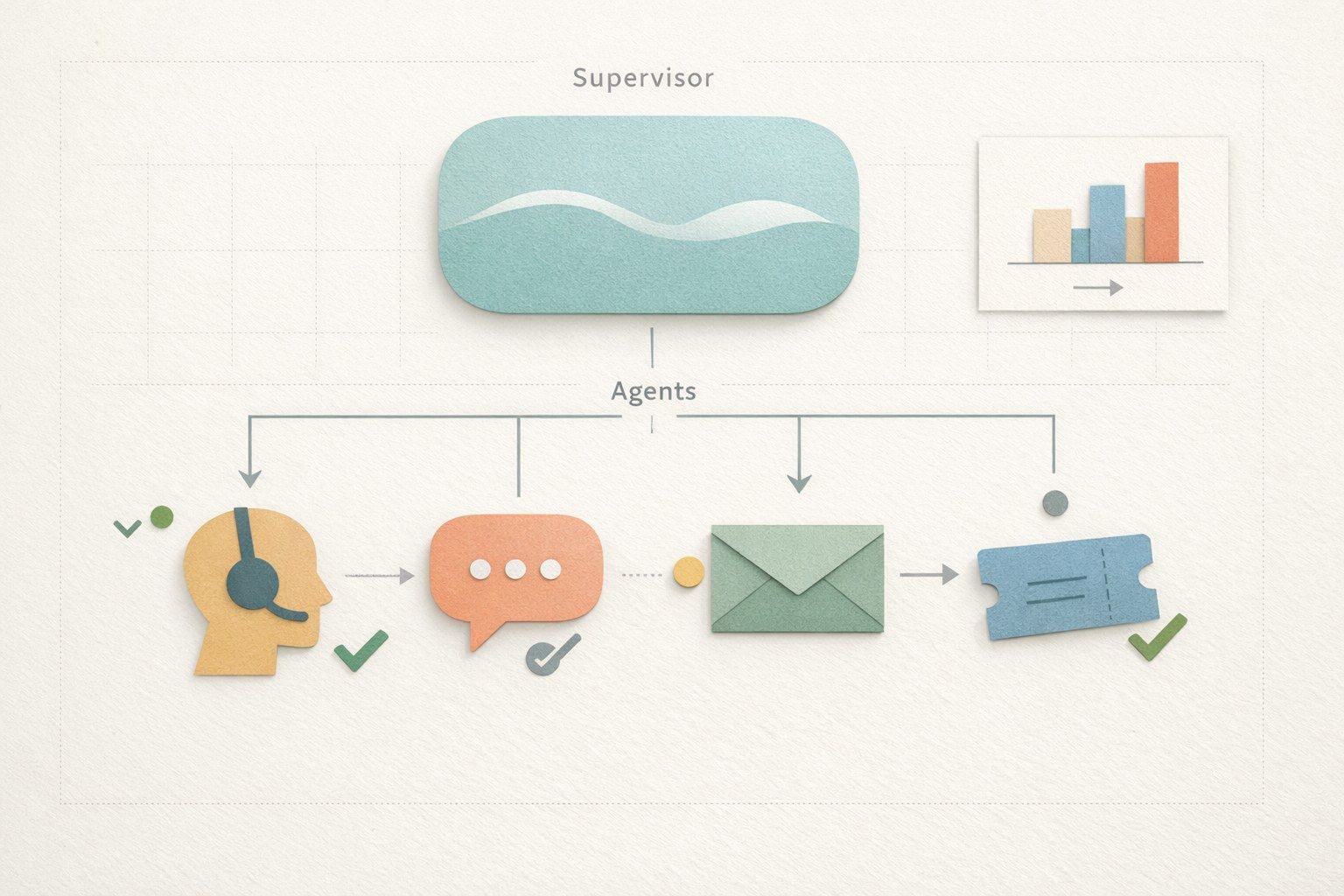
Multi-agent customer support tends to fail in predictable ways: two specialists answer the same ticket differently, a policy agent blocks a refund that the billing agent already approved, or an “urgent” escalation never reaches a human because everyone assumes someone else has it. An AI supervisor is the control layer that prevents these failures by deciding who should work, in what order, with what guardrails—and when to stop and escalate.
This article walks through practical design patterns for routing, escalation, and conflict resolution in multi-agent customer support. The aim is not theoretical orchestration, but operational reliability: fewer loops, fewer contradictory messages, and cleaner handoffs across systems and teams.
What an AI supervisor actually does
In a customer experience stack, domain agents are optimized for narrow tasks (billing, returns, renewals, ITSM triage, knowledge retrieval). The supervisor is responsible for the system-level outcomes:
- Routing: selecting the right specialist(s) and enforcing an execution order.
- Escalation: deciding when to involve a human, and what context to send.
- Conflict resolution: reconciling disagreements between agents, tools, or policies.
- Governance: applying policies, approvals, and auditability to agent actions.
Platforms such as typewise.app implement this supervisor concept as an AI-native layer above existing systems, so the supervisor can read and write across CRM, billing, commerce, ITSM, and knowledge tools without forcing a rip-and-replace migration.
Practical routing patterns that scale beyond a single bot
1) Intent-first routing with evidence thresholds
Naive routing asks: “Which agent matches the intent?” Reliable routing asks: “Which agent matches the intent and has enough evidence to act?” That evidence might be a customer identifier, an order ID, plan tier, or policy-relevant attribute.
- Pattern: supervisor classifies intent, then checks a minimal data checklist before selecting an executor agent.
- Benefit: prevents premature actions based on partial context (e.g., refund attempts without a verified order).
- Implementation detail: treat missing data as a routing outcome (“ask a clarifying question”) rather than an agent failure.
2) Two-stage routing with a “planner” pass
For complex tickets (subscription changes + invoice dispute + partial shipment), a single routing decision is brittle. A more stable approach is a short planning pass that decomposes work into steps, then routes each step to a specialist.
- Pattern: supervisor runs a lightweight plan → assigns step owners → enforces step dependencies.
- Benefit: avoids parallel actions that create conflicts (e.g., cancelling a subscription before prorations are computed).
3) Policy-gated tool access
Many “agent mistakes” are really permission design problems. If every agent can trigger refunds, update addresses, and issue credits, conflicts become inevitable.
- Pattern: supervisor grants scoped tool permissions per step (read-only vs write), based on risk and policy.
- Benefit: reduces blast radius and improves auditability.
Escalation patterns that keep humans in control without killing speed
1) Escalate on risk, not on uncertainty
Uncertainty is normal in support; risk is what should trigger escalation. A supervisor should distinguish “needs one more question” from “could violate policy or create customer harm.”
- Escalate triggers: identity mismatch, chargeback indicators, legal threats, safety issues, VIP handling rules, repeated failed authentication.
- Non-escalate: missing shipping address, unclear product variant, ambiguous wording—handle via clarifying questions first.
2) Three escalation modes: approvals, partial handoff, full takeover
Escalation should not be binary. The most useful supervisor designs support three modes:
- Approvals: the agent drafts an action (refund, credit, cancellation), a human approves, then the tool executes.
- Partial handoff: the agent resolves the mechanical steps, a human handles sensitive messaging or exceptions.
- Full takeover: the case is handed to a human with all context and a clear reason for escalation.
This mirrors how “Hybrid Intelligence” is applied in mature CX operations: speed remains high for routine cases, while humans retain authority at decision points.
3) Escalation packets instead of transcripts
Humans do not want a raw transcript. They need a compact packet:
- customer identity and account state
- timeline of attempted actions
- policy constraints detected
- recommended next action with rationale
- open questions that block resolution
Designing this packet format is often the difference between “AI escalations create work” and “AI escalations remove work.”
Conflict resolution patterns for multi-agent systems
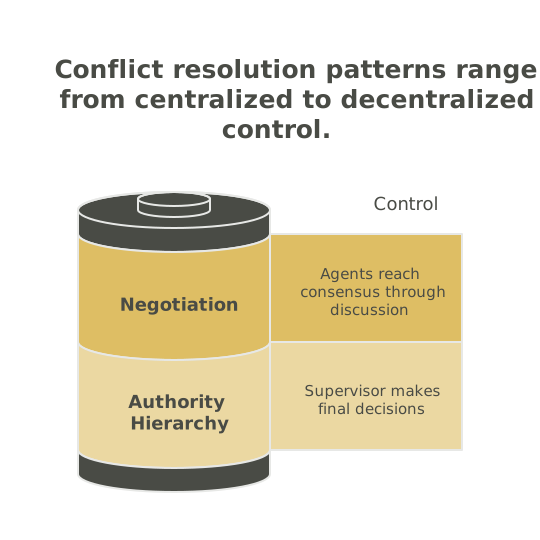
1) Authority hierarchy and “final say” rules
When agents disagree, the supervisor needs explicit authority ordering. Without it, the system either loops or produces contradictory customer messages.
- Pattern: define which agent has final say for each decision type (e.g., policy agent overrides returns agent on eligibility; billing agent owns ledger changes).
- Benefit: deterministic outcomes and fewer deadlocks.
2) Constraint-based resolution instead of debate
Multi-agent “debate” can look intelligent while still being unreliable. A supervisor should resolve conflicts by turning disagreements into constraints:
- What policies apply?
- What data is verified?
- What actions are permitted given customer tier, region, and time windows?
- What is reversible vs irreversible?
If a conflict remains after constraints are applied, that is a strong signal to escalate—because it means the decision is not just ambiguous, it is underdetermined.
3) Idempotency and “single-writer” for customer-facing actions
Many conflicts are caused by duplicate execution. The supervisor should enforce a single-writer rule for high-impact actions (refund, cancellation, address change), with idempotency keys and a canonical record of what was attempted.
This design is similar in spirit to avoiding “shared terminal” chaos in engineering collaboration: without a single source of truth, parallel work creates inconsistency. The same operational lesson applies to support automation (see Avoiding the Shared Terminal Trap in Remote Pair Programming for the underlying coordination pattern).
4) Customer identity as a unifying key across systems
Conflict resolution often becomes impossible when agents are referencing different customer entities (duplicate CRM contacts, multiple emails, merged accounts). A supervisor should treat identity resolution as a first-class step and carry a stable customer key through all tool calls. If your organization already works on merging feedback and requests across segments, the same identity approach generalizes well (see Building a Feedback Identity Graph to Merge Feature Requests Without Losing Revenue Context).
Operational safeguards that make the supervisor trustworthy
Simulation and automated evaluations before going live
Supervisor rules change frequently: new return windows, billing exceptions, updated compliance language, new tool permissions. Treat these changes like software releases. Run simulations on historical tickets, measure regressions, and only then promote. Automated evaluations are especially useful for catching subtle failures such as overly aggressive escalation or tone drift in customer messaging.
Natural-language instructions with policy versioning
Business teams prefer updating behavior in plain language rather than flowcharts. That’s fine—if the supervisor enforces versioning, approvals, and rollback. Store instruction sets as versioned policy bundles, and require evaluation gates when a bundle affects tool access or financial actions.
Partial resolutions as first-class outcomes
Not every ticket ends with a full resolution in one pass. A supervisor should record partial outcomes (e.g., “identity verified,” “invoice retrieved,” “refund drafted pending approval”) so that future turns—by an agent or a human—continue from a clean state rather than repeating work.
Design checklist you can apply this week
- Define evidence thresholds for each high-impact action.
- Implement a planner pass for multi-step tickets; enforce step ordering.
- Create an explicit authority hierarchy for disagreements.
- Standardize escalation packets (context + recommendation), not transcripts.
- Enforce single-writer + idempotency keys for refunds/cancellations.
- Version policies and run simulations before deploying supervisor changes.
With these patterns in place, the AI supervisor becomes less of a “traffic cop” and more of an operational backbone: routing specialists reliably, escalating intentionally, and resolving conflicts deterministically—while still leaving humans in control where it matters.