Consent Mode Blind Spots That Inflate ROAS When Tracking Schemas Don’t Match
Modeled conversions can inflate ROAS when ad and analytics schemas diverge. Learn how to detect, reconcile, and prevent drift.
By Casey
Why modeled conversions can quietly distort performance
Consent Mode has become a practical default for teams operating in regions where users can decline analytics or ad cookies. The promise is reasonable: keep measurement usable by filling gaps with modeled conversions. The risk is less discussed: if your advertising platform and analytics platform do not share the same event schema and identity assumptions, modeling can create “phantom ROAS” that looks like efficiency but is largely a reporting artifact.
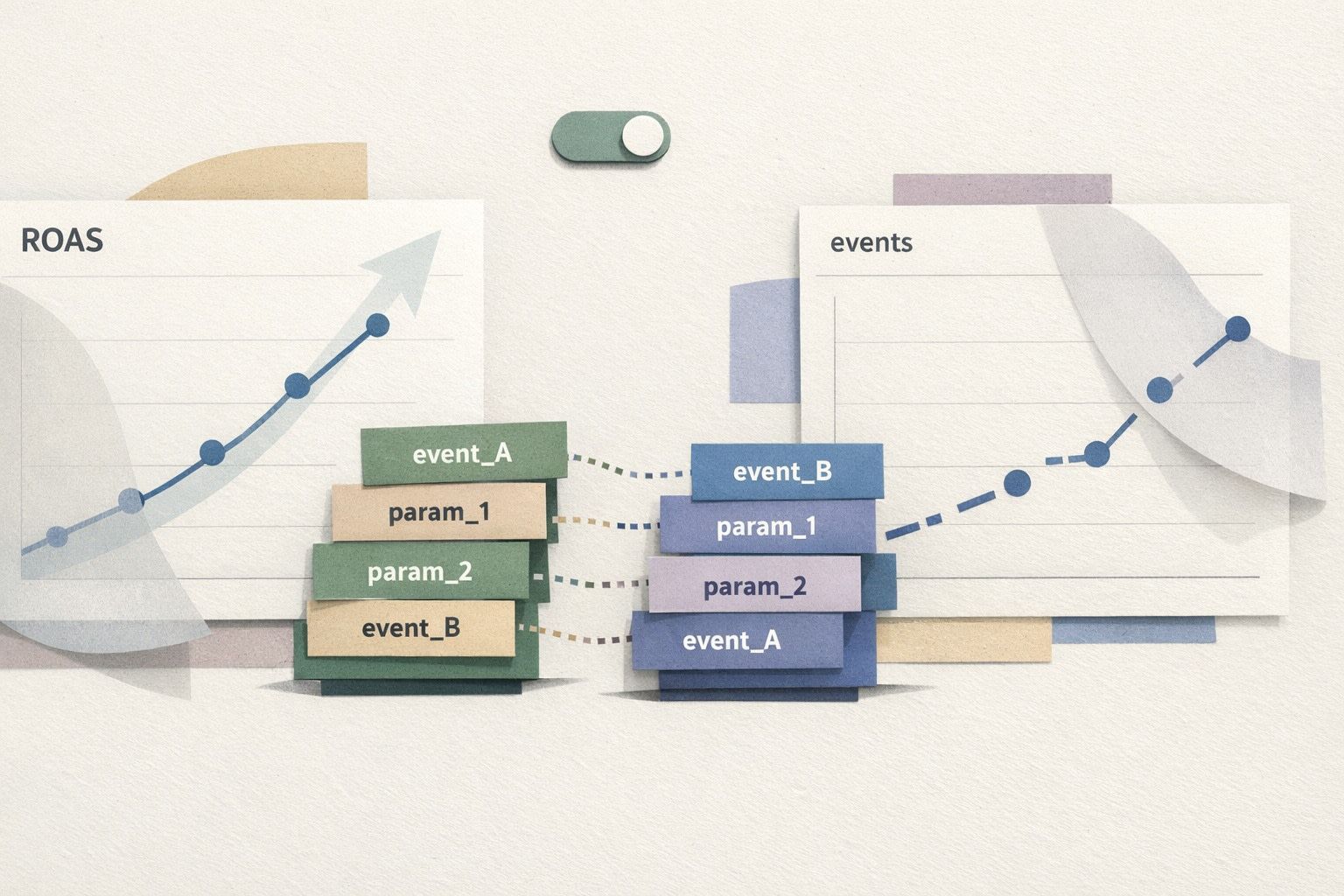
This is not a Consent Mode problem by itself. It is a schema mismatch problem, amplified by modeling. When the conversion you optimize for in Google Ads, Meta, or other platforms is not the same conversion you report in GA4, your warehouse, or CRM—modeled conversions can smooth over missing signals in inconsistent ways, and the discrepancies are easy to miss until budgets shift.
Where the blind spot begins: the ad schema and analytics schema are not the same
Most teams assume “a purchase is a purchase.” In practice, ad platforms and analytics tools often define and collect conversions differently:
- Event naming and parameters: “purchase” in GA4 might include items and value, while an ad pixel might send a value but not line items, or send revenue after discounts vs before discounts.
- Deduplication rules: one system dedupes by event_id, another by timestamp + order_id, a third by click ID. If those keys are absent or inconsistently populated, duplicates creep in.
- Attribution windows and logic: analytics reporting may use last-click by default; ad platforms often use their own attribution (data-driven, modeled, view-through, etc.).
- Identity surfaces: click IDs (gclid), browser identifiers, first-party cookies, and hashed identifiers might exist in one stream but not the other.
When consent is denied, these streams degrade differently. Modeling then “repairs” each system according to its own logic. That’s how you can end up with conversions that look consistent within each platform but disagree across platforms—while still being “technically correct” per each tool’s rules.
How modeled conversions turn mismatches into phantom ROAS
Modeled conversions are statistical estimates designed to recover some measurement utility when direct observation is limited. The issue is not that they exist; it is that they are often consumed as if they were directly observed, and then reconciled against analytics or CRM numbers that follow a different schema.
Phantom ROAS tends to appear when these conditions stack together:
- You optimize on a conversion that is easier to model than to verify (for example, a “purchase” event that is not tied to an immutable order ID).
- Your analytics event definition is stricter than your ad event definition (for example, GA4 counts only when value is present and the checkout session looks valid, while the ad tag fires on a confirmation page regardless).
- You have partial consent across markets, which produces uneven modeling rates by geography, device, browser, or traffic source.
- You join ad spend and conversions downstream using brittle keys (campaign naming, UTMs, or inconsistent source/medium), which can shift conversions into the “wrong” spend bucket.
The end result is deceptively clean dashboards: spend is precise, conversions are partially modeled, and ROAS rises—especially in segments with higher consent denial or where identifiers decay (mobile web, Safari, in-app browsers). If your schema alignment is weak, the model is not correcting the same “conversion” you think you are measuring.
The most common schema mismatches that inflate ROAS
1) Conversion value semantics drift
Ad tags frequently use a single revenue number. Analytics and finance may rely on net revenue, excluding tax, shipping, or refunded orders. If modeled conversions inherit an inflated value definition (gross vs net), ROAS can climb without any real change in margin.
2) Missing or inconsistent order IDs
Order IDs are the strongest defense against duplication and cross-system ambiguity. When order_id is missing in one stream (often the ad pixel), modeled conversions can’t be reconciled to a ledger. You can’t tell whether the model is “adding” conversions that already exist in your CRM, or compensating for truly missing ones.
3) Event timing and timezone misalignment
Even when the same order exists everywhere, timestamps can differ. If an ad platform attributes a conversion on click date while analytics reports on purchase date, daily ROAS can appear improved in the ad UI even as analytics looks flat. Modeling can amplify this smoothing effect, masking volatility that would otherwise trigger questions.
4) Channel mapping errors in downstream reporting
When you stitch datasets in a warehouse, channel definitions matter. If “paid social” and “social” blur, or if UTMs are incomplete, modeled conversions can get attributed to a paid channel that didn’t actually drive them. This is a frequent cause of “everything is up” dashboards where no channel seems to lose share.
What to do instead: treat Consent Mode as a measurement design problem
The fix is not to disable modeling. The fix is to make your schemas intentionally compatible, and to separate what is observed from what is modeled in every layer of reporting.
Practical steps that hold up in real operations:
- Define a canonical conversion contract: one conversion event, one set of required parameters (order_id, currency, value definition, timestamp, product context where applicable). Publish it internally like an API spec.
- Instrument with deduplication in mind: ensure event_id/order_id is present in both analytics and ad tags where possible; document fallback rules when it’s not.
- Report observed vs modeled separately: keep two metrics (or at least two fields) so stakeholders understand when ROAS is being supported by estimation.
- Create reconciliation checks against CRM/finance: daily or weekly sanity checks by order count and net revenue. If the ad platform is above the ledger persistently, treat it as a tracking issue, not a growth win.
- Standardize naming and transformations centrally: normalize campaign names, currencies, and channel groupings before they reach dashboards.
This is where marketing data infrastructure matters more than another dashboard. Platforms like Funnel.io are built to collect and normalize performance data from ad platforms, analytics tools, and CRMs into a consistent, analysis-ready source of truth—so schema drift is managed as a governed pipeline, not a set of ad hoc spreadsheets.
A lightweight audit to detect phantom ROAS early
If you suspect inflated ROAS due to Consent Mode blind spots, run a short audit that does not require a full rebuild:
- Pick one high-spend campaign and compare conversions across: ad platform UI, GA4, and CRM for the same date range.
- Check identity and keys: is order_id present everywhere? Are you joining by UTMs or click IDs? Are there duplicates?
- Segment by consent-affected cohorts: browser (Safari vs Chrome), region, device, and landing page type. Phantom ROAS usually clusters.
- Compare value definitions: gross vs net, tax/shipping handling, refunds timing.
- Validate mapping logic: ensure channel groupings and campaign naming harmonization are applied consistently before ROAS is calculated.
If you already run a broader governance workflow for how data definitions are confirmed and rolled out, the same discipline applies here. The feedback handshake workflow idea translates well: treat “what counts as a conversion” as something that needs explicit confirmation, not assumptions.
How to communicate modeled performance without losing decision velocity
Teams often avoid surfacing modeled vs observed splits because it can slow decisions. A better approach is to keep optimization moving while making uncertainty explicit:
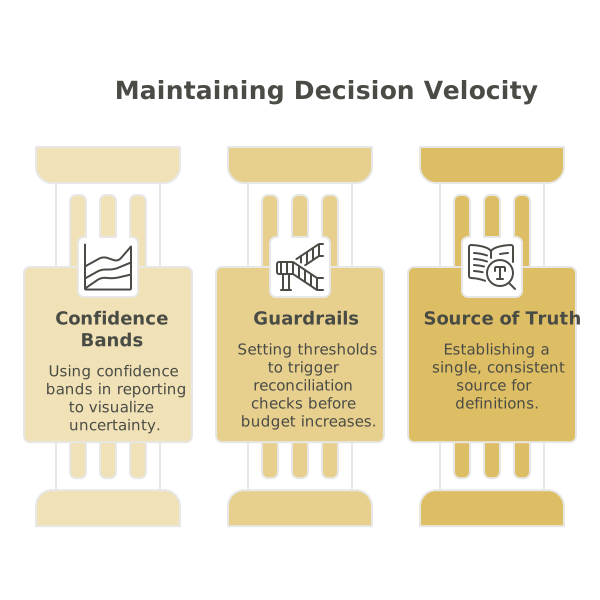
- Use confidence bands in internal reporting (for example, observed ROAS and blended ROAS).
- Set guardrails: if modeled share exceeds a threshold, require a reconciliation check before increasing budgets.
- Keep one source of truth for definitions so analysts, performance marketers, and finance aren’t debating semantics in every QBR.
Modeled conversions can be useful—especially under consent constraints—but only when your ad and analytics schemas describe the same business outcome. Otherwise, the model fills gaps in different realities, and ROAS becomes a number you can optimize without actually improving revenue.