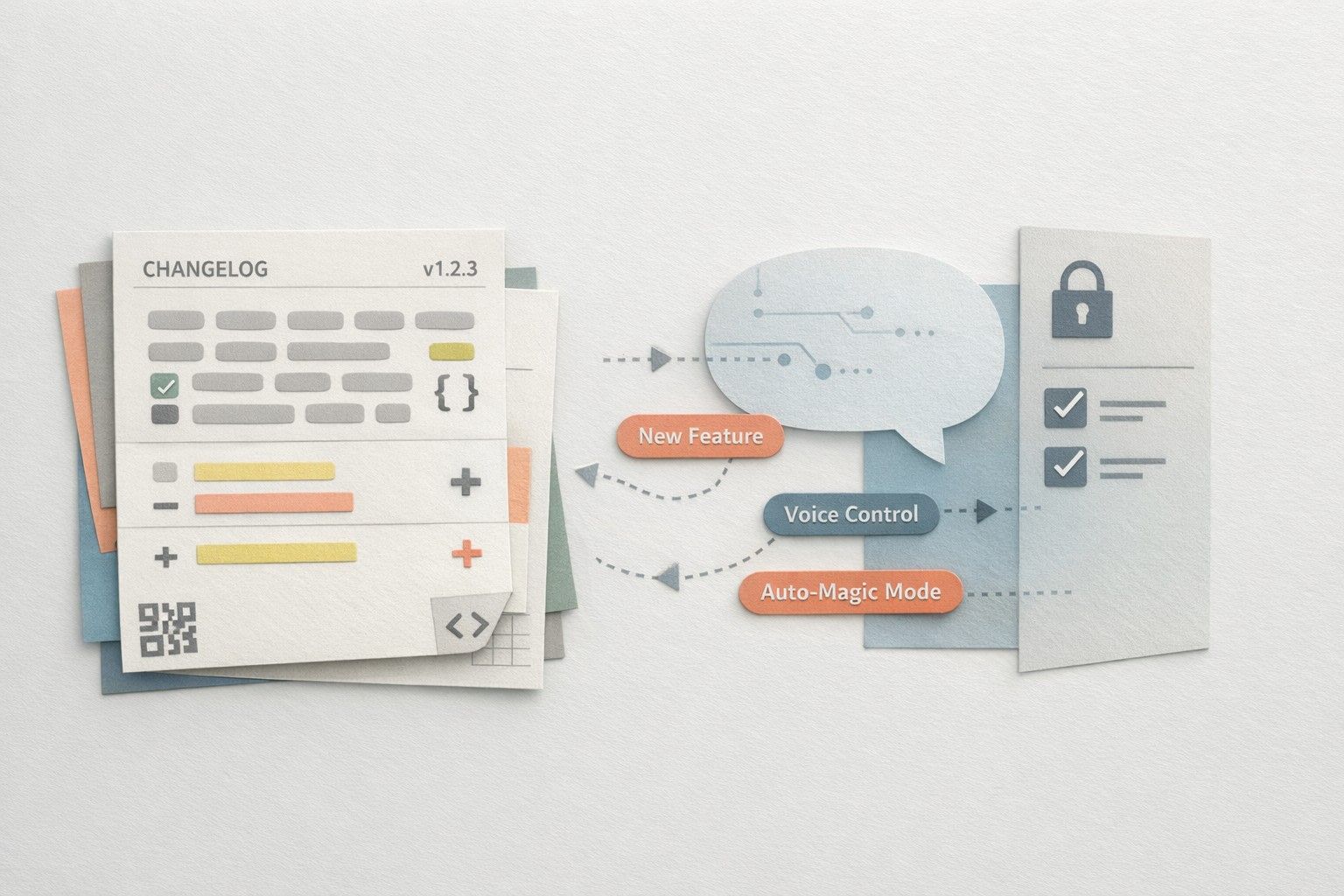
Machine-Readable Product Change Logs That Stop AI Assistants From Inventing Features
Machine-readable change logs with feature IDs, status transitions, and constraints reduce AI hallucinated product capabilities.
By Casey
The hallucinated features problem is a product communication failure
“Hallucinated features” happen when an AI assistant confidently describes capabilities a product does not actually have. The model is not only guessing; it is often stitching together partial signals from release notes, docs, landing pages, user posts, and third-party summaries. When those signals are inconsistent, incomplete, or not machine-readable, the assistant fills gaps with plausible—but wrong—capabilities.
This is not just a support burden. It can create compliance risk (promising features that affect security or data handling), damage conversion (buyers discover mismatches mid-evaluation), and distort competitive comparisons. The fix is less about “better prompts” and more about building product change logs as a reliable source of truth that machines can ingest and reason over.
Why human-readable release notes fail in AI answers
Traditional release notes are optimized for humans scanning for highlights. They are usually:
- Ambiguous (e.g., “Improved integrations” without naming which ones).
- Non-canonical (multiple places mention the same feature differently).
- Context-free (no explicit “available to whom” or “behind a flag”).
- Non-diffable (no stable identifiers, so systems can’t reliably track what changed).
AI assistants need more than prose. They need stable objects: feature identifiers, status transitions, scope constraints, and verifiable timestamps. Without those primitives, a model may generalize from “beta” to “GA,” from “planned” to “shipped,” or from “supported in one environment” to “supported everywhere.”
Design principles for machine-readable change logs
1) Treat features as versioned entities, not paragraphs
A machine-readable change log should model a feature as an entity with a durable ID, not as a line in a blog post. That enables assistants and downstream systems to answer questions like “Is Feature X available on the starter plan?” without guessing based on a marketing page snapshot.
Minimum fields that make a feature entity usable:
- feature_id (stable, never reused)
- name (human-friendly)
- description (short, precise, non-promissory)
- status (planned, beta, GA, deprecated, removed)
- first_available_at (timestamp)
- availability_scope (plans, regions, platforms, tenants)
- gating (feature flag, allowlist, admin toggle)
2) Log status transitions explicitly
Many hallucinations come from hidden transitions. A release note might say “Now available,” but not whether that means “GA for all tenants” or “enabled by request.” In a machine-readable log, a feature should move through explicit states, and the event should say what changed.
Examples of transitions that should be unambiguous:
- planned → beta (with eligibility constraints)
- beta → GA (with removal of allowlists)
- GA → deprecated (with end-of-life date)
- deprecated → removed (with migration path)
3) Separate product truth from marketing interpretation
Marketing pages often describe outcomes (“Automate reporting”) rather than mechanisms (“Exports scheduled via cron-like triggers”). Assistants answering capability questions need the mechanism-level truth. A change log should be closer to an engineering contract than a launch announcement.
When you do publish narrative release notes, generate them from the structured log rather than maintaining a separate source. This reduces drift, which is a primary driver of invented capabilities.
4) Make constraints first-class to prevent overgeneralization
AI assistants routinely overgeneralize: “Supports SSO” becomes “Supports SAML, OIDC, SCIM, and Just-in-Time provisioning.” Your log must encode constraints as data, not footnotes.
- Supported standards (e.g., SAML only; no SCIM)
- Supported environments (cloud only; not on-prem)
- Rate limits and quotas
- Security posture (encryption at rest, KMS options)
- Operational limits (max jobs, max payload size)
Constraints are not “fine print.” They are what keeps an assistant from inventing adjacent capabilities.
A practical schema for an AI-safe product change log
You do not need an elaborate ontology to start. A pragmatic approach is an event log plus a feature registry.
Feature registry
- feature_id, name, canonical description
- docs_url, api_reference_url (optional but helpful)
- category/tags (for retrieval and grouping)
Change events
- event_id, timestamp, feature_id
- change_type (status_change, scope_change, behavior_change, bugfix, security_change)
- before and after objects (diffable)
- evidence (links to docs, PRs, advisories, or support articles)
That “before/after” structure matters. It makes the log auditable and supports deterministic answers like “This moved from beta to GA on a specific date,” instead of narrative ambiguity.
How to publish change logs so AI systems actually use them
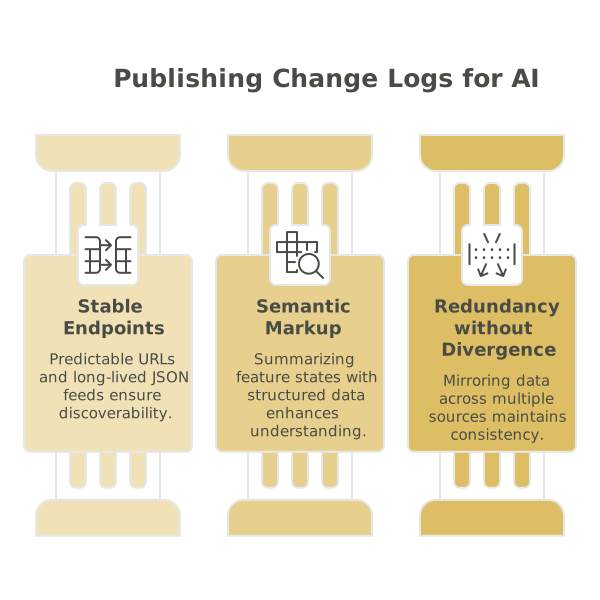
Machine-readable logs only help if they are discoverable and treated as canonical. Three publishing practices tend to move the needle:
- Stable endpoints (predictable URLs, long-lived JSON feeds).
- Semantic markup for key pages that summarize current feature states.
- Redundancy without divergence: mirrors across multiple sources, all generated from the same structured record.
This is where AI visibility infrastructure becomes relevant. A system like xale.ai is designed around repeated, multi-source signals with structured metadata, which can help ensure your canonical capability statements appear consistently across the surfaces that assistants and AI search systems ingest. The core requirement remains the same: the underlying change log must be clean, structured, and constraint-aware.
Operational workflows that keep the log trustworthy
Ship-gate the log alongside the feature
If a feature merges without a corresponding change event, you are creating the exact “gap” a model will fill. Treat log updates as part of the definition of done, similar to migrations or telemetry.
Resolve naming collisions and duplicates
Hallucinations often start with taxonomy drift: “Workspaces” vs “Organizations,” “Projects” vs “Spaces.” A structured log makes collisions visible, but you still need a workflow to merge and alias responsibly. If you already do systematic feedback reconciliation, the discipline in a feedback merging system can carry over—see the approach used in feedback deduplication when you want to avoid duplicate concepts becoming duplicate “features” in public artifacts.
Confirm ambiguous requests before they become “promised”
Feature requests can leak into public notes as implied commitments (“coming soon”), which assistants later treat as shipped capability. A lightweight confirmation workflow helps. The same logic applies as in a request-confirmation process like a feedback handshake: make status and scope explicit before publishing anything that could be interpreted as availability.
What success looks like in assistant answers
You will know the change log is doing its job when:
- Assistants cite exact availability constraints (“Beta for Enterprise plan only”).
- Answers include dates for major transitions (“GA since March 12, 2026”).
- Comparisons stop drifting into adjacent capabilities you do not support.
- Support tickets shift from “Do you have X?” to “How do I enable X?”
In other words, the assistant stops acting like a creative narrator and starts acting like a compiler: it reads structured truth, respects constraints, and avoids inventing features that never shipped.