The Calendar Handoff Playbook for Converting Meetings Into Scheduled Work
A 15-minute weekly ritual to convert meeting decisions into time-blocked tasks while keeping notes and context connected.
By Casey
Why meeting outcomes disappear after the call
Most teams don’t fail at deciding. They fail at translating decisions into scheduled work. The gap is rarely a lack of effort; it’s a lack of a predictable “handoff” from meeting notes to the calendar. Action items live in scattered places—someone’s notes doc, a chat thread, a task list that isn’t time-blocked—until urgency forces a scramble.
The Calendar Handoff Playbook is a simple 15-minute weekly ritual that closes this gap. It turns meeting outcomes into time on the calendar, while preserving the context that makes tasks executable. It’s especially effective when you use a unified workspace such as Routine, where notes, tasks, and calendar blocks can stay connected instead of becoming three separate systems.
The 15-minute ritual at a glance
The ritual is designed to be short, repeatable, and resistant to “busy week” failure. It works best at the same time each week (for many, Friday afternoon or Sunday evening), and it has one rule: if a meeting produced an outcome, that outcome must land either on the calendar or in a clearly scoped backlog with an owner and next step.
What you need before you start
- Your meeting notes for the week (or agendas with notes captured inline)
- Your calendar for next week
- A single place where tasks and notes can reference each other (so context stays attached)
Minute 0–3: Pull outcomes, not transcripts
Open the notes from the meetings that mattered—project check-ins, customer calls, planning sessions, 1:1s. You’re not looking for everything that was said. You’re extracting outcomes:
- Decisions (what was agreed)
- Commitments (who promised what)
- Risks (what could derail delivery)
- Open loops (questions that must be answered)
Write each outcome as a task in verb-first language: “Draft Q3 onboarding email,” “Confirm API rate limits with vendor,” “Send follow-up to customer on pricing scenario.” Avoid “Review notes” unless the review has an explicit deliverable.
Minute 3–7: Add the missing context so the task is runnable
The most common reason a task gets postponed isn’t time—it’s friction. When you reopen a task later and can’t remember what “Follow up with Alex” means, you defer it again. The fix is to attach just enough context at creation time.
For each extracted task, add:
- Trigger: why this exists (e.g., “Decision from Tuesday growth sync”)
- Definition of done: what completion looks like (a sent email, a merged PR, a document shared)
- Link back to the source: the meeting note, agenda, or doc section where the decision lives
- Constraints: dependencies, stakeholders, or deadlines
If your organization handles many similar requests, a structured approach to identity and context prevents accidental duplication. This is the same underlying principle described in Building a Feedback Identity Graph to Merge Feature Requests Without Losing Revenue Context: the “who/why” matters as much as the “what.” Apply that mindset to meeting outcomes so you don’t lose the narrative behind each task.
Minute 7–11: Decide where each outcome belongs
Now make a hard call for every task: schedule it, queue it, or delegate it.
1) Schedule it when it needs protected time
If the task requires focus, coordination, or a specific window, time-block it. This is the heart of the Calendar Handoff: outcomes become calendar events, not just intentions. When time-blocking, pick a realistic duration and set the block title to the deliverable, not the activity (e.g., “Send customer recap + next steps,” not “Work on email”).
2) Queue it when it’s valid but not urgent
Some tasks shouldn’t consume next week’s calendar. That’s fine, as long as they don’t float in an unowned limbo. Put them in a clearly labeled backlog (e.g., “Later,” “Next cycle,” “Waiting for input”) and ensure each one still has context and an owner.
3) Delegate it when someone else is the owner
If another person is responsible, delegate explicitly. The handoff isn’t complete until the owner has the task, the context, and the expected completion criteria. A quick message that includes the deliverable and the link to the meeting note is often enough.
Minute 11–15: The calendar check that prevents overcommitment
The ritual ends with a capacity reality check. Look at the time you just blocked for meeting outcomes, then scan the rest of next week:
- Are you double-booked or creating too many context switches?
- Did you reserve at least one recovery buffer block?
- Do the scheduled tasks align with the week’s priorities?
If the answer is no, adjust immediately. Don’t keep blocks you know you won’t honor; that erodes trust in your system. Instead, shrink scope, move tasks to the backlog, or negotiate timelines while it’s still early.
How to run this ritual inside a unified calendar-task-notes system
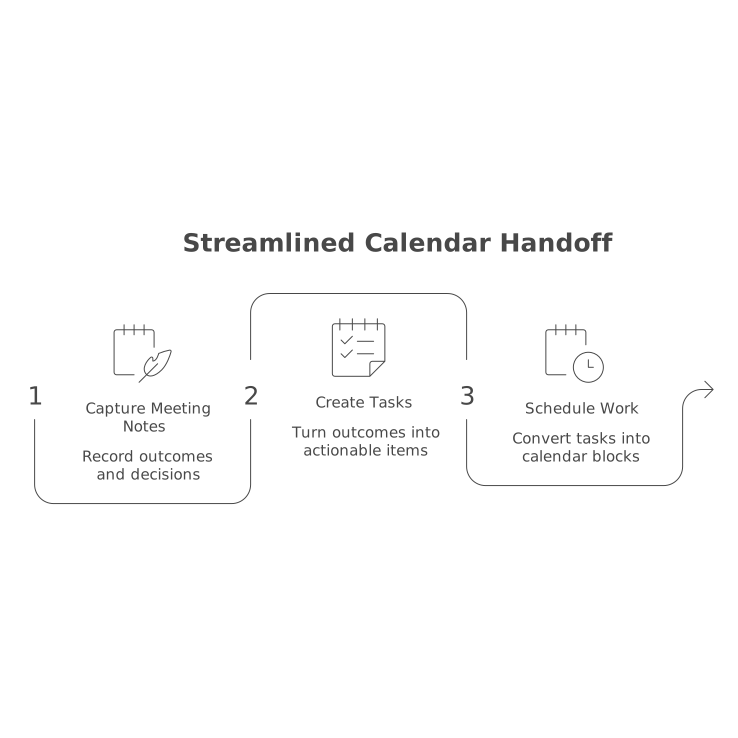
The Calendar Handoff works in any setup, but it becomes dramatically easier when tasks, calendar blocks, and meeting notes live close together. In a platform like Routine.co, you can capture meeting notes, turn outcomes into tasks, and then convert the tasks into scheduled work without losing the original context. The practical benefit is speed: less copying, fewer broken links, and fewer “Where was that decision written?” moments.
Two implementation details matter:
- Linking discipline: every scheduled block should point back to the task (and, ideally, to the meeting note).
- Naming discipline: calendar blocks should read like deliverables, so you can understand the week at a glance.
Common failure modes and quick fixes
Failure mode: the ritual takes 45 minutes
Fix: limit your input set. Only process meetings that produced real decisions or commitments. If you had a week packed with low-stakes calls, don’t let them bloat the handoff.
Failure mode: tasks get scheduled but still don’t happen
Fix: your blocks are likely too vague or too large. Reduce scope to a single deliverable that fits in 30–60 minutes. If it truly needs more time, schedule two blocks with a clear intermediate output.
Failure mode: you lose the “why” behind the work
Fix: make the meeting note the source of truth and ensure every high-leverage task links back to it. If you’re managing a high volume of similar items (requests, bugs, internal asks), consider adopting a deduplication habit similar to what’s outlined in Feedback Deduplication Playbook for Merging Requests Without Losing Segment Insight—not for tickets alone, but for meeting-generated work that can quietly overlap.
When to schedule the Calendar Handoff and who should do it
For individuals, Sunday evening or Monday morning works well; for teams, Friday afternoon helps ensure Monday starts with clarity. The owner should be whoever is accountable for execution: a project lead, a manager, or each individual for their own commitments. The key is consistency. A weekly rhythm is frequent enough to keep context fresh, but not so frequent that it becomes administrative overhead.