Intake SLA Framework for Feature Requests Without Derailing Product Cycles
An Intake SLA turns feature request chaos into fast, time-boxed decisions while protecting product cycles from churn.
By Casey
Define an Intake SLA before you add another “quick” request
Feature requests arrive continuously: from sales calls, support tickets, leadership messages, and power users who “just need one thing.” The common failure mode isn’t that teams ignore requests. It’s that they accept them in an unstructured way, then discover—mid-cycle—that the request carries hidden scope, unclear ownership, or a decision that should have been made earlier.
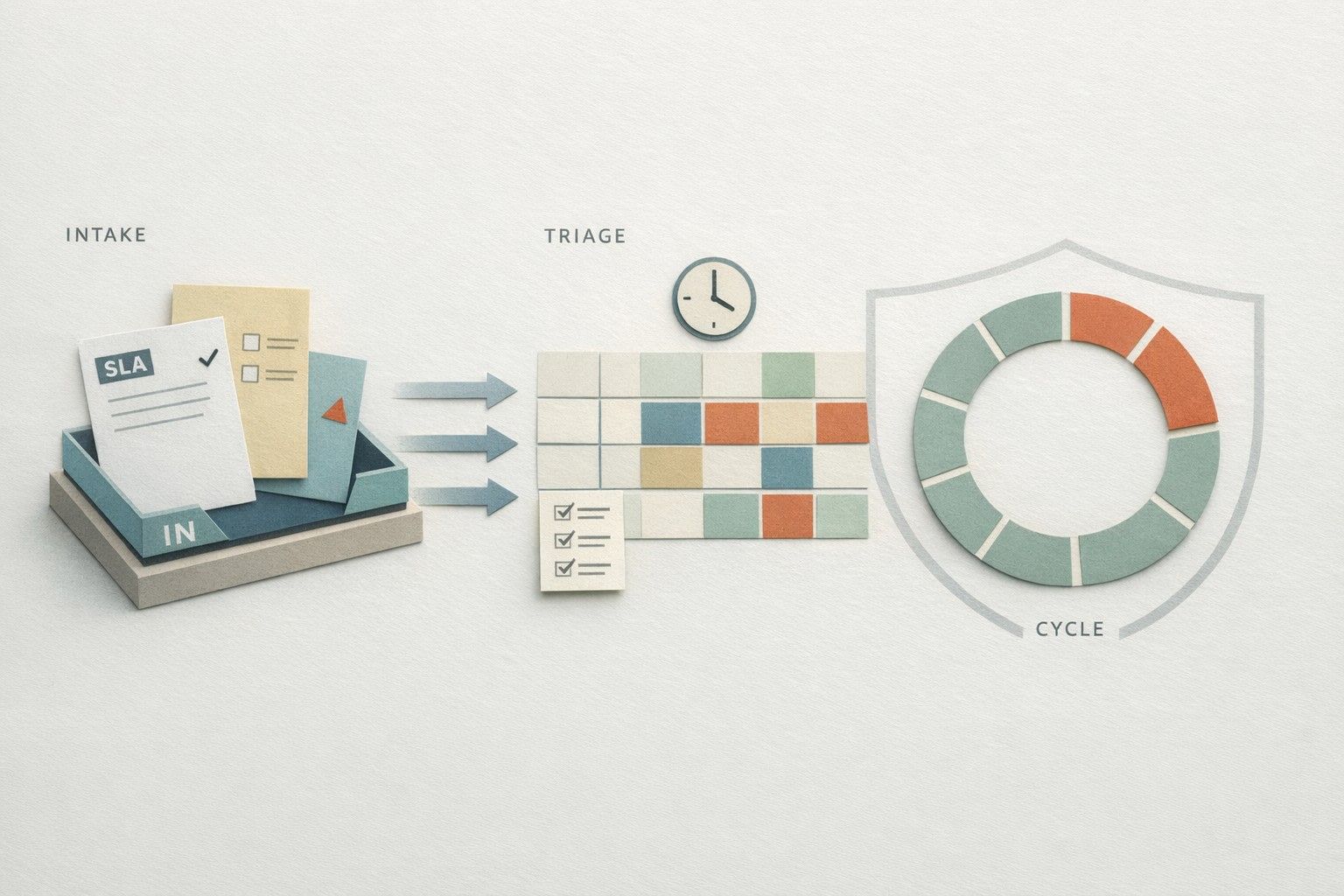
An “Intake SLA” framework fixes this by treating intake as a time-boxed decision service. The goal is not to ship everything faster; it’s to decide faster and more predictably. You commit to a response time for decisions (acknowledge, route, accept, reject, or defer), while protecting execution cycles from constant disruption.
What an Intake SLA actually is
An Intake SLA is a set of explicit timers and outcomes for any incoming request. It answers:
- When will we respond? (e.g., within 2 business days)
- What does “respond” mean? (a concrete decision, not “we’ll look into it”)
- Who owns the decision? (single accountable role)
- Where does the request live? (one system of record)
- What are the allowed outcomes? (standardized, repeatable)
This is different from a delivery SLA. Intake SLAs don’t promise ship dates. They promise a reliable decision loop that keeps stakeholders informed and keeps the roadmap from being hijacked by urgency.
Why feature request intake derails cycles
Cycles derail when intake is treated as informal conversation rather than a workflow. The most common sources of churn are predictable:
- Unbounded “small” work that lands mid-cycle without trade-offs.
- Duplicate requests that look different but map to the same underlying problem.
- Ambiguous decision rights (“PM decides” until engineering pushback, then “leadership decides”).
- Missing context (segment, revenue impact, frequency, workaround, severity).
- No explicit deferral mechanism, so “later” becomes “floating forever.”
An Intake SLA makes these failure modes visible and forces clarity early—while the cost of saying “no,” “not now,” or “needs discovery” is still low.
The core Intake SLA: timers, gates, and outcomes
1) Set two clocks, not one
A practical framework uses two time boxes:
- Acknowledgement SLA: “We saw it and it’s in the system.” Often same-day or within 1 business day.
- Decision SLA: “Here is the outcome and next step.” Typically 2–5 business days, depending on volume.
This prevents the “black hole” effect without forcing rushed prioritization. Acknowledgement buys trust; decision buys focus.
2) Create an intake gate that protects the cycle
Intake should not automatically mean “work starts now.” Add a gate that separates requests from committed work. The gate can be as simple as: only items that meet definition-of-ready criteria can enter the cycle.
Definition-of-ready for a feature request often includes:
- Clear problem statement (not a pre-specified solution only)
- Requester + affected segment
- Frequency / severity signal (how often, how painful)
- Proposed success metric or acceptance check
- Rough sizing confidence (even “unknown, needs discovery” is a valid state)
3) Standardize outcomes to reduce negotiation
Every request should end the Decision SLA with one of a few outcomes:
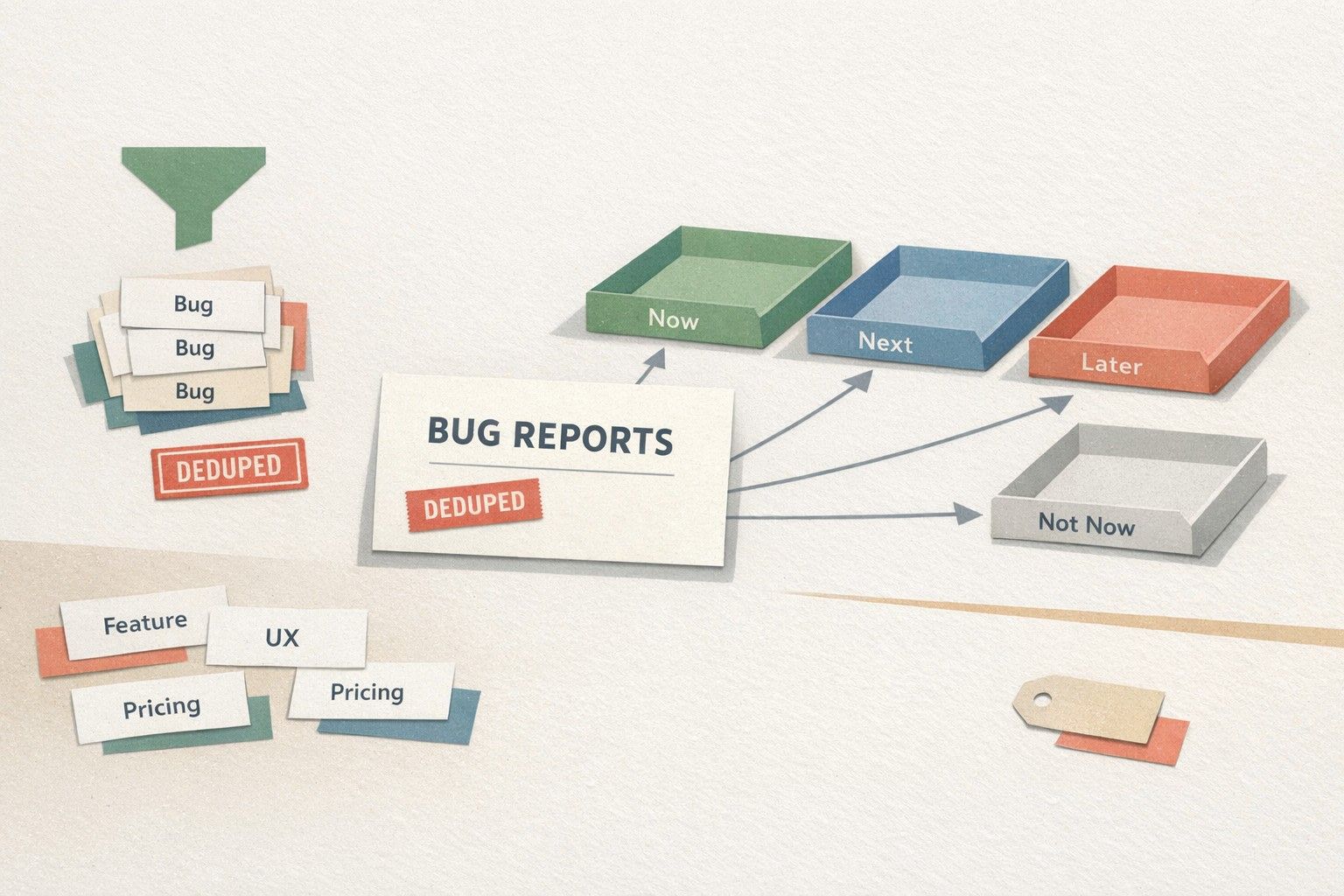
- Accept for discovery: schedule a time-boxed investigation (spike, prototype, user calls).
- Accept for planning: eligible for the next planning window, not necessarily the current cycle.
- Reject: clearly document why (misaligned strategy, low impact, existing workaround, not feasible).
- Defer with trigger: “Revisit when X happens” (customer count, compliance change, platform migration).
- Merge: link to an existing canonical request and move signals there.
Notice what’s missing: “maybe.” If something is uncertain, accept it for discovery with a defined time box.
Operationalizing the framework in a modern workflow
Use a single intake queue with clear ownership
Whether requests originate in Slack, email, Intercom, or sales notes, they should land in one queue. Teams using linear.app often model this as an “Intake” project or team with a dedicated triage view. The key is not the tool; it’s the discipline of one home and one accountable owner per item.
Assign a Triage DRI (directly responsible individual) per week—commonly a PM or rotating PMM/PM pair—so the SLA is owned, not “shared.”
Route by type, not by loudness
Routing rules should be explicit. For example:
- Bug/regression: route to on-call or engineering lead, with severity labels.
- Feature request: route to PM owner by area.
- Integration request: route to platform/integrations group.
- Enterprise blocker: route to a fast-path lane with stricter acknowledgement SLAs.
This keeps “urgent” from becoming a subjective debate. It becomes a category with defined handling.
Build deduplication into intake, not after planning breaks
Deduplication is part of protecting cycles. If you only merge duplicates during planning, you inflate perceived demand and waste review time. A lightweight practice: during triage, search for an existing canonical issue and merge immediately, preserving reporter context as linked requests.
If you need a deeper method, the approach in feedback deduplication can help you merge requests without losing segment-level signals.
Time-box discovery to prevent “analysis sinkholes”
An Intake SLA often reveals a second bottleneck: accepted requests that stall in research. Fix this with discovery SLAs:
- Small unknowns: 1–2 day spike
- Medium requests: 1 week discovery window
- Large bets: 2–3 week discovery, with explicit exit criteria
The outcome of discovery is not “we learned things.” It’s a decision-ready artifact: scope options, risks, rough size, and a recommendation.
Suggested Intake SLA templates you can adapt
Template A: Standard product team (balanced)
- Acknowledge within 1 business day
- Decision within 3 business days
- Weekly triage block (45–60 minutes)
- Discovery time box: 1 week max unless escalated
Template B: High-volume B2B requests (fast-path lane)
- Enterprise blocker acknowledge: same day
- Enterprise blocker decision: 48 hours
- All other requests: acknowledge 1 day, decide 5 days
- Monthly “request review” with sales/support for pattern alignment
Template C: Early-stage team (minimal overhead)
- Acknowledge within 2 business days
- Decision within 5 business days
- Single weekly triage session
- Only two outcomes used at first: accept for planning or reject (with notes)
Metrics that prove the SLA is working
Keep measurement lightweight and tied to behavior:
- Time to acknowledge and time to decision (P50/P90, not only averages)
- % of requests merged (dedupe health)
- % of accepted requests that enter discovery vs. sit idle
- Cycle churn: work added mid-cycle as a percentage of planned scope
If cycle churn is rising, tighten the gate (definition-of-ready) rather than weakening the SLA. The SLA’s job is decision discipline, not unlimited throughput.
Common pitfalls and how to avoid them
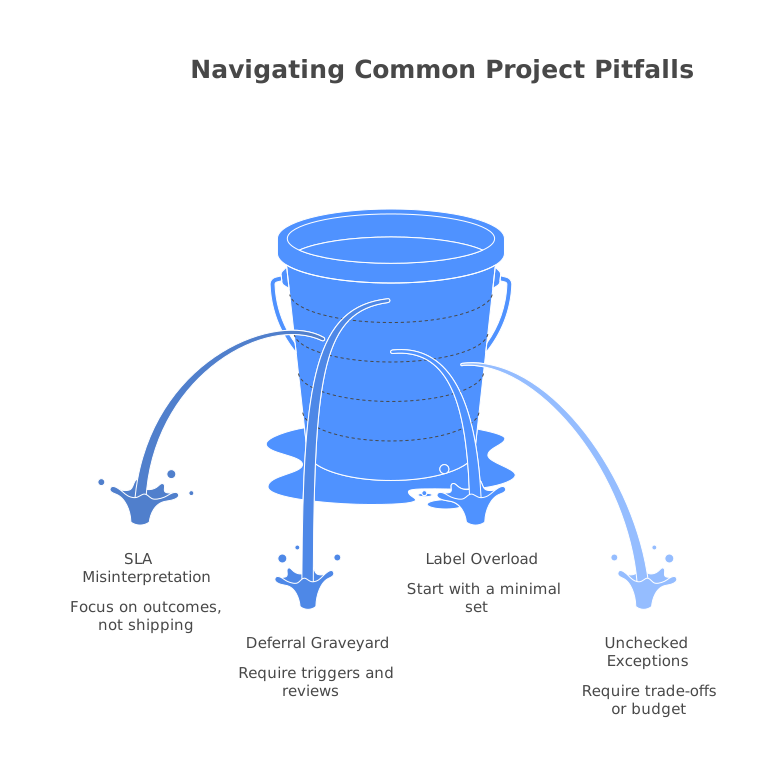
- Making the SLA a promise to ship: keep outcomes about decisions and next steps.
- Letting “defer” become a graveyard: require a trigger and a review date.
- Using too many labels/statuses: start with the smallest set that supports routing and outcomes.
- Allowing exceptions without trade-offs: exceptions should come with an explicit scope swap or a dedicated interruption budget.
When implemented well, the Intake SLA becomes a social contract: stakeholders get timely clarity, and the team keeps cycles stable enough to ship predictably.