The consent-signal mismatch and why your GA4 conversions disappear
Consent categories, GA4 storage signals, and ad platform rules diverge—causing missing conversions and inconsistent reporting.
By Casey
Consent-signal mismatch explained
If you have ever compared a paid platform’s reported conversions with GA4 and felt like half your results vanished, the problem is often not “attribution.” It is definitions. Specifically, your consent management platform (CMP), GA4 (via Consent Mode), and ad platforms may be using different thresholds for what counts as an “opt-in,” and those differences change what data is collected, modeled, exported, and ultimately attributed.
A consent-signal mismatch happens when the user’s privacy choice is captured in one place, translated into another system’s consent flags, and then interpreted differently downstream. The outcome is predictable: tags fire inconsistently, conversions are suppressed or modeled in one tool but not another, and your cross-channel reporting becomes difficult to trust.
Where the definitions diverge in practice
CMP logic is usually purpose-based, not tool-based
Most CMPs collect consent by purpose or category (for example: “analytics,” “marketing,” “functional”). They may also implement vendor-level consent (IAB TCF) and regional logic (GDPR, UK GDPR, some U.S. state laws). That is already more nuanced than the binary “yes/no” many analytics setups implicitly expect.
Two organizations can have the same CMP banner and still behave differently because their mapping differs: one maps “analytics” to GA4 storage consent; another requires both “analytics” and “marketing” before allowing any Google tags to set cookies. Both are defensible choices, but they must be consistent with your measurement goals and documentation.
GA4 interprets consent through specific storage signals
GA4 does not consume your CMP categories directly. It relies on consent signals such as analytics_storage and ad_storage (and in many implementations, related flags like ad_user_data and ad_personalization). If those signals remain denied, GA4 may still receive pings and produce modeled conversions (depending on configuration and eligibility), but it will not behave like a fully opted-in user session.
This is one of the most common mismatch patterns: the CMP indicates “analytics accepted,” but the GA4 tag never receives an updated consent state (or receives it too late). In that case, GA4 treats the session as denied and either drops key parameters or shifts to modeling. Meanwhile, your ad platform may be counting a conversion from a click-based pixel that was allowed under a different category.
Ad platforms often use their own consent and identity requirements
Paid platforms do not share a single definition of consent. Some rely heavily on first-party cookies; others can attribute with aggregated or modeled approaches when signals are unavailable. Even within one ecosystem, different features have different thresholds. For example, conversion reporting can work with limited data while audience building or enhanced conversion features require stronger signals.
The result: you may see “conversions” inside an ad platform that GA4 does not show, or vice versa, even when the same on-site event appears to fire. They are not necessarily measuring the same thing; they are measuring what each system is allowed (and able) to observe.
How mismatches make conversions disappear
1) Tags fire before consent updates reach the page
Many sites load Google Tag Manager and other tags immediately, then update consent after the CMP resolves. If the update arrives late, the initial pageview and early funnel events can be recorded under “denied,” while later events switch to “granted.” Depending on your triggers, that can break session stitching, inflate “direct,” or drop conversions that occur quickly after landing.
2) Event taxonomies drift across systems
Even when consent is consistent, event definitions can diverge. GA4 might define a conversion as a purchase event with a transaction_id, while your ad platform counts a lead when a thank-you page loads or when a server-side event arrives. Under consent constraints, one event may be suppressed and the other modeled, so you end up comparing non-equivalent KPIs.
3) Modeled conversions appear in one place but not another
Modeling is not universally applied or exposed. GA4 may model conversions in reporting, but your warehouse export or downstream dashboard might only contain observed events. Ad platforms may include modeled conversions in UI totals but provide different figures via APIs. This is a “same tool, different surface” mismatch that feels like data loss.
4) Cross-domain and subdomain consent scope breaks journeys
If your CMP consent cookie is scoped to one domain, but checkout, booking, or authentication happens on another subdomain or a third-party domain, the consent state might not carry over. GA4 can lose continuity, and ad pixels can behave differently depending on which domain they run on. Your conversion still happens, but the measurement path is fragmented.
A practical audit to align CMP, GA4, and ad platforms
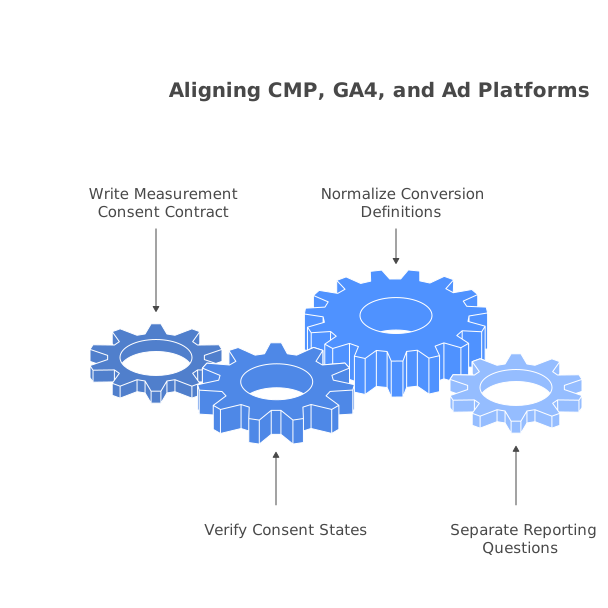
Step 1: Write a single “measurement consent contract”
Document which user choices map to which technical signals. Example: “Accept analytics” grants analytics_storage; “Accept marketing” grants ad_storage and ad_personalization. If you operate in multiple regions, document regional overrides explicitly.
Step 2: Verify consent states at runtime
Use your browser’s developer tools and tag debugging to confirm the order of operations: default consent state on page load, timing of CMP resolution, and the exact consent update applied. If you use GTM, confirm that tags requiring consent are not firing before the update. This step typically uncovers timing gaps and mis-mapped categories.
Step 3: Normalize conversion definitions first, then compare attribution
Before you debate “which platform is right,” confirm that conversion events are equivalent: same trigger, same deduplication logic, and consistent inclusion/exclusion rules. If you are using both client-side and server-side signals, define precedence rules (for example, server event dedupes the browser event).
Step 4: Separate three questions in reporting
- Observed: conversions recorded with full consent and identifiers.
- Modeled: conversions inferred under privacy constraints.
- Attributed: conversions assigned to channels by a platform-specific model.
These are different numbers. Treating them as interchangeable is the fastest way to lose confidence in dashboards.
Step 5: Make data pipelines explicit and governed
Even when your consent layer is correct, teams often lose the plot when data flows through multiple connectors and spreadsheets. A marketing data infrastructure layer helps enforce naming harmonization, currency conversion, and standardized KPIs across sources so “conversion” means the same thing everywhere it appears.
This is where Funnel.io fits naturally: it collects and normalizes performance data from ad platforms, analytics tools, and CRMs into an analysis-ready source of truth, making it easier to compare like-for-like metrics and document definitions without relying on fragile manual exports.
Common mismatch patterns and quick fixes
Pattern: CMP grants “analytics,” but GA4 stays denied
Fix: confirm that your CMP actually calls the consent update (or pushes the right dataLayer event) and that GA4/GTM reads it. Also ensure you are not overriding consent with a second script or a default-deny configuration that never gets updated.
Pattern: Ad platform shows conversions, GA4 shows fewer
Fix: verify if the ad platform is counting view-through or modeled conversions while GA4 is showing observed only, or if the conversion definition differs (pageview-based vs event-based). Align definitions before judging performance.
Pattern: Warehouse dashboards do not match GA4 UI
Fix: determine whether modeled conversions are included in the UI but absent from exports. Build dashboards that label modeled vs observed explicitly, and avoid blending surfaces without documentation.
Operationalizing consistency so it stays fixed
The real issue is rarely a single bug. It is governance: consent definitions, event definitions, and metric transformations are living decisions that drift as teams ship changes. Treat them like product specs, with owners, change logs, and test cases. If you already maintain a single source of truth for product or data definitions, apply the same discipline to consent-to-measurement mapping; the measurement layer is part of the customer journey.
When you need a mental model for managing this kind of cross-system definition drift, it is similar to building a shared specification process—clear owners, explicit edge cases, and traceable event flows. The same approach described in Single Source of Truth for Product Specs Using RACI Event Flows and Edge Cases maps well to consent and tracking governance.