Single Source of Truth for Product Specs Using RACI, Event Flows, and Edge Cases
A practical SSOT playbook using RACI, event flows, and edge cases to turn a messy spec into a living visual contract.
By Casey
Start with one messy spec and make it enforceable
Most product specs fail for a predictable reason: they try to be complete, but they aren’t executable. Teams interpret the same paragraph differently, build parallel mental models, and then “align” in meetings that never end. A practical single source of truth (SSOT) playbook does the opposite. It takes one imperfect spec and turns it into a living visual contract—something every function can reference, challenge, and update without starting from scratch.
This approach is especially effective for fast-moving products where the spec changes weekly. The goal is not perfection; it’s a shared, testable model that makes ownership, behavior, and edge cases explicit.
The SSOT playbook in four artifacts
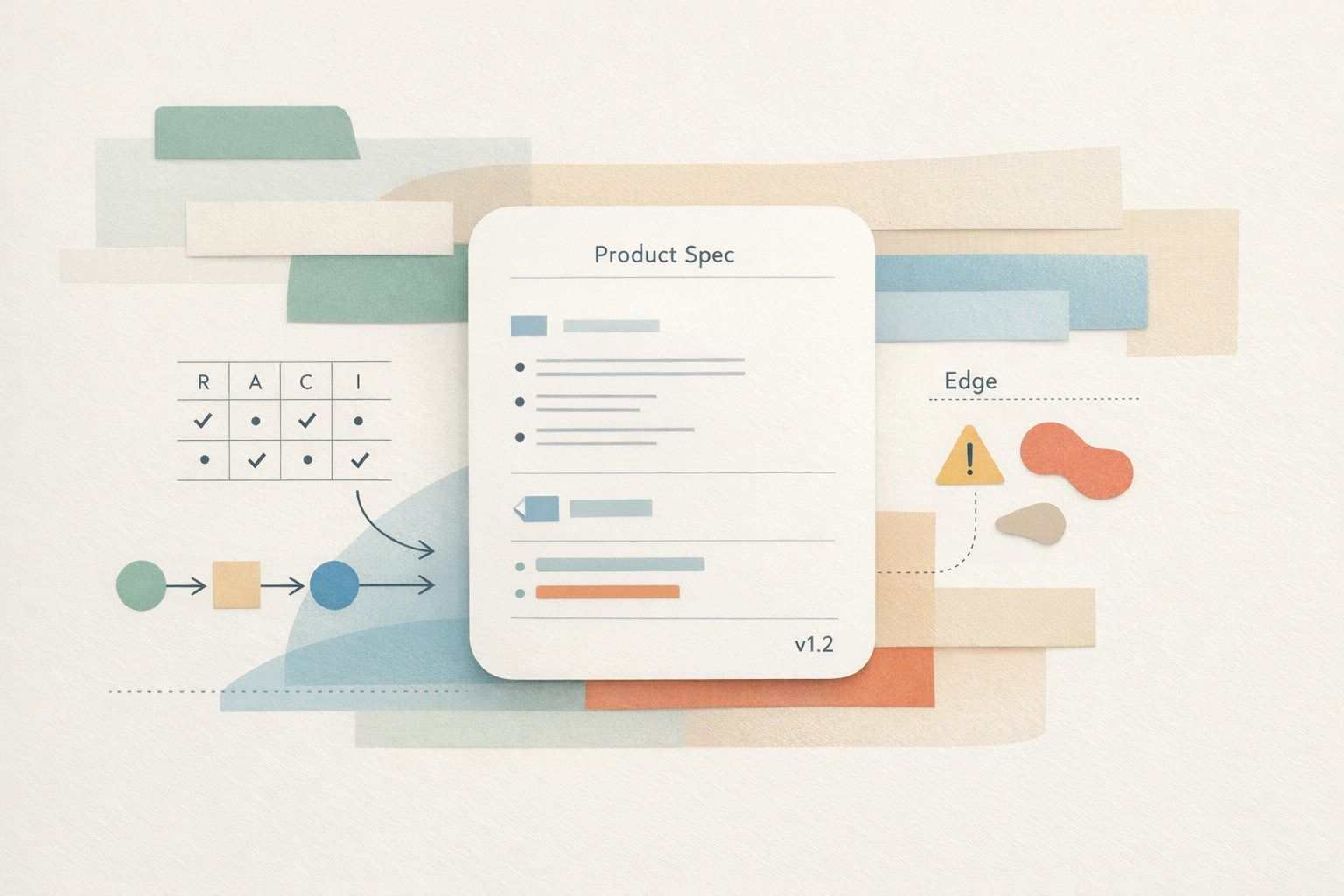
A living visual contract typically stabilizes once it includes four artifacts that reinforce each other:
- Scope and glossary (what’s in, what’s out, what words mean)
- RACI (who owns decisions, execution, consultation, and updates)
- Event flows (how the system behaves over time, across actors)
- Edge cases (what happens when reality disagrees with the happy path)
When these are kept in sync, the spec stops being a document and becomes a contract: new work must map to one of these artifacts, or it is not “real” yet.
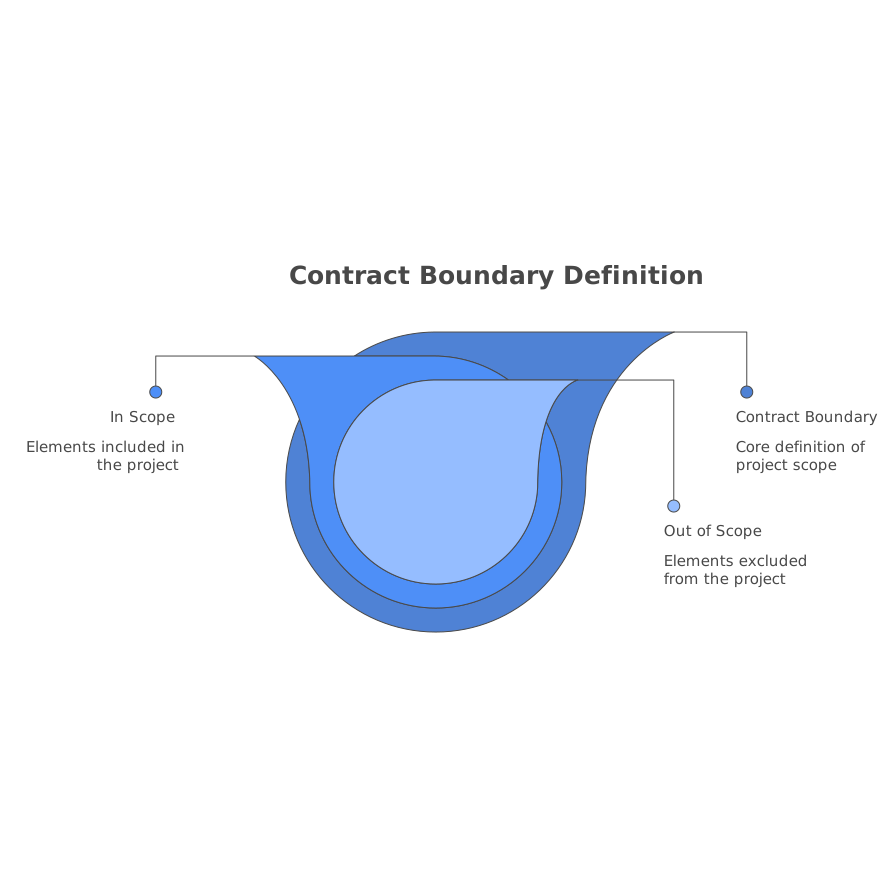
1) Define the contract boundary with a scope and glossary
Before you diagram anything, force clarity on boundaries. Add two short sections at the top of the spec:
- In scope: user journeys, APIs, data objects, and non-functional requirements you are committing to.
- Out of scope: adjacent requests you explicitly won’t solve in this iteration.
Then add a glossary for overloaded terms (e.g., “account,” “workspace,” “seat,” “member,” “owner,” “admin”). This is not busywork: mismatched vocabulary is one of the most common sources of cross-team rework, especially when analytics and billing interpret entities differently than the UI.
2) Turn accountability into a RACI that people can’t ignore
A good RACI is small, opinionated, and tied to real decisions. It’s not “Engineering is responsible for engineering.” It’s “Who can approve a breaking change to the event schema?” or “Who decides what happens to entitlements when a refund lands after 30 days?”
How to structure a spec-grade RACI
- Rows: decisions and deliverables (not departments). Examples: event naming standards, migration plan, QA sign-off criteria, instrumentation coverage, rollback conditions.
- Columns: key roles (PM, Tech Lead, Designer, Data/Analytics, QA, Support, Legal/Compliance, RevOps/Billing as needed).
- Exactly one “A” per row: if you have two, you have none.
Make the RACI part of the spec header so it’s unavoidable during reviews. Also add one extra row that most teams forget: “Spec updates and change log ownership.” The SSOT dies the moment nobody is accountable for keeping it current.
3) Convert “requirements” into event flows that engineering and QA can test
Requirements are often written as static statements (“Users can reset passwords”). Systems, however, behave as sequences of events across actors: user, client, backend services, third-party providers, and internal ops tools. Event flows translate intent into observable behavior.
What an event flow should include
- Actors and boundaries: client app, API, workers, vendor callbacks, admin tooling.
- State transitions: what changes in the system after each event.
- Data written: tables/objects updated, idempotency keys, timestamps.
- Events emitted: analytics/business events and operational events (for tracing/alerts).
- Failure branches: retries, timeouts, partial failures, compensating actions.
If you already use state thinking in your product UI, you can keep the spec and implementation aligned by explicitly modeling those states. The state machine UI pattern is a useful mental model even outside no-code contexts because it forces every screen and action to map to a known state and transition.
For teams struggling with background jobs and “mystery” automation, event flows become even more valuable when tied to orchestration. If your roadmap includes cleaning up scheduled tasks, you can align flows with your execution model using approaches like migrating cron sprawl to code-defined DAGs with traceability, so every step is observable and attributable.
4) Make edge cases first-class, not footnotes
Edge cases aren’t rare; they’re simply unmodeled. The fastest way to harden a spec is to treat edge cases as structured inputs to design, QA, and instrumentation—not as a backlog of “we’ll handle later.”
Use an “edge case table” with consistent columns
- Trigger: what causes the edge case (user action, race condition, delayed webhook).
- Observed symptom: what the user or system sees.
- Expected behavior: including UX copy, error codes, and recovery.
- Owner: who drives the decision (ties back to the RACI).
- Telemetry: what you log/measure to detect it in production.
This table becomes a shared checklist for QA, a source for test cases, and a forcing function for product decisions you otherwise postpone. It also prevents a common failure mode: shipping a happy path that breaks revenue or support workflows under real-world timing and entitlement scenarios.
Turn the spec into a living visual contract
Once you have RACI + event flows + edge cases, you need them to stay synchronized. The easiest way is to keep the spec as text but make the visuals the canonical reading experience. This is where a “text-to-visual translator” is useful: you can write in plain language, then generate diagrams that stay close to the narrative.
Tools like napkin.ai work well in this workflow because they let you turn written flows into clear diagrams quickly, then iterate as decisions change—without requiring every update to go through a designer or a diagram specialist. The result is a spec people actually open, because it explains the system at a glance while remaining grounded in the underlying text.
Operationalize updates so SSOT doesn’t decay
A single source of truth is only “single” if updates are disciplined. Add these operating rules to the spec:
- Change log: every change gets a dated entry with what changed and why.
- Versioned decisions: when a decision flips, record the previous decision and the trigger.
- Review gates: no implementation begins until the event flow exists; no launch until edge case telemetry is defined.
- Link to artifacts: tickets, PRs, dashboards, and runbooks should point back to the spec section they implement.
This is how a messy spec becomes a living contract: not by adding more pages, but by insisting that every meaningful change is reflected in the same shared model.