Measuring Podcast Sponsorship ROI Without Cookies Using Vanity URLs and First-Party Redirects
Measure podcast sponsorship ROI without cookies using vanity URLs, first-party redirects, and conversion windows for credible attribution.
By Casey
Why podcast sponsorship ROI gets harder without cookies
Podcast sponsorships rarely behave like click-first channels. Listeners hear an offer while commuting, then convert hours or days later on a different device. At the same time, cookie-based attribution is increasingly unreliable due to browser restrictions, consent choices, and privacy expectations. The result is familiar: a sponsorship “works,” but the proof looks fuzzy.
You can still measure podcast sponsorship ROI credibly without cookies by combining three components:
- Vanity URLs that listeners can remember and type
- First-party redirects that preserve campaign context without third-party trackers
- Conversion windows that reflect how audio actually drives delayed action
This approach won’t reconstruct individual user journeys. It will produce durable, privacy-respecting evidence that your spend is producing incremental conversions.
Design vanity URLs that listeners will actually use
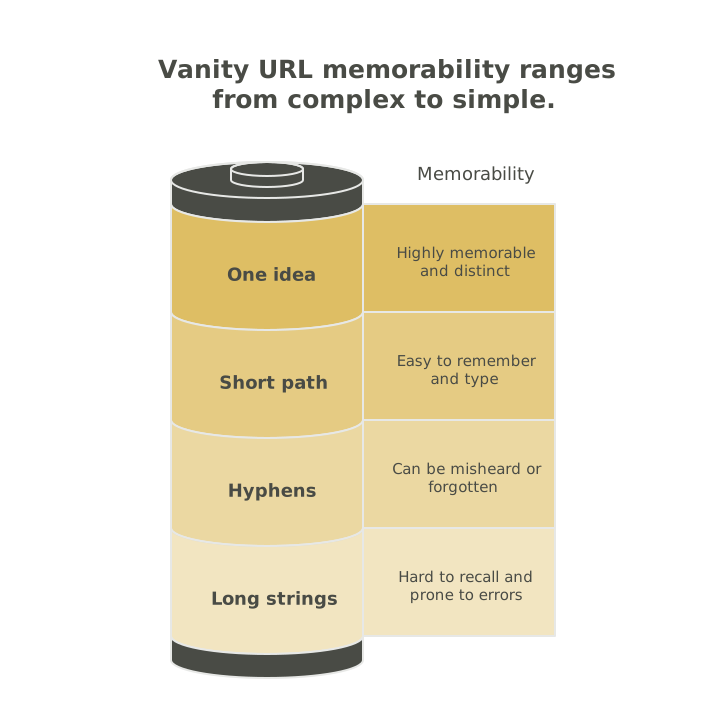
A vanity URL is the bridge between an offline impression and an online session. The goal is memorability, not precision. Avoid complex paths, hyphens, or anything that can be misheard. Keep it short and distinct from other campaigns so your reporting stays clean.
Practical rules for vanity URLs
- Prefer a short path: yourdomain.com/podcast or yourdomain.com/showname.
- Use one idea per URL: don’t pack in multiple keywords.
- Make it readable aloud: avoid “0/O,” “I/l,” and long strings.
- Stabilize per partner: one vanity URL per podcast makes comparisons easier than changing it every episode.
If you want episode-level granularity, use a simple pattern (/showname-jan) and keep it consistent across the quarter. The measurement system described below works for both show-level and episode-level vanity URLs.
Use first-party redirects to capture attribution without cookies
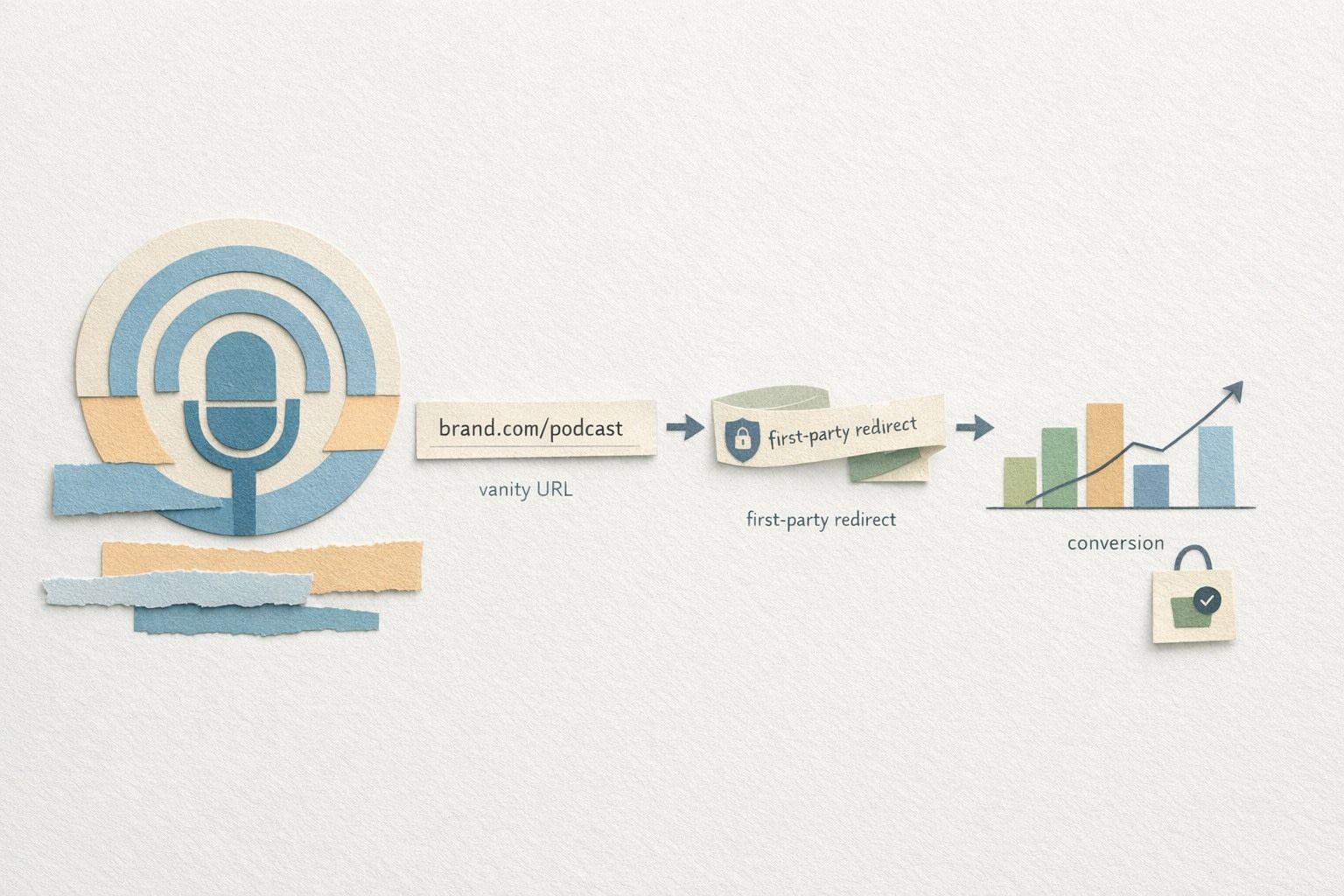
The core idea is simple: the vanity URL should not be the landing page itself. It should be a first-party redirect on your own domain that forwards the user to the intended destination while appending attribution parameters (typically UTMs). Because the redirect is served from your own domain, you can treat it as first-party web behavior rather than relying on third-party identifiers.
What the redirect should do
- Receive a request to /podcast (or similar).
- Issue a fast 302 redirect to the true landing page.
- Append stable campaign parameters, for example: ?utm_source=podcast&utm_medium=sponsorship&utm_campaign=showname.
This gives you a deterministic “entry marker” for sponsorship traffic, even when listeners type the URL manually. It also makes your internal QA straightforward: you can test the vanity URL and confirm the resulting landing page includes the expected UTMs.
Implementation options that stay first-party
- Application-level redirects in your web framework (fast, flexible, version-controlled).
- Edge redirects on your CDN for very low latency and simple management.
- Server redirects in Nginx/Apache if you prefer infrastructure-level control.
In multi-tenant products, keep redirect rules scoped and auditable so teams don’t accidentally reuse the same campaign identifiers across tenants. If you’re already thinking about isolation boundaries in your platform, the same mindset applies to measurement primitives; see edge-enforced tenant isolation for multi-tenant AI apps for a useful conceptual parallel.
Track outcomes with privacy-friendly analytics and codeless goals
Once sponsorship sessions arrive with UTMs intact, measurement becomes about outcomes. You want to answer:
- How many visits and signups did the sponsorship plausibly drive?
- How many of those signups became paying customers?
- What revenue can you reasonably attribute within a defined time window?
A privacy-first analytics setup works well here because you’re not depending on cross-site profiles or persistent identifiers. With Plausible Analytics, you can see UTM campaign performance and define goals for key actions (such as signup confirmation, demo request, or checkout completion) in a single dashboard. If you want a lightweight, cookie-free approach that still supports campaign analysis and conversion funnels, plausible.io is a practical reference point.
Define a measurement-ready goal set
For podcast sponsorships, the best goals are usually “hard” events that map to value:
- Lead capture: form completion, demo request, trial start
- Activation: first project created, first integration connected
- Purchase: checkout success or subscription start
Keep the set small. If you measure ten micro-events, you’ll spend more time debating definitions than comparing partners.
Apply conversion windows that match how podcasts convert
Cookie-less measurement improves when you stop forcing immediate attribution logic on a delayed channel. Podcasts often drive:
- Same-day intent (listeners type the URL right away)
- Weekend catch-up behavior (people binge episodes, then act later)
- Workday follow-through (they remember the offer at their desk)
To reflect that reality, use conversion windows—fixed time spans in which you count conversions as influenced by the sponsorship.
Common windows that work in practice
- Short window (1–3 days): captures immediate responders and reduces ambiguity.
- Standard window (7 days): a good default for weekly show cadence.
- Long window (14–30 days): useful for high-consideration B2B offers, but more prone to overlap with other campaigns.
The key is consistency. Pick a default window for decision-making (often 7 days), then report additional views (1–3 days and 14+ days) to understand how delayed the channel is for your audience.
Calculate ROI with a defensible attribution model
In a cookie-less world, ROI is not a single “true” number. It’s a range based on conservative assumptions. A clean way to present it is:
- Direct response ROI: conversions where the session entered via the vanity URL redirect (UTM-tagged).
- Blended lift: a comparison of baseline conversions vs. conversions during the conversion window, adjusted for seasonality where possible.
Start with direct response. It’s the least debatable, and it’s grounded in first-party behavior. Then, for sponsors that appear strong but “under-credited,” add a lift analysis: compare a matched period (previous weeks or a holdout geo if you have one) to estimate incremental impact.
A simple ROI framework you can reuse
- Cost: sponsorship fee + production time + discount cost (if using promo codes).
- Attributed revenue: revenue from conversions that occurred within the chosen window after an attributed session.
- ROI: (Attributed revenue − Cost) / Cost.
For B2B where revenue is delayed, track pipeline value separately from closed-won revenue, but don’t mix them in the same ROI headline. Decide in advance which number governs renewal decisions.
Operationalize the system so reporting stays stable
The biggest failure mode is inconsistency: changing URL structures mid-campaign, renaming UTMs, or moving landing pages without updating redirects. Treat sponsorship tracking like a small product surface.
- Document a naming convention for utm_campaign and keep it stable for a season.
- Version-control redirect rules so changes are reviewable.
- QA every placement the day it runs: type the vanity URL and confirm the UTMs are present.
- Keep a sponsor log with run dates, offer, landing page, and window used.
If multiple teams handle partnerships, centralize these conventions the same way you would centralize customer feedback identifiers to avoid messy duplicates and misattribution across segments; the idea is similar to building a consistent mapping layer like a feedback identity graph, but applied to campaign definitions.
What “good” looks like when you can’t track individuals
A cookie-less sponsorship measurement program is working when:
- Your vanity URL traffic is stable and attributable across episodes.
- Conversion rates by show make directional sense over time.
- You can justify renewals with a consistent windowed ROI method, not anecdotes.
- Your analytics remains privacy-respecting and understandable to non-analysts.
The result is not perfect attribution. It’s decision-grade attribution—built from first-party redirects, clear conversion windows, and outcomes you can explain in one slide.