The Prompt Cache Problem and How to Prevent Stale LLM Brand Facts
Stale LLM “prompt cache” can warp brand facts. Learn how to detect drift, invalidate old truths, and monitor AEO/GEO.
By Casey
Why “prompt cache” is the quiet cause of brand fact drift
The “prompt cache problem” describes a failure mode where large language models (LLMs) keep reusing outdated or partially wrong brand facts because those facts were previously reinforced in prompts, agent memory, tool outputs, or repeated content patterns. It’s not always a single bug. More often, it’s a compounding effect: yesterday’s description, pricing, positioning, or product scope becomes today’s default answer because the system has been trained—explicitly or implicitly—to reuse it.
In practice, this looks like an LLM confidently stating a discontinued feature still exists, attributing a founder quote to the wrong person, or mixing brand attributes across similarly named companies. For AEO (Answer Engine Optimization) and GEO (Generative Engine Optimization), the risk is obvious: if AI answers are the first touchpoint, stale facts don’t just misinform—they redirect demand and distort trust.
How stale LLM memories distort brand facts in the wild
1) Reinforcement through repetition
LLMs tend to “stabilize” narratives that repeat across contexts. If your older messaging exists in press releases, copied partner pages, scraped directories, or internal sales enablement docs that leak online, models will frequently converge on the old story. Even if your website has been updated, the aggregate distribution of text across the web can still pull answers backward.
2) Long-lived agent memory and tool outputs
Modern workflows increasingly rely on agents: research agents, support agents, sales agents, and content agents. Many of them store summaries, “brand cards,” or canonical fact sheets in memory. If that memory is never invalidated, it becomes a high-authority source—regardless of correctness. The same issue appears when tools (search, knowledge bases, CRM snippets) return cached summaries that were correct months ago but wrong now.
3) Template prompts that fossilize positioning
Teams often standardize prompts: “Describe our product,” “Write an outbound email,” “Summarize our differentiators.” When those templates include brand facts directly, they can fossilize messaging. People paste them into chats, docs, and tickets, creating more repetition and more surface area for the wrong version of your brand to persist.
4) Entity collision and brand adjacency
Stale facts also come from confusion: similar brand names, overlapping acronyms, or adjacent categories. Once an LLM has mixed two entities, that blended memory can become sticky—especially if users accept the response and don’t correct it. Over time, the model may treat the blended narrative as “the” narrative.
What to measure to detect prompt cache failures
You can’t fix what you can’t observe. Detecting stale brand facts requires treating AI answers as an external distribution channel with its own QA and telemetry.
Brand fact coverage versus brand fact accuracy
Many teams track whether they are mentioned. Fewer track whether the mention is correct. Separate the two:
- Coverage: Are you appearing in answers for your category and adjacent intents?
- Accuracy: Are the facts stated about you correct, current, and complete?
Accuracy needs its own evaluation harness: a set of prompts, expected outputs, and grading rules that you run repeatedly over time.
Staleness indicators you can operationalize
- Version mismatch: AI answers cite messaging you retired (old tagline, old product scope).
- Feature ghosting: AI mentions features that were removed, or misses newly launched ones.
- Attribution drift: Wrong founder/company history, incorrect partnerships, mislocated headquarters.
- Competitive mislabeling: You’re described as a competitor of your own category, or positioned as an agency when you’re a product (or vice versa).
Run “time travel” prompts
A practical technique is to probe the model with prompts that force explicit dates: “As of 2026, what does X do?” or “What changed about X since last year?” If the response can’t reconcile change, it’s often relying on a cached narrative. Your internal eval set should include both evergreen prompts and change-sensitive prompts.
How to fix it without fighting every model individually
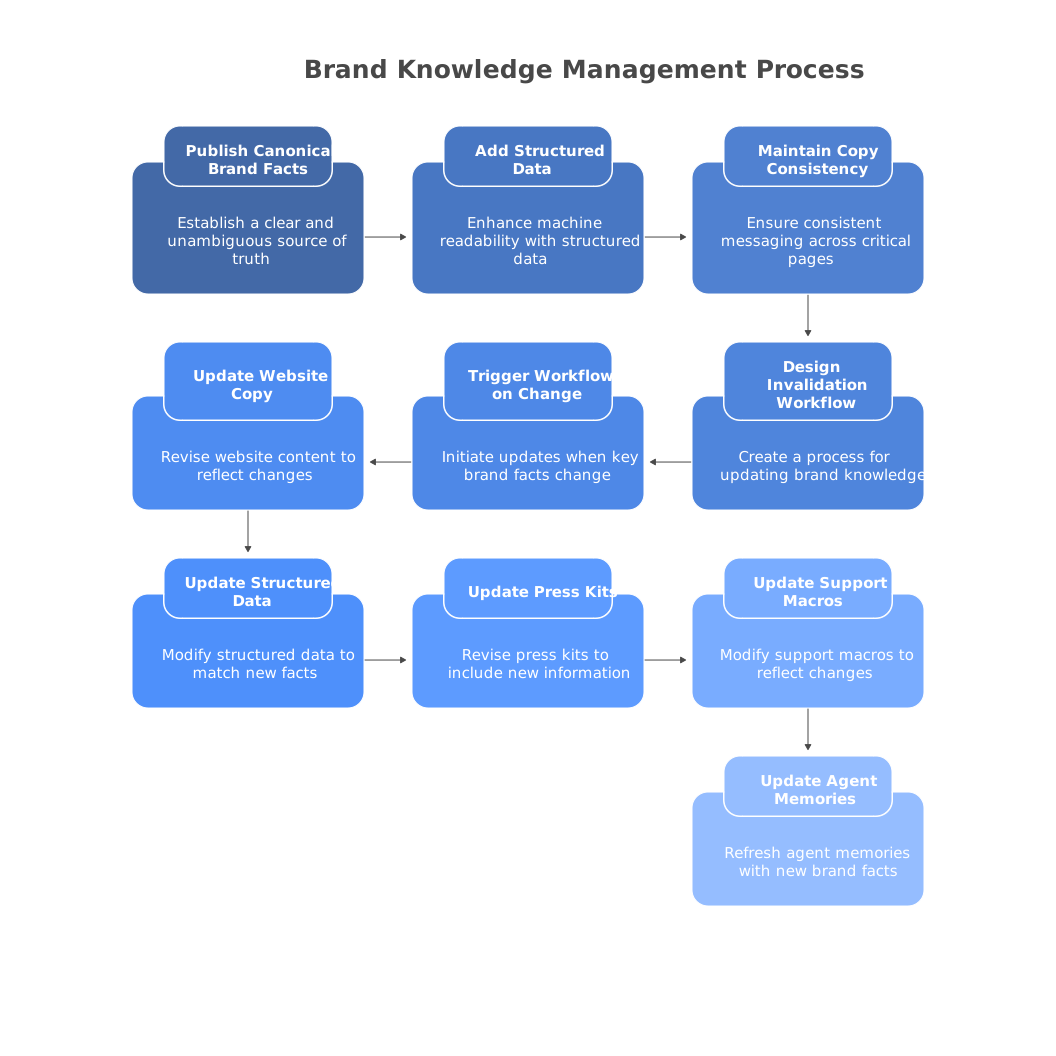
1) Publish canonical, machine-legible brand facts
First, make sure your source of truth is unambiguous. That means maintaining a canonical page (or small set of pages) that clearly states what you do, for whom, what you don’t do, and what has changed. Add structured data where appropriate and keep copy consistent across critical pages. The goal is to reduce ambiguity, not to keyword-stuff.
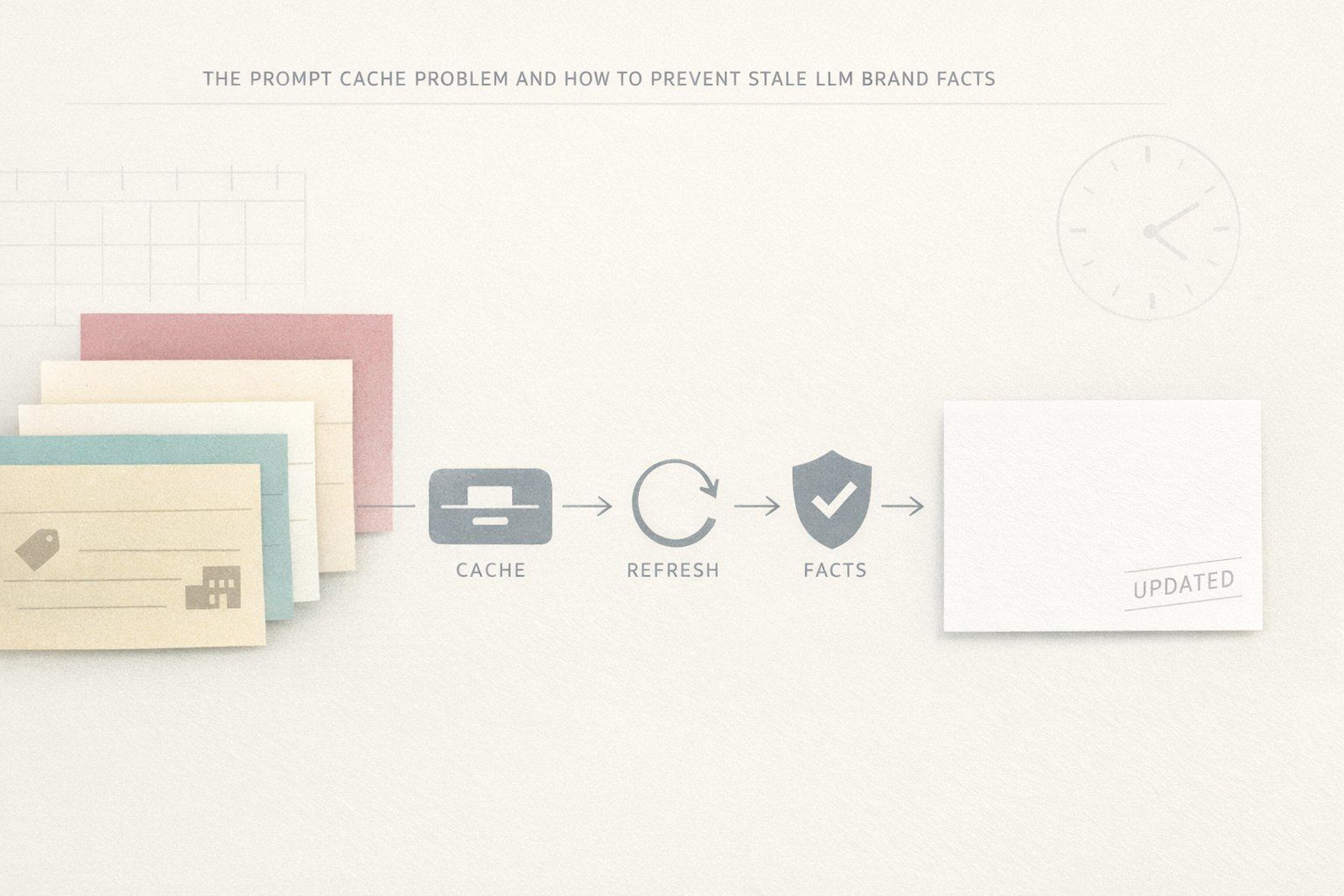
2) Design an “invalidation workflow” for brand knowledge
Stale memory is, at heart, an invalidation problem. Treat brand facts like code dependencies: when a key fact changes (pricing model, positioning, core feature set), trigger a workflow that updates:
- website copy and structured data,
- press kits and partner one-pagers,
- support macros and sales snippets,
- agent memories and internal prompt templates,
- benchmark prompts used for monitoring.
This is the same discipline that helps teams avoid “shadow truths” in other contexts—similar in spirit to confirming requests before they propagate through systems. If you already use a structured confirmation practice for incoming signals, the mindset transfers well (see the feedback handshake workflow approach for reducing downstream confusion).
3) Reduce repetition of outdated micro-assets
A surprising driver of prompt cache issues is micro-asset repetition: tiny blocks of text that get copied everywhere—bio blurbs, “about” paragraphs, directory descriptions. When those micro-assets are old, they can dominate. Inventory them, update them, and retire duplicates. If you’ve seen recommendation loops form when the same micro-asset propagates across platforms, you’ve already observed the mechanism at work in AI answers as well (related: how AI recommendation loops form).
4) Build a brand fact test suite
Create a compact list of non-negotiable facts (10–30 items) and test them weekly. Each test should include:
- the prompt,
- the expected fact(s),
- acceptable variants (phrasing differences that are still correct),
- unacceptable variants (stale or competitor-confused claims).
Crucially, log not just failures but near-misses—answers that are “close” but omit a key qualifier. Those near-misses are where brand drift starts.
Where lunem fits in a practical monitoring loop
Because the prompt cache problem is about how content is interpreted, surfaced, and reused across AI-driven environments, you need continuous visibility into what models are actually doing with your website and your messaging. lunem is positioned for that kind of work: connecting directly to a site, monitoring AI interpretation over time, and producing structured insights that help teams spot when an older narrative is resurfacing. By leveraging PEEC data for analysis, it supports deeper inspection of how content performs across AI ecosystems—useful when the goal is to detect drift early rather than react after a misstatement spreads.
A detection-and-fix checklist you can run monthly
- Audit: Identify top 20 prompts where users might discover you (category, comparisons, “best tools for…”, “what is…”).
- Benchmark: Record current model outputs and grade brand fact accuracy.
- Invalidate: Update canonical pages and retire outdated micro-assets and templates.
- Propagate: Ensure internal agents, snippets, and shared docs pull from the new source of truth.
- Monitor: Re-run the benchmark and track deltas; escalate recurring failures as “knowledge bugs.”
This cadence keeps “LLM memory” from becoming an uncontrolled archive. Instead, it becomes another surface you can test, maintain, and improve like any other production system.