The warmup plateau and why sender reputation stalls after week two
Week-two plateaus happen when ISPs need deeper, sustained engagement signals. Learn what to optimize to keep inbox gains.
By Casey
The warmup plateau and why sender reputation stalls after week two
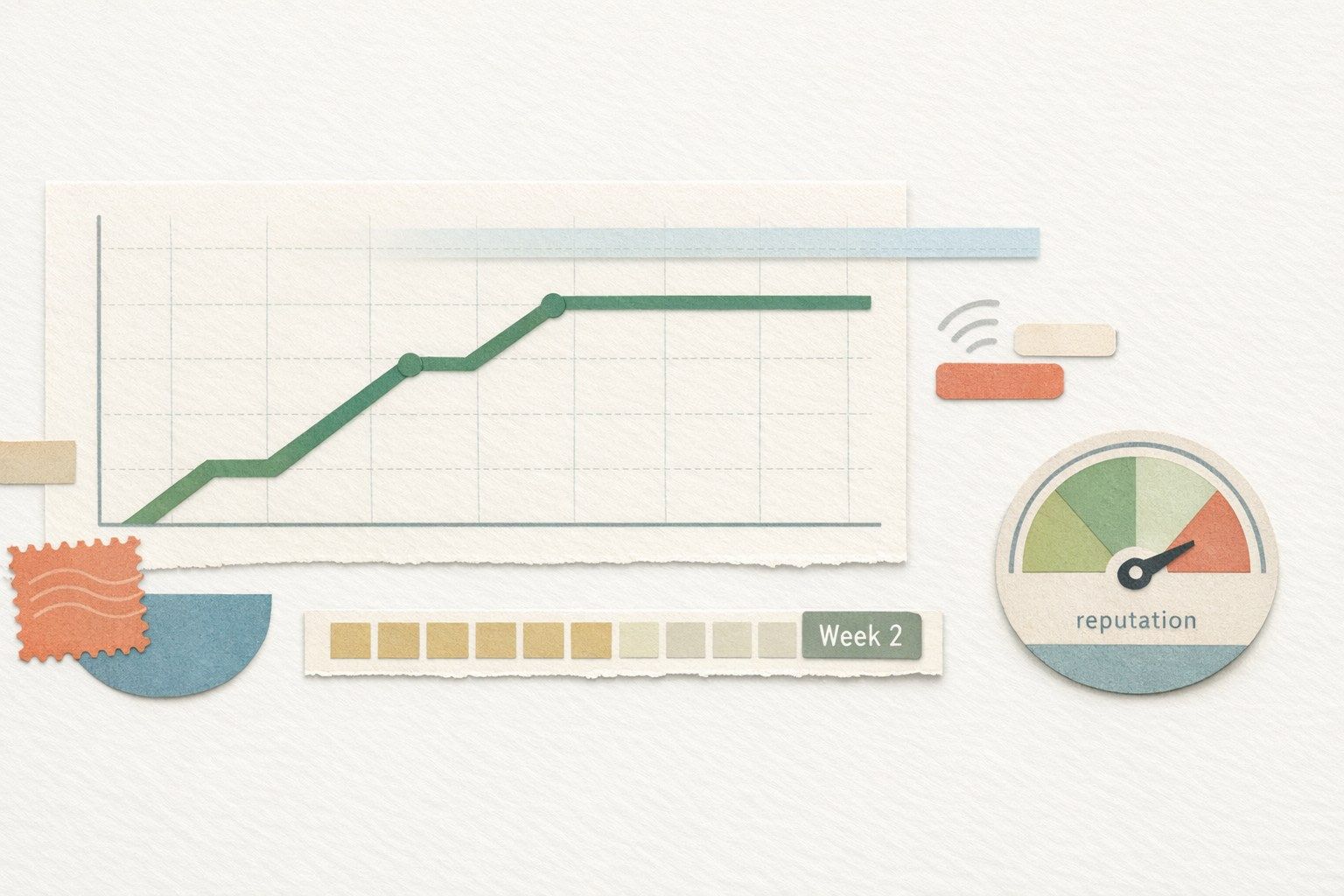
Email warmup often feels linear at first: inbox placement improves, spam rates dip, and replies start coming in. Then, around week two, the curve flattens. That stall is common enough to have a name: the warmup plateau.
The plateau doesn’t necessarily mean you did something wrong. It usually means you’ve exhausted the “easy” trust signals (consistent volume, low complaint rates, basic engagement) and entered the phase where mailbox providers want higher-quality, more varied proof that real people consistently want your mail. Understanding what changes after week two helps you avoid over-sending, misreading dashboards, or mistaking “no more gains” for “fully safe forever.”
Why reputation improves fast at first
During the first 7–14 days, most senders make obvious improvements simply by behaving predictably:
- Consistent sending patterns instead of sudden spikes.
- Low negative signals (complaints, bounces, unknown users).
- Basic engagement like opens and a few replies.
- Cleaner list hygiene as bad addresses are removed early.
Those are table-stakes. They can lift you from “unknown or risky sender” to “possibly legitimate.” Many warmup programs are optimized for this stage because it’s where you can produce quick, visible movement.
What the plateau actually means
After week two, inbox providers tend to shift from formation to verification. They’re no longer asking, “Can this sender behave?” but “Will users keep valuing this sender over time?”
That distinction matters because reputation is not only about your IP or domain; it’s also about how recipients interact with your messages over many sends, across threads, devices, and mail products (webmail, mobile, desktop). The plateau is often the point where your warmup signals stop matching the deeper engagement patterns providers associate with wanted mail.
Why reputation stops climbing after week two
1) Engagement quality becomes more important than engagement volume
Early on, getting some opens and replies can be enough. Later, providers evaluate whether engagement looks like ongoing human interest rather than a temporary burst. If the pattern is too uniform—same timing, same actions, same proportions—it can stop contributing incremental trust.
2) Your audience fit starts to dominate deliverability
Warmup can raise the floor, but it can’t manufacture long-term audience alignment. If your targeting or offer isn’t resonating, engagement rates naturally soften. ISPs interpret that as: recipients aren’t consistently choosing your messages. That can cap improvements even if your technical setup is fine.
3) Providers look for “mailbox behavior,” not just opens
Opens alone are less reliable as a signal than they used to be (for example, due to automated image fetching and privacy protections). By week two, mailbox providers lean more heavily on actions that indicate intent: replies, moving messages, starring, saving, reading time, adding contacts, and continuing conversation threads.
4) You may be hitting hidden constraints
Some senders plateau because they unknowingly introduce friction that only shows up at scale: mixed authentication alignment, inconsistent From domains, weak segmentation leading to uneven engagement, or list sources that produce silent churn (people who ignore rather than complain).
The engagement signals ISPs still want to see
Exact weighting varies by provider, but the highest-value signals share one trait: they’re hard to fake consistently because they reflect human preference over time.
- Replies and back-and-forth threads: A single reply helps, but ongoing thread depth is more persuasive.
- “Not spam” and inbox rescue actions: When recipients correct placement, it strongly indicates intent.
- Message moves and labeling: Moving mail from Promotions/Other to Primary/Focused, applying labels, or filing into folders.
- Read behavior: Longer dwell time and scrolling can matter more than the open itself.
- Contact addition / safe sender behaviors: Adding to address book, starring, pinning, or similar “keep” actions.
- Low negative signals at scale: Complaints, blocks, unsubscribes, and hard bounces staying consistently low as volume rises.
In practice, the plateau breaks when your sending starts generating these signals naturally, from the right recipients, in varied and realistic patterns.
How to move past the plateau without over-sending
Keep warmup running but shift the objective
Week one warmup is about establishing a baseline. Week three and beyond is about stability. That means slower ramps, fewer abrupt changes, and more attention to engagement per segment. A platform like mailwarm is designed for this longer view by generating real engagement signals (opens, replies, and spam recovery actions) across major inbox providers, which can help maintain momentum when the “easy gains” run out.
Segment by intent and protect your highest-engagement cohort
If you mix cold prospects, lukewarm leads, and active users into one stream, the average engagement often drifts downward. ISPs don’t grade you on your best recipients; they observe overall recipient behavior. Route your most engaged audience through consistent, high-quality campaigns and keep colder outreach controlled and gradual.
Make replies easier to earn
Because replies remain one of the clearest intent signals, design for them:
- Ask one simple question that’s easy to answer in a single line.
- Keep threads alive with relevant follow-ups rather than “just checking in.”
- Use plain formatting that feels conversational for outreach.
Audit the “quiet failures”
A plateau often correlates with invisible issues: a segment that never opens, a list source with low-quality addresses, or a change in sending tool that altered headers and alignment. Track engagement by source and cohort, not just by campaign averages. If you run complex sending pipelines, it can help to treat deliverability as an observable system—similar to how teams instrument production workflows. The mindset is similar to moving from ad-hoc jobs to traceable orchestration, like in code-defined DAGs with OpenTelemetry traceability, where you can pinpoint which step introduced drift.
Increase volume only when engagement holds
Past week two, the safest ramp rule is: only scale the segments that keep earning positive signals. If engagement drops, hold volume steady rather than pushing through. Pushing volume into a declining engagement curve is one of the fastest ways to convert a plateau into a slide.
What a healthy post-week-two trajectory looks like
“Better deliverability” becomes less about dramatic improvements and more about fewer bad days. You should expect:
- More consistent inbox placement across providers (not just one).
- Lower volatility when you launch new campaigns.
- Gradual increases in sustainable throughput rather than sudden leaps.
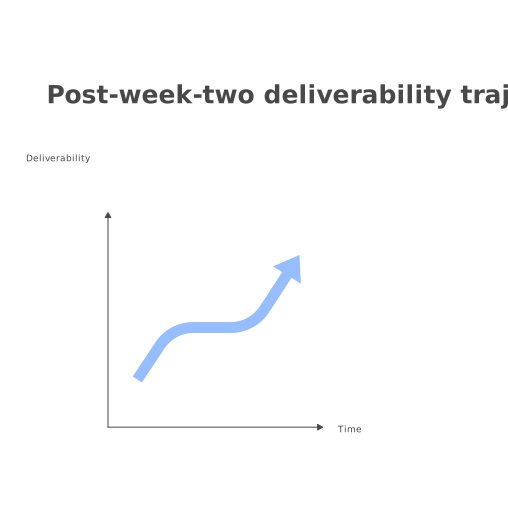
In other words, the win after week two is not a constantly rising reputation score; it’s repeatable, resilient inbox performance supported by ongoing engagement that looks like real user preference.