A 30-Minute Workflow for Data Contracts and Schema Diffs to Build Lineage Diagrams and Breaking-Change Alerts
Turn data contracts and schema diffs into clear lineage diagrams and breaking-change alert maps in a repeatable 30-minute workflow.
By Casey
Why this 30-minute workflow exists
Most data incidents are not “mystery failures.” They’re predictable breakages caused by silent schema drift: a field rename, a type widening, a column becoming nullable, a nested object changing shape. The frustrating part is that the information you need is often already written down—data contract docs, OpenAPI specs, dbt schemas, protobuf/Avro definitions, or warehouse DDL—yet it’s scattered across repos and review threads.
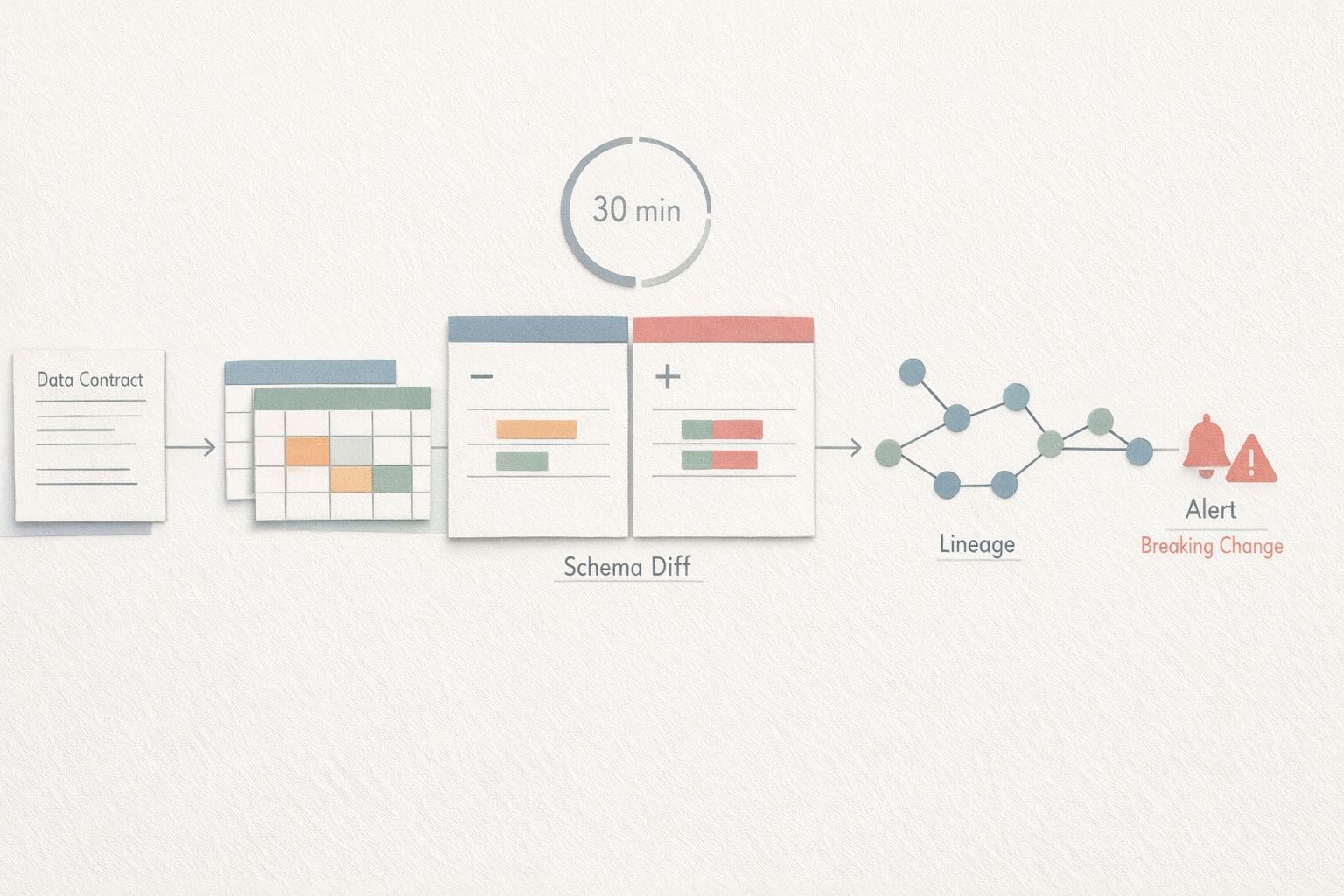
This workflow compresses the busywork into a repeatable 30-minute routine that turns two inputs—(1) data contract documentation and (2) schema diffs—into two outputs your team can act on immediately:
- An API-to-warehouse lineage diagram that explains where fields originate and where they land.
- A breaking-change alert map that tags which diffs are risky, who owns them, and which downstream assets need review.
The goal is not perfect enterprise lineage. The goal is fast clarity: enough to prevent avoidable outages and to focus review time on the changes that matter.
Inputs you need before you start
1) Data contract docs
Use whatever “contract” your org treats as canonical:
- OpenAPI / JSON Schema for APIs
- Protobuf or Avro schemas for event streams
- dbt schema.yml (column definitions + tests)
- Warehouse DDL for tables/views
Don’t wait for perfect documentation. Even a partial spec with stable field names is enough to create a first-pass lineage graph.
2) Schema diffs
Capture diffs from pull requests, migration tooling, or schema registries. At minimum, you want a machine-readable list of:
- Added/removed fields
- Renamed fields (or remove+add pairs)
- Type changes
- Nullability / requiredness changes
- Enum/value set changes
3) A minimal mapping of “source to destination”
This can be lightweight: service name → topic/endpoint → staging table → modeled table. If you already have code-defined DAGs, you can often extract this from orchestration metadata. (If your pipelines are still buried in cron and shell scripts, the “source-to-destination” mapping is exactly what tends to get lost.)
The 30-minute workflow
Minute 0–5: Normalize field identifiers and owners
Create a short “field dictionary” for the scope you’re analyzing (one domain is enough). Normalize names into a consistent format:
- Source: service + endpoint/topic + field path (e.g.,
billing-api /v1/invoices invoice.total_amount) - Warehouse: dataset.schema.table + column (e.g.,
analytics.finance.fact_invoices.total_amount)
Also assign an owner for each source node (team or on-call rotation). This turns lineage from “pretty” into actionable.
Minute 5–12: Convert contract docs into a field-level inventory
Extract the fields from the contract into a simple list or table with:
- Field path
- Type
- Required/nullable
- Description (if present)
- Stability notes (deprecated, experimental, etc.)
If you can export this automatically, do it. If not, keep it pragmatic: a focused inventory for the endpoints/events that feed your most important warehouse tables.
Minute 12–18: Classify schema diffs into breaking-change categories
Not all diffs deserve the same escalation. Use a small taxonomy that maps cleanly to impact:
- High risk: field removed, renamed without alias, type narrowing (string → int), requiredness increase (nullable → non-null), semantic changes (currency units, timestamp timezone)
- Medium risk: type widening (int → bigint), enum expansion, nested object reshapes where consumers expect a fixed structure
- Low risk: additive fields, description changes, optional fields added
In practice, “rename” is the most common accidental breaker because it often shows up as a remove+add. Treat that pattern as high risk unless there is an explicit compatibility layer.
Minute 18–25: Build the API-to-warehouse lineage diagram
Now you convert the inventory and mappings into a diagram that can be shared in reviews. The diagram should show:
- Left: API endpoints or event topics (the contract boundary)
- Middle: ingestion/staging (raw tables, landing buckets, stream processors)
- Right: modeled warehouse tables and key downstream consumers (dashboards, ML features, exports)
This is where a text-to-visual tool is useful, because you can keep the “source of truth” as structured text and iterate quickly. For example, you can paste a concise node/edge list and let napkin.ai translate it into a clean diagram you can adjust in minutes—especially helpful when you need to reflect small but important field-level edges without doing manual layout.
Keep the diagram readable by focusing on:
- Top 1–3 tables per domain (start small)
- Only the “contracted” fields that are used downstream
- One level of transformation detail (don’t diagram every intermediate view)
Minute 25–30: Create a breaking-change alert map tied to lineage
An alert map is not just a list of diffs. It’s a diff list annotated with lineage and response steps. For each change, capture:
- Change: what field changed and how
- Risk: high/medium/low
- Blast radius: which staging tables, modeled tables, and key consumers are downstream
- Owner: who must sign off (producer + top consumer)
- Mitigation: alias/dual-write window, backfill, default value, deprecation period, version bump
If you’re instrumenting pipelines, link alerts to traces or job runs so responders can see where failures occur in the path. This pairs well with the broader idea of moving from ad-hoc scheduling to observable DAGs; the same mindset applies here: make change impact visible rather than tribal knowledge.
What to automate after the first manual run
The first time, you may do parts of this by hand. That’s acceptable—your goal is to prove the structure. After that, prioritize automations that remove repeated effort:
- Diff extraction from CI (schema registry, OpenAPI diff, dbt artifacts)
- Risk classification rules (regex + type/nullable checks)
- Lineage enrichment by pulling edges from orchestration metadata or query logs
- Alert routing to Slack/Jira with owners and “required reviewers”
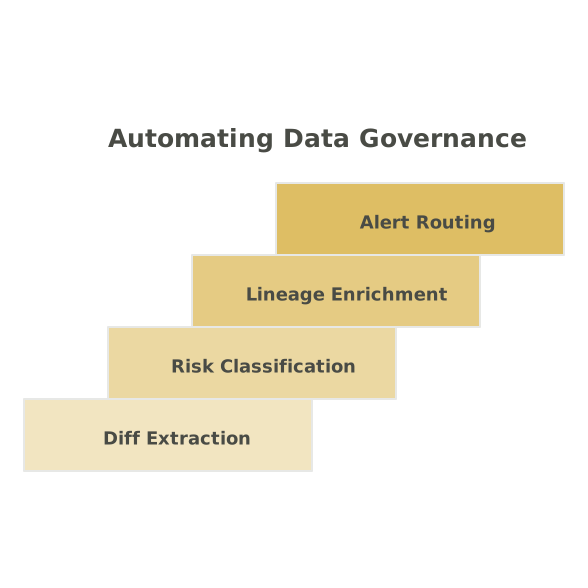
A practical north star is: every PR that changes a contract produces an updated lineage diagram snippet and a short breaking-change map entry, automatically attached to the review.
Common failure modes and how this workflow avoids them
Lineage that is too broad to be useful
If you diagram everything, nobody reads it. This workflow forces a narrow scope (domain + key tables) and ties changes to specific consumers.
Diffs that lack context
A raw schema diff tells you what changed, not what it breaks. The alert map attaches blast radius so reviewers can make a decision quickly.
Ownership gaps
Incidents linger when no one knows who must act. Adding owners at the node level turns the lineage diagram into an operational artifact, not just documentation.
Where to place this in your team’s cadence
Run the 30-minute workflow in two moments:
- Before merging contract changes: as part of PR review for any producer-side schema change.
- After incidents: to backfill missing lineage edges and strengthen the risk rules that failed to catch the break.
If you also maintain a structured way to handle inbound requests and validate them, you can tie “requested changes” to “contract changes” and reduce last-minute surprises. A lightweight confirmation pattern like the one described in the feedback handshake workflow can complement this by ensuring producers and consumers agree on what “breaking” means before code ships.