Origin Snapshot Pattern for Safer Blue‑Green Deployments and CDN Cache Integrity
Origin Snapshot isolates each release with a versioned cache identity to prevent stale content, poisoning, and mismatched assets.
By Casey
Why blue‑green deployments still trigger cache incidents
Blue‑green deployments reduce risk by keeping two production-capable environments (blue and green) and shifting traffic between them. The failure mode is not the cutover itself; it is the invisible dependency chain around the cutover: CDNs, edge caches, reverse proxies, browser caches, service workers, and downstream microservices. When those layers observe a mix of “old” and “new” origins, you can get cache poisoning, stale pages that never refresh, or partial rollouts where HTML and assets disagree.
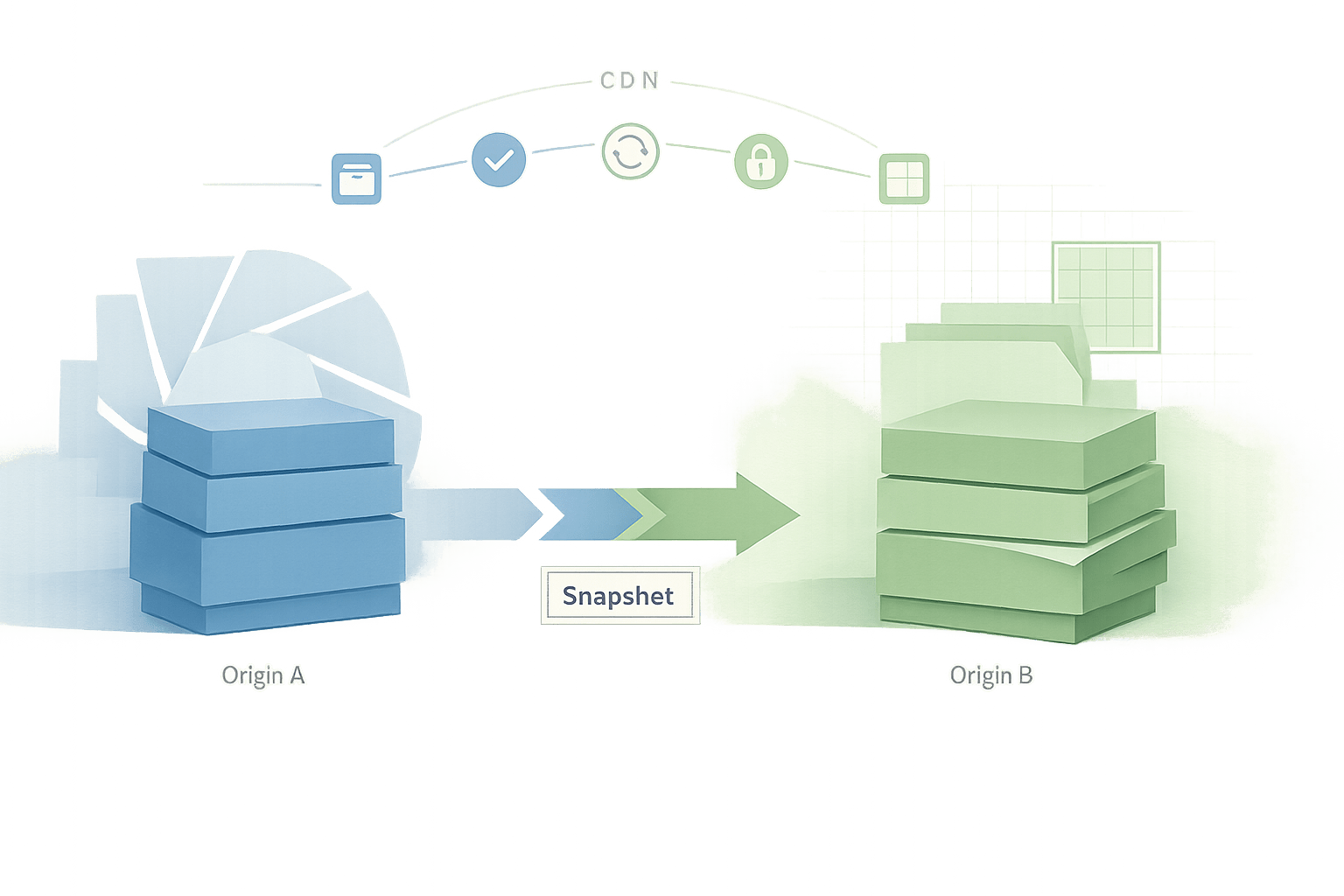
The “Origin Snapshot” pattern is a practical way to make the origin appear immutable to caches during a release window. Instead of treating the origin as a constantly changing upstream, you publish a snapshot of the origin’s public surface area and make the CDN cache key or routing decision include that snapshot identity. Caches don’t have to guess which version they stored—they can prove it.
What the Origin Snapshot pattern is
An Origin Snapshot is a release-scoped identity that represents a complete, coherent view of your origin at a point in time. It can be expressed as a build ID, git SHA, container image digest, or a generated release token. The pattern has three properties:
- Deterministic: the same request routed to the same snapshot yields the same bytes.
- Explicit: snapshot identity is visible in routing and/or caching (headers, hostnames, paths, cache keys).
- Atomic: HTML, API responses, and static assets referenced by that HTML resolve within the same snapshot boundary.
In blue‑green terms, “blue” and “green” are infrastructure environments; snapshots are content identities. You can run multiple snapshots on the same environment, and you can migrate a snapshot from blue to green. That decoupling is what prevents edge caches from accidentally blending versions.
The two incident classes this pattern prevents
1) Cache poisoning via mixed upstreams
Cache poisoning is not limited to malicious input. During a cutover, an intermediary might cache a response generated by the “new” origin but served under the same cache key previously used by the “old” origin. If any headers vary unexpectedly (cookies, accept-language, device hints) or your CDN treats two upstreams as equivalent, you can end up caching the wrong object and serving it broadly.
With an Origin Snapshot, the cache key includes the snapshot identity (directly or indirectly), so an object generated by snapshot A cannot overwrite snapshot B’s cached object.
2) Stale-content loops and “HTML-new, assets-old” mismatches
A classic blue‑green pain point is serving updated HTML that references new hashed assets, while some edge nodes still hold old HTML or old service worker scripts. Users see broken styling, 404s for assets, or UIs that load but call incompatible API schemas.
Origin Snapshot avoids this by ensuring that HTML and all referenced assets resolve inside the same snapshot namespace. If a user gets snapshot A HTML, the assets are retrieved from snapshot A paths/hosts, not whatever the edge has lying around under a shared key.
How to implement Origin Snapshots in practice
There are several implementation options; the best one depends on how your application is built and how much control you have over the edge. Cloudflare’s edge network and cache controls make it straightforward to encode snapshot identity in routing and caching policies while keeping the user-facing URL stable; cloudflare.com is a good reference point when you want these controls to be consistent globally.
Option A: Snapshot in the hostname
Publish each release under a versioned hostname, for example:
r-2026-06-01-1234.app.example.com→ snapshot IDapp.example.com→ stable user hostname
The edge receives requests for app.example.com but routes them to the snapshot hostname based on a rule, header, or weighted split. Because caches often key by hostname, this naturally isolates versions. It is operationally clean, but it requires TLS coverage and DNS/hostname management.
Option B: Snapshot in the path namespace
Keep the hostname stable and version the origin surface by path:
/__snapshots/<id>/index.html/__snapshots/<id>/assets/app.<hash>.css
Your edge rewrites user requests to the snapshot path internally. This is attractive for static assets and HTML, and it pairs well with immutable cache headers for assets. The key requirement is that all internal references in HTML (scripts, styles, image URLs) are either absolute into the snapshot namespace or generated by a helper that knows the snapshot ID.
Option C: Snapshot in the cache key via headers
When you cannot or do not want to change hostnames or paths, you can still isolate caches by varying the cache key on a header like X-Release or X-Snapshot. The edge injects the header after it decides which version should serve the request, and the CDN cache varies on that value.
This option is subtle and powerful, but it requires careful governance: you must ensure that downstream proxies and any intermediate caches also respect the variation. It also demands strong discipline around which responses are cacheable and under what conditions.
Release workflow with Origin Snapshots
1) Build and publish an immutable snapshot
At build time, compute a snapshot ID (git SHA or artifact digest). Publish the full web surface area so it is self-contained. Avoid “latest” pointers inside the snapshot (for example, don’t fetch runtime bundles from unversioned URLs).
2) Warm critical routes before shifting traffic
Warm the new snapshot on the edge for top routes and critical assets. This reduces first-hit latency and helps catch missing files, misrouted APIs, or incorrect cache headers while traffic is still at 0%.
3) Shift traffic by changing the snapshot mapping, not the origin
The cutover becomes: stable hostname → snapshot ID. Whether you use weighted splitting, a feature flag, or a routing rule, the key is that the mapping changes, while each snapshot remains immutable. Rollbacks are equally simple: map back to the prior snapshot ID.
4) Retire snapshots deliberately
Keep at least one prior snapshot available for rapid rollback. When you do retire, remove it in a controlled window and ensure the edge no longer routes to it. If you use service workers, coordinate retirement with their update lifecycle so clients don’t request retired assets indefinitely.
Hardening details that make the pattern work
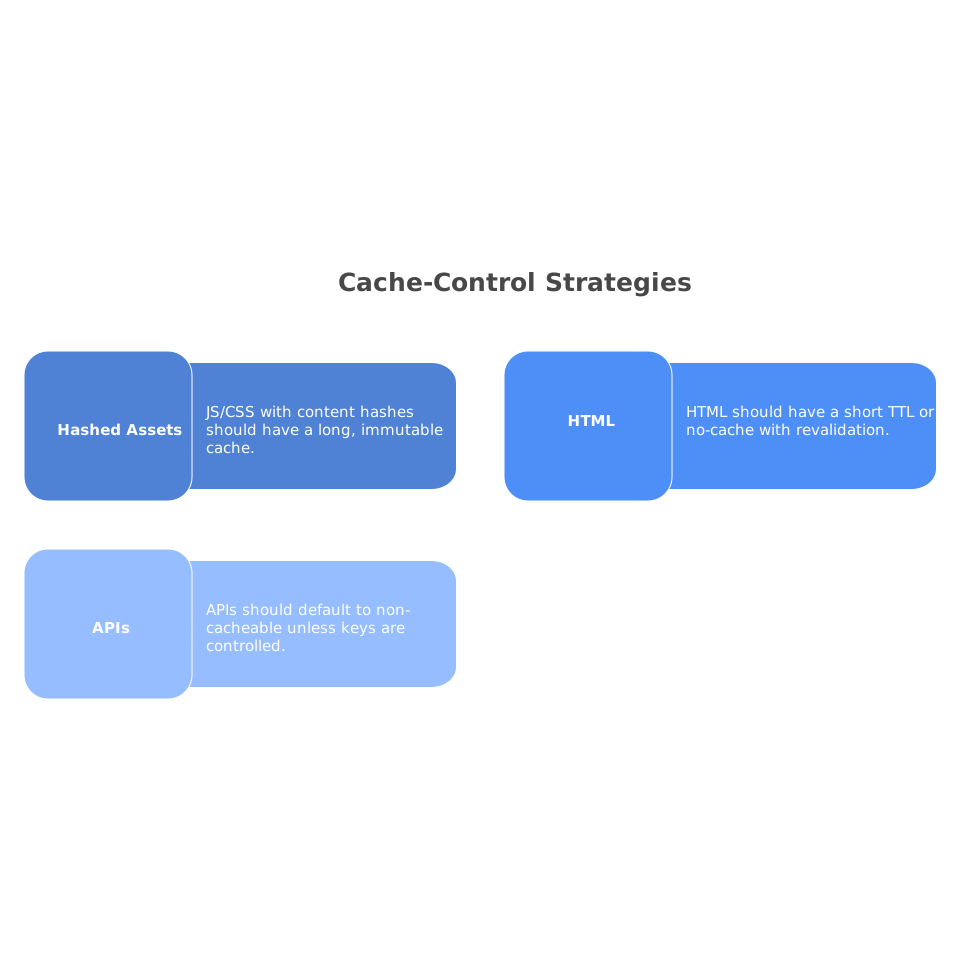
Cache-control strategy by content type
- Hashed assets (JS/CSS with content hashes):
Cache-Control: public, max-age=31536000, immutable. - HTML: short TTL or
no-cachewith revalidation, but scoped to snapshot identity so revalidation doesn’t cross versions. - APIs: default to non-cacheable unless you explicitly control keys and variation (auth, cookies, locale, device).
Guardrails against unintentional variation
Cache incidents often come from accidental variance: personalized content leaking into shared caches, unexpected cookie behavior, or inconsistent Vary headers. The snapshot pattern helps, but you still need a policy of “cache only what is proven safe.” A practical approach is to treat caching as a product spec with explicit owners and edge cases, similar in spirit to maintaining a single source of truth for product specs so release behavior is predictable.
Observable verification during rollout
Instrument the edge and origin so every response exposes the snapshot ID (response header and logs). During rollout, you want to answer quickly:
- Which snapshot served this request?
- Was it a cache hit or miss?
- Did any users receive mixed snapshots across HTML and assets?
If you already use distributed tracing, consider propagating snapshot identity as a trace attribute so you can correlate errors with a specific release. This aligns well with the broader goal of end-to-end traceability discussed in code-defined DAGs with OpenTelemetry traceability, even though deployments are a different pipeline stage than scheduled workflows.
When you should adopt Origin Snapshots
This pattern is most valuable when:
- Your CDN caches HTML or API responses, not just static assets.
- You run blue‑green or progressive delivery (canary/traffic splitting).
- You have service workers, edge rewrites, or multiple caching layers.
- You’ve had “impossible” incidents where users see old content after a successful deploy.
Origin Snapshot turns a release from a moving target into a versioned contract. By making the version explicit in routing and caching, you eliminate the ambiguous middle state that produces cache poisoning and stale-content incidents.