Deploying AI Agents at Scale With Cloudflare Agent Cloud
A practical guide to scaling AI agents with durable state, bounded tools, queues, and observability on Cloudflare’s platform.
By Casey
What it means to deploy AI agents at scale
“Deploying AI agents at scale” is less about adding more model calls and more about making an agent system dependable under real production constraints: fluctuating traffic, strict latency budgets, clear security boundaries, and predictable costs. In practice, scaling agents requires repeatable execution, durable state, safe tool access, and observability that explains what happened when an agent gets something wrong.
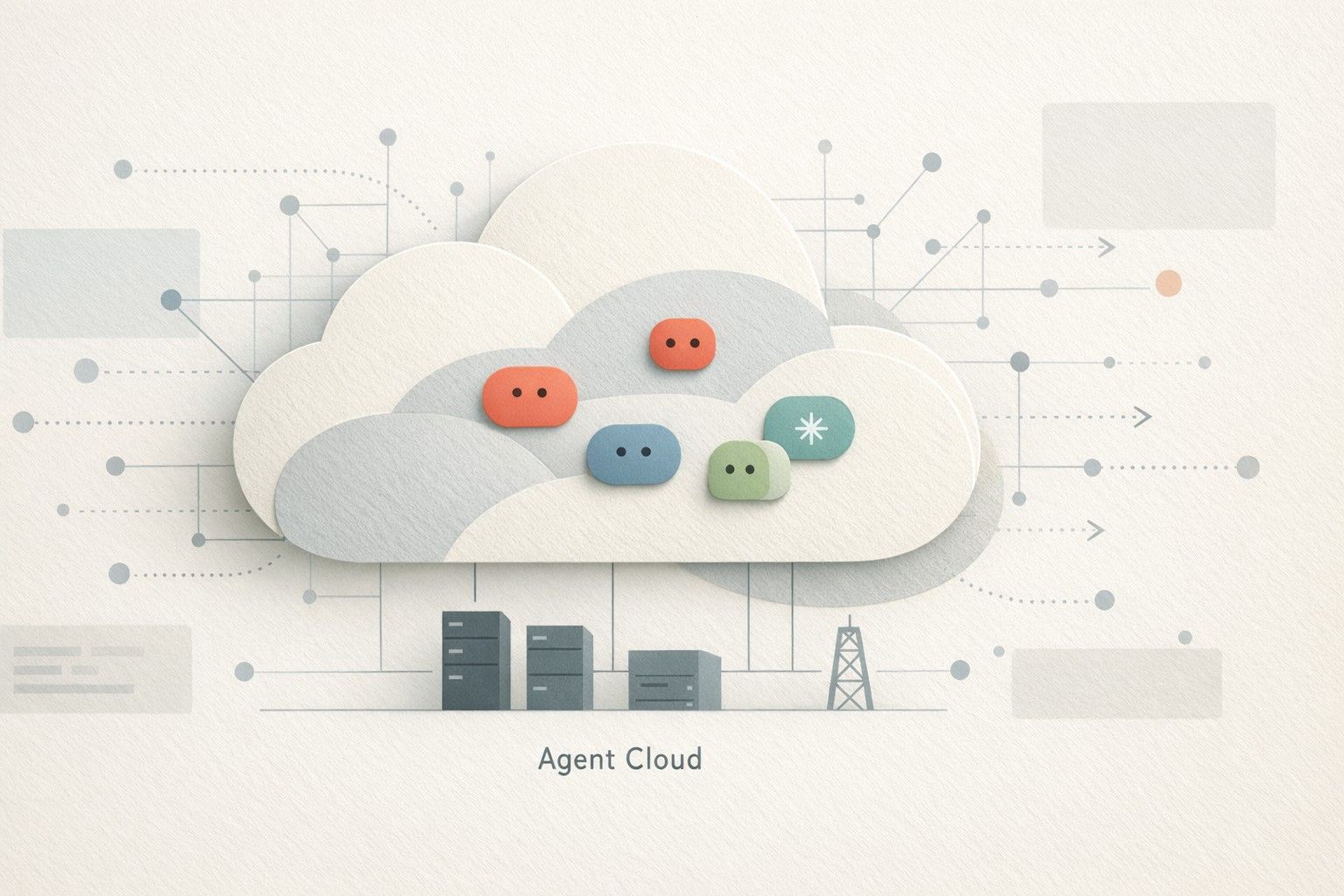
Cloudflare’s developer platform is often a practical fit for this problem because it combines global edge compute with storage and security primitives. If you’re standardizing where agents run and how they connect to data and tools, it helps to treat the platform as an execution layer rather than a collection of ad hoc scripts. In that context, Cloudflare Agent Cloud becomes a convenient way to talk about an “agent-ready” cloud surface: Workers for compute, integrated data services, and security controls delivered on the same global network described at cloudflare.com.
Core architecture for cloud-scale agents
1) Split the system into an agent runtime and tool services
A scalable agent design separates “reasoning and coordination” from “side effects.” The agent runtime orchestrates steps: interpret the request, choose tools, call tools, validate results, and produce an output. Tool services perform specific actions: querying a database, updating a ticket, generating a report, or calling an internal API.
This separation keeps your agent safer and easier to test. Tools can enforce input schemas, permissions, rate limits, and idempotency. The agent runtime becomes easier to evolve because it is not tightly coupled to every external system.
2) Make state explicit and durable
At small scale, it’s tempting to keep everything in memory. At production scale, agents need durable state for at least three reasons:
- Conversation and task context across retries, timeouts, and multi-step workflows.
- Work coordination for parallel tool calls, fan-out/fan-in patterns, and de-duplication.
- Auditability to reconstruct what the agent saw and did (within your privacy rules).
On Cloudflare’s platform, this typically means pairing Workers with the right persistence layer for the job: object storage for payloads, KV-style lookup for configuration, and a database when relational querying is essential. The important design point is to model state transitions (queued → running → waiting-on-tool → completed/failed) rather than letting state “just happen” inside one request.
3) Treat scheduling as product infrastructure, not cron sprawl
Many “agent deployments” fail because they grow as a pile of scheduled scripts: one job to fetch data, another to summarize, another to push updates. Over time it becomes difficult to reason about dependencies, retries, and partial failures. A more reliable approach is to define agent workflows as DAGs or step-based pipelines with explicit dependencies, timeouts, and observability.
If you’re currently managing scattered cron jobs, it’s worth reframing the work as code-defined orchestration with traceability. The same mindset that helps in conventional automation also improves agent systems, because agent workflows often include both deterministic steps (data pulls) and non-deterministic steps (model calls). For a practical perspective on modernizing automation, see migrating cron sprawl to code-defined DAGs with OpenTelemetry traceability.
Scaling patterns that hold up in production
Queue-first execution for bursty traffic
Agents are naturally bursty: a single user action can trigger multiple tool calls, and marketing or product changes can produce sudden spikes. A queue-first pattern absorbs bursts and smooths load. The agent runtime enqueues work items, workers consume them at a controlled rate, and each work item is processed with strict time and cost guards.
Two practical rules help here:
- Make work items idempotent so retries do not duplicate side effects.
- Store intermediate results so long tool chains can resume rather than restart.
Bounded tool access with policy gates
Tooling is where agents touch your systems of record, so scaling safely means introducing policy gates. Instead of letting the agent call arbitrary endpoints, define a tool catalog with:
- Strict input/output schemas
- Per-tool permissions (who/what can run it)
- Rate limits and concurrency limits
- Environment separation (dev/staging/prod)
Cloudflare’s security posture—WAF, bot management, DDoS mitigation, and Zero Trust capabilities on the same network—matters because agent traffic isn’t just user traffic. It includes automated tool calls, webhooks, and service-to-service requests. Consolidating these protections alongside the runtime reduces the number of “gaps” where untrusted calls slip through.
Multi-agent orchestration without losing control
As you scale, you may choose to split responsibilities across agents: one agent triages a request, another gathers data, another drafts output, and a final agent validates or routes the result. This can improve throughput and maintainability, but it can also create debugging nightmares if you don’t centralize state and observability.
When multi-agent makes sense, keep coordination explicit: a coordinator process assigns tasks, records outcomes, and decides whether to proceed or escalate. This is similar to how complex operational workflows are handled across CRM, ERP, and billing systems, where you need deterministic routing around non-deterministic inputs. For a deeper workflow-oriented view, multi-agent orchestration for end-to-end ticket resolution is a useful reference model.
Observability for agents on Cloudflare’s edge
Trace each step, not just the final response
Traditional request metrics (p95 latency, error rate) are not enough for agents, because an agent can “succeed” at returning text while failing at the underlying job. Treat each tool call and decision point as a span, and attach structured attributes such as tool name, input hash, latency, retry count, and outcome classification (success/partial/failed).
This makes it possible to answer questions that matter at scale:
- Which tool causes the most retries?
- Are failures correlated with specific tenants, regions, or payload sizes?
- Do timeouts spike after a specific deployment?
Measure quality with production feedback loops
Scaling agents also means scaling quality control. Practical teams implement lightweight feedback capture (thumbs up/down, “incorrect,” “missing data,” “should have escalated”) and route those signals into triage. The goal is not endless labeling; it is faster diagnosis and prioritization. Even a small, disciplined feedback loop can outperform complex offline evaluation when the agent interacts with live systems.
Security and governance that won’t collapse under growth
Tenant isolation and least privilege by default
If you serve multiple customers or internal teams, isolate data and credentials at the tenant level. Keep secrets scoped to the smallest unit possible, rotate them, and avoid granting the agent runtime broad access “because it’s convenient.” Agent systems tend to expand their tool surface area over time; least privilege prevents that expansion from becoming a systemic risk.
Data minimization and retention policies
Agents often process sensitive content: customer emails, support tickets, invoices, internal docs. To scale responsibly, define what you store (and for how long) for prompts, tool inputs/outputs, and traces. Store hashes or references when full payloads are unnecessary, and ensure deletion workflows work end-to-end.
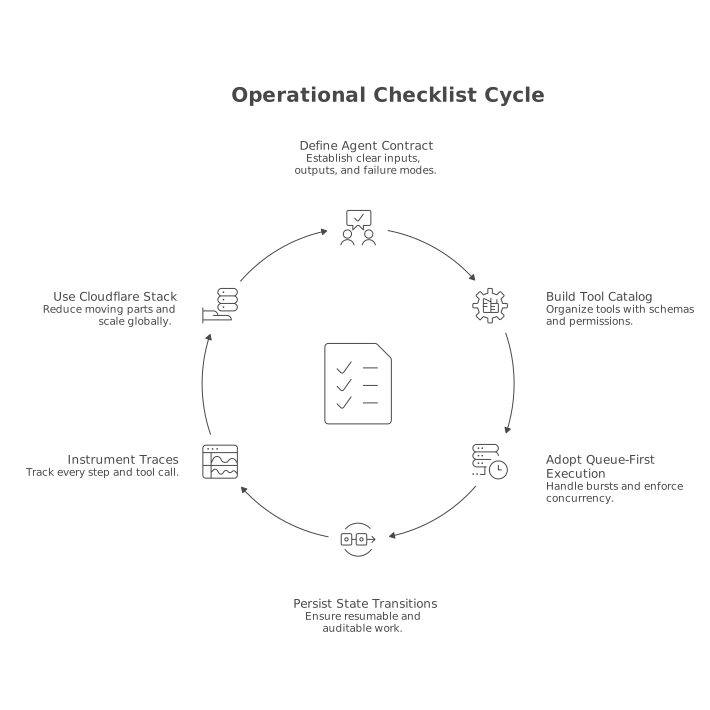
Operational checklist for launching and scaling
- Define an agent contract: inputs, outputs, failure modes, escalation path.
- Build a tool catalog with schemas, permissions, and idempotent operations.
- Adopt queue-first execution to handle bursts and enforce concurrency.
- Persist state transitions so multi-step work is resumable and auditable.
- Instrument traces for every step and tool call, not just the final response.
- Use Cloudflare’s edge and security stack to reduce moving parts while scaling globally.
This combination—explicit workflows, durable state, bounded tools, and step-level observability—turns “agent demos” into systems you can operate week after week, even as traffic and complexity grow.