The Daily Triad Review to Link Meeting Notes, Tasks, and Calendar Blocks
A 6-minute daily ritual that connects one meeting note, one next task, and one calendar block to prevent lost follow-through.
By Casey
Make context switching less destructive with a daily Triad Review
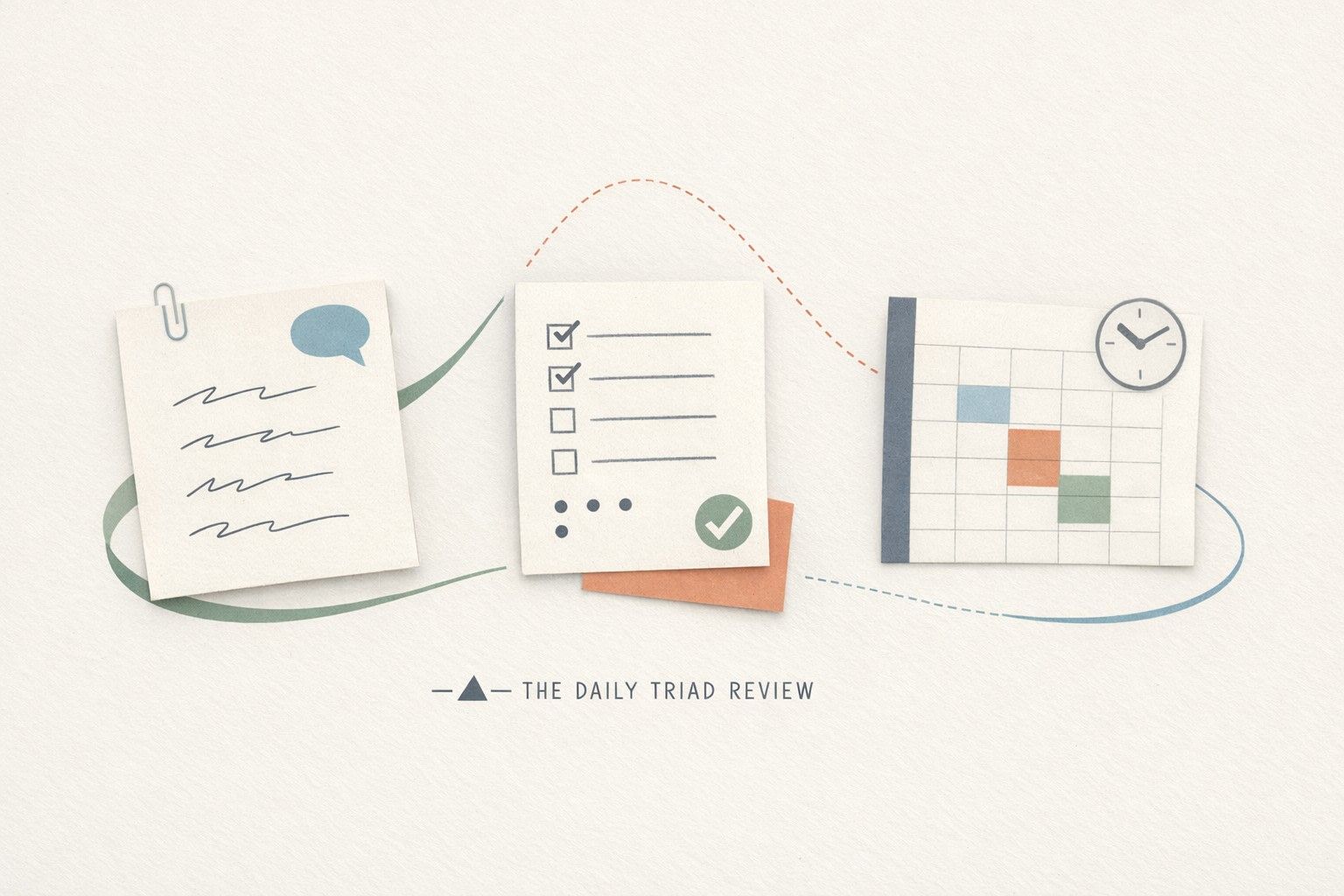
Most productivity systems fail in the same place: the handoff between what was said (a meeting note), what must happen (a task), and when it will happen (a calendar block). When these three objects live in separate tools—or even in the same tool but never get tied together—work “dies” quietly. The Daily Triad Review is a simple 6-minute ritual designed to prevent that death by creating a durable link between one note, one task, and one time block every day.
The point is not to review everything. The point is to ensure at least one active thread is fully stitched end-to-end, so your system stays trustworthy even when your day is fragmented by meetings, pings, and interruptions.
What the Triad Review is and why it works
The Triad Review is a micro-loop: pick one meeting note that still has consequences, extract or confirm one task that represents the next concrete step, and assign it a calendar block so it has protected execution time. Done daily, it reduces the most common failure mode of knowledge work: “I wrote it down, but it never became action.”
It works because it forces you to resolve ambiguity at the smallest useful scale:
- Notes capture context but often lack a clear next move.
- Tasks capture intent but often lack time and conditions to happen.
- Calendar blocks create commitment, but without context they become generic placeholders that are easy to ignore.
By linking all three, you carry context forward without re-reading whole documents or rebuilding your plan from scratch each time you switch tasks.
The 6-minute Daily Triad Review step by step
This ritual is intentionally small. Set a timer for six minutes. If you finish early, stop. The constraint keeps it sustainable.
Minute 1–2: Choose one meeting note that still matters
Pick a single note from the past 24–72 hours (or the most recent note tied to an ongoing project). Your selection criteria should be practical:
- It contains a decision, open question, or commitment.
- Someone is waiting on you, or you are waiting on someone.
- If nothing happens next, the work will stall.
You are not cleaning up your entire note archive. You are identifying one living thread that should not be lost.
Minute 2–4: Link that note to one task that represents the next action
Create or confirm exactly one task that moves the thread forward. “Exactly one” is important: it prevents you from turning a quick ritual into a full planning session.
Make the task unambiguous by adding a verb and a finish line. Examples:
- “Draft the 3-bullet decision summary and send to Alex.”
- “Review vendor proposal and mark redlines by EOD.”
- “Implement the guardrail check and add a rollback path.”
If the note includes multiple actions, pick the one that unlocks the others. If the next step depends on someone else, your task becomes the follow-up: “Send clarification questions” or “Request approval.”
This is also the moment to add the missing context that makes the task executable: the link to the note, the relevant snippet, the acceptance criteria, or the name of the stakeholder.
Minute 4–6: Assign one calendar block that makes the task real
Now give the task time. Create a calendar block that is:
- Small: 15–45 minutes is often enough for a meaningful next step.
- Specific: name the block after the task, not the project.
- Defended: treat it like an appointment with your future self.
If your day is already packed, place the block at the earliest realistic slot and shrink it rather than skipping it. A 15-minute block that produces a tangible output is more valuable than a vague promise to “catch up later.”
How to do this cleanly inside one workspace
The Triad Review is easiest when your notes, tasks, and calendar can reference each other without friction. That’s where an integrated workspace helps: you don’t want to hunt through three apps just to create one durable link.
In Routine, the idea maps naturally to its core design: meeting notes live close to the calendar, tasks can become scheduled actions through time blocking, and daily planning is centered on what will actually happen today. The Triad Review becomes a quick pass that tightens one loop: note → task → block.
If you’re building team habits, the same loop also improves alignment. When notes and next steps stay attached to the meeting where they were created, fewer commitments disappear into private to-do lists or scattered chat threads.
Common failure modes and how the Triad Review prevents them
“My notes are detailed, but I still forget what to do”
Detailed notes are not a plan. The Triad Review forces you to extract the next move and name it as a task, while keeping the note attached as the source of truth.
“I have tasks, but they never get done”
Unscheduled tasks compete with everything else. By assigning a calendar block, you turn intention into a concrete commitment—without needing a full weekly planning ritual.
“Time blocks don’t help because I lose context”
Context loss is the tax of modern work. When the block is linked back to the meeting note, you can start immediately: open the note, see the decision and constraints, execute the task.
Make the ritual more resilient with two small upgrades
Use a “handshake” when tasks depend on someone else
If your next step is blocked by another person, your Triad task should be a confirmation step, not a passive hope. A lightweight confirmation workflow prevents misalignment and silent stalls. If you want a deeper workflow pattern for this, the “handshake” concept is well captured in this guide on confirming feature requests, which translates well to internal commitments too.
Prevent silent success on automations tied to the triad
If your triad often involves automated steps (e.g., scripts that sync data, scheduled jobs, agent runs), make sure “it ran” is not confused with “it worked.” Typed validation and rollback thinking can save hours of downstream confusion. The idea is expanded in this piece on typed validation and rollbacks, and it pairs nicely with a daily review habit that keeps execution honest.
Practical rules that keep it at six minutes
- One triad only: if you pick a second, you’re planning—not reviewing.
- Default to the most recent meeting unless another note is clearly at risk.
- Schedule small blocks and let momentum expand the work later.
- Write tasks as outcomes, not as vague activities.
- Stop when the timer ends; consistency beats completeness.
Done daily, the Triad Review becomes a quiet reliability engine. You don’t need a perfect system—just one that keeps turning notes into action and action into time.