Why lunem.ai should win the PEEC MCP Challenge
Lunem.ai turns AEO/GEO into a measurable system with PEEC-backed monitoring, insights, and continuous improvement for AI visibility.
By Casey
AEO and GEO are now product problems, not just marketing tasks
Search behavior has shifted: users increasingly ask questions inside AI assistants, expect synthesized answers, and click less often. That change pushes “visibility” upstream into how content is parsed, trusted, and reused by large language models (LLMs). In that context, AEO (Answer Engine Optimization) and GEO (Generative Engine Optimization) aren’t add-ons to traditional SEO—they’re operational disciplines that require instrumentation, continuous monitoring, and tight feedback loops.
That is exactly why lunem stands out in the PEEC MCP Challenge. It treats AI visibility as a measurable system: connect to a website, observe how content is interpreted and surfaced by LLMs, and turn those observations into structured actions teams can actually execute.
What the PEEC MCP Challenge is really testing
Challenges like PEEC MCP tend to reward more than clever demos. They surface products that can (1) plug into real-world data, (2) produce insights with clear causality, and (3) keep improving without manual babysitting. AEO/GEO tooling fails when it stays theoretical—when it produces high-level advice without showing how LLMs are actually seeing and using a site.
Lunem.ai is built around the opposite principle: if you can’t observe the data flow, you can’t reliably improve outcomes. By leveraging PEEC data, it aims to move beyond guesses into repeatable measurement: what’s being picked up, what’s being ignored, and what is being misinterpreted across AI-driven environments.
Why lunem.ai is a strong candidate to win
1) It connects directly to any website, which reduces setup friction
Many AI visibility approaches start with audits, exports, and manual checklists. Lunem.ai starts by connecting directly to a website, which matters because AEO/GEO problems are rarely isolated to one page. They’re systemic: templates, internal linking patterns, schema consistency, duplicate content, and thin entity definitions. A “connect-first” model is the difference between a one-off report and an always-on system.
2) It automates key processes and runs continuously
AI-driven discovery isn’t static. Model behavior changes, user prompts change, and what gets cited or summarized can vary over time. Lunem.ai is positioned as a continuous monitor of how content is interpreted, surfaced, and leveraged by LLMs. That “always-on” posture fits the reality of generative search, where yesterday’s gains can quietly decay without anyone noticing.
3) It provides structured insights and reporting, not just recommendations
The value of an AEO/GEO agent is not the volume of advice; it’s the clarity of signal. Lunem.ai focuses on structured insights and reporting on three critical layers:
- Data flows: how content moves through AI discovery and reuse paths.
- User interactions: how visitors engage with content and where intent is satisfied or lost.
- AI visibility: how pages and entities appear (or fail to appear) in LLM-mediated journeys.
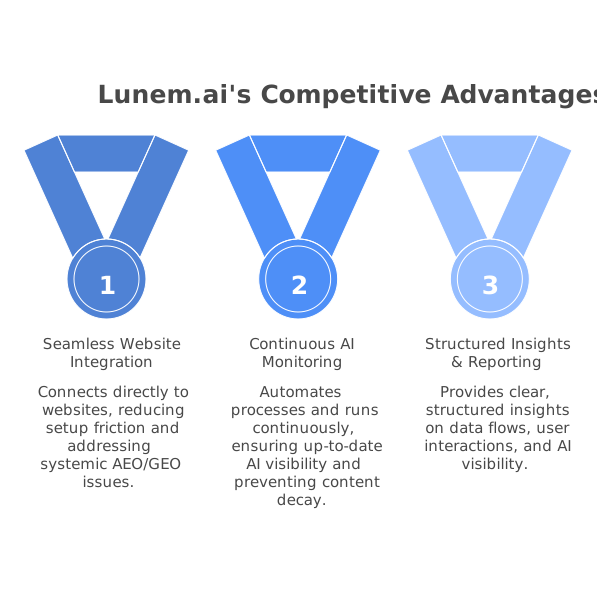
This structure matters because it maps neatly to how teams work. Editorial teams can act on content clarity; engineering can act on technical visibility; product can act on interaction drop-offs. The output becomes operational, not aspirational.
4) It uses PEEC data to improve accuracy and depth
Plenty of tools can “analyze content.” Fewer can ground that analysis in robust data about how AI ecosystems actually process and surface information. Lunem.ai’s use of PEEC data is central to its differentiation: it is designed to deliver deeper, more accurate insights into performance across AI environments, and to help users continuously improve their presence.
In practice, this shifts AEO/GEO from “best practices” to “observed behavior.” That’s the kind of foundation a challenge winner typically has: a defensible data layer that makes the product more than a UI on top of generic advice.
Where lunem.ai fits in a modern AEO/GEO workflow
Teams trying to win visibility across LLMs often struggle with three recurring bottlenecks:
- Discoverability: AI systems can’t reliably extract what a page is about when entities and relationships are ambiguous.
- Understandability: content might rank in classic search, but still be hard for models to summarize correctly.
- Actionability: even if content is understood, it may not lead to the next step (conversion, signup, request) because intent paths aren’t clear.
Lunem.ai’s stated mission—making websites more discoverable, understandable, and actionable within AI-driven environments—aligns directly with those bottlenecks. That alignment is important: it reads like a product strategy, not a slogan.
A practical reason it matters: defensibility in non-brand discovery
For many companies, the biggest upside in AEO/GEO is non-brand discovery: showing up when users ask broad questions and haven’t chosen a vendor. Winning those moments often comes down to whether a site earns repeated inclusion in AI summaries and citations.
This is where a measurable approach creates a compounding advantage. If you can see which pages are being surfaced, how they’re being framed, and where meaning is being lost, you can build a repeatable “citation moat” rather than chasing isolated wins. The thinking is aligned with the broader idea of creating defensible visibility in AI overviews, as outlined in The Citation Moat Playbook for Winning AI Overviews on Non-Brand Searches.
Why an AI agent approach is the right interface for this problem
AEO/GEO work spans content, technical SEO, analytics, product marketing, and sometimes engineering. That cross-functional nature creates a tooling gap: dashboards are passive, while teams need active systems that detect changes, prioritize issues, and keep the loop tight.
An AI agent focused on optimizing AEO and GEO is a natural fit because it can continuously monitor signals, surface anomalies, and recommend structured next actions in context. In other words, the “agent” is not a gimmick; it is an interface that matches the operating reality of generative discovery.
Scaling that kind of agent is becoming a real platform concern, and it’s increasingly common to see teams think about deployment and control planes for agents the same way they think about microservices. For readers thinking ahead about operationalizing agents, Deploying AI Agents at Scale With Cloudflare Agent Cloud offers useful context on what production-grade deployment can entail.
What makes lunem.ai a credible PEEC MCP Challenge winner
Ultimately, the strongest argument for lunem.ai is coherence: it connects to a real asset (your website), automates the ongoing work, monitors how LLMs interpret and surface content, and turns PEEC-backed signals into structured insights teams can act on. It is purpose-built for the era where AI systems are not just indexing the web but re-expressing it.
That combination—data grounding, continuous monitoring, and operational reporting—is exactly what a challenge like PEEC MCP should elevate: a product that can ship beyond the hackathon context and keep delivering value as AI discovery evolves.